


Hey Transformation Leader,
Last few weeks, I have been spending time talking about frameworks and explaining why AI is no longer just a model or compute story. It is not just a digital story and the winners of today will not necessarily be the winners of tomorrow.
This week I want to connect the dots between theory and practice. I want to test my frameworks using what’s happening in the news from the last 60 days, almost like a litmus test.
It’s no surprise that AI news today is filled with large numbers everywhere.
For example, another hyperscaler committing hundreds of billions of dollars, a data center campus being built on land that apparently was farmland not long ago, a new chip architecture and another announcement telling us everything is about to become faster and cheaper.
Most of these stories are read based on the size of the announcement. How much capital was committed or how many chips were ordered or how many gigawatts of capacity will be built.
But, I want to know what these announcements are actually telling us about the structure of the AI infrastructure economy.
Do they show infrastructure scaling before the intelligence output is measured?
Is the constraint still compute or has it moved somewhere else?
Are the existing operating models ready for these new loads and is anyone actually measuring the value created from all of this power being consumed?
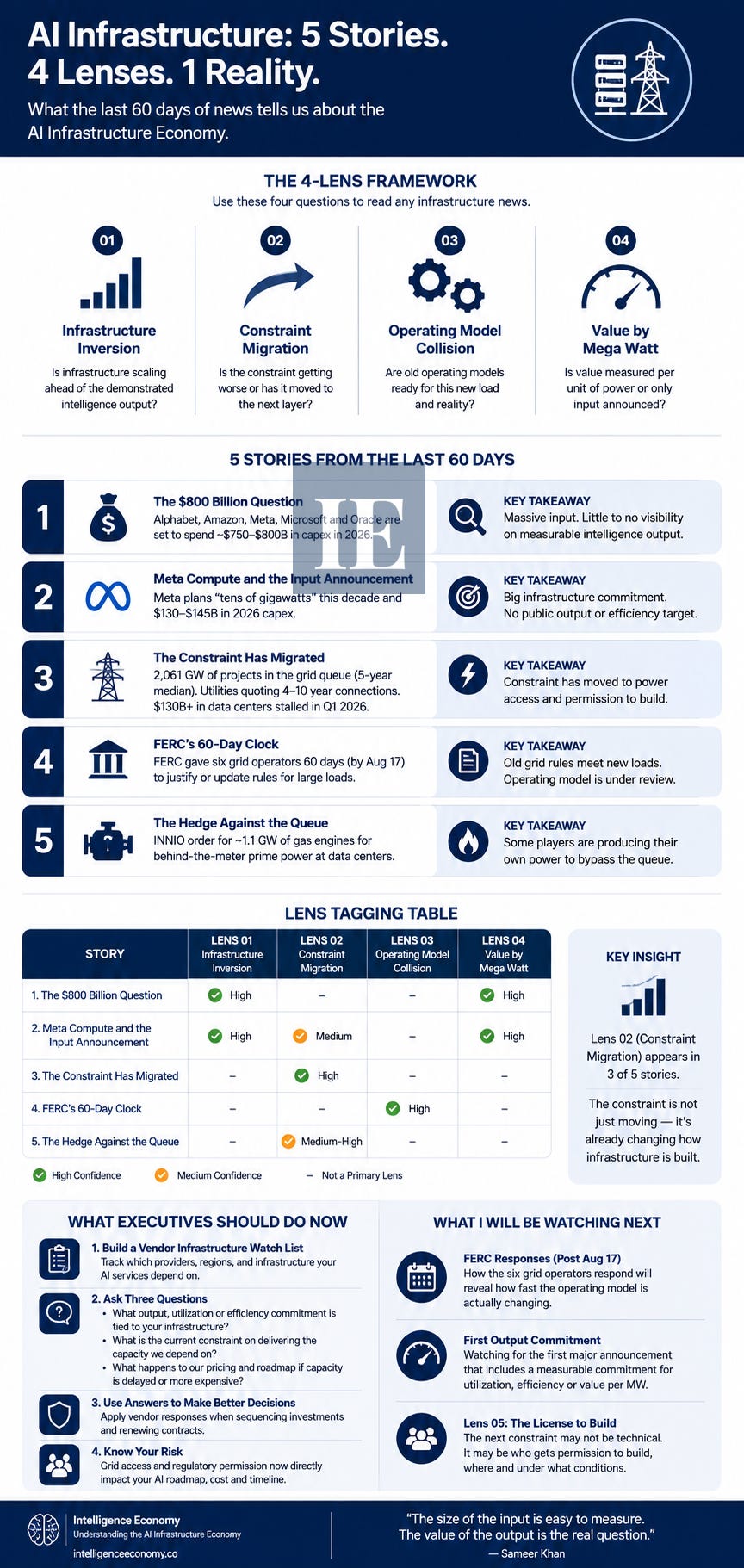
So I researched and selected five of the largest infrastructure stories from the last 60 days and tested each one using the four lenses from this series.
While doing this I noticed that the same story was sometimes showing two or three things at the same time. It did not always fit cleanly into one lens.
Table of Contents
The Lens Check: How to Read Infrastructure News
Story One: The $800 Billion Question
Story Two: Meta Compute and the Input Announcement
Story Three: The Constraint Has Migrated
Story Four: FERC’s 60-Day Clock
Story Five: The Hedge Against the Queue
The Lens Tagging Table
What Executives Should Do Now
What I Will Be Watching Next
How I Am Reading Infrastructure News
A thorough analysis requires unbiased review of the information.
Although I used AI to research the information, I had to manually read the top stories without forming any opinion.
Why?
AI unfortunately is also biased because it is built by humans and it inherently adds the bias of the model builder or your bias if you “customize” its response using the system prompt.
I call this process the Lens Check. I review each news article by these four questions across the lenses.
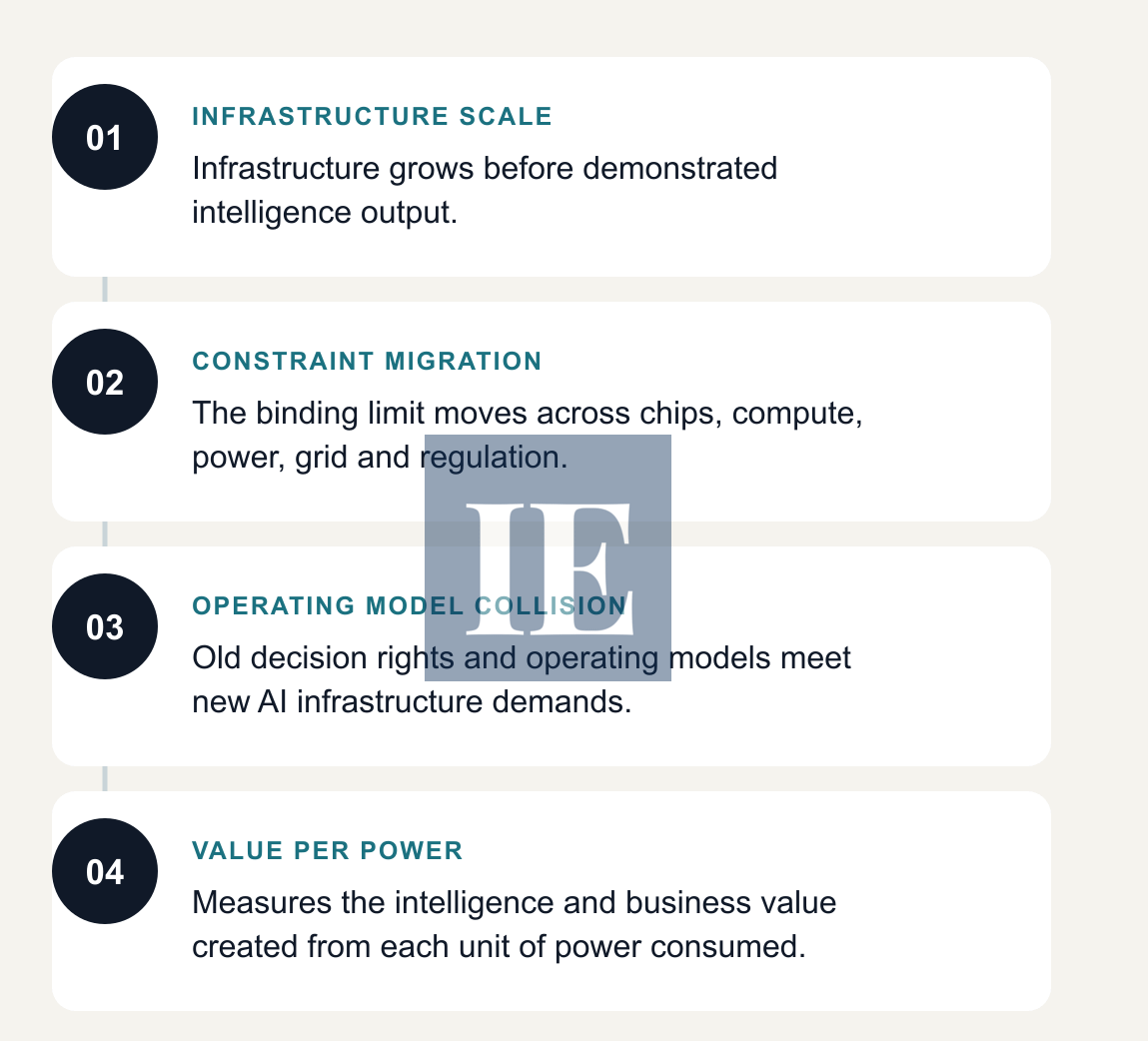
The first question is whether infrastructure is scaling ahead of the demonstrated intelligence output. This is Lens 01.
Then I look at the constraint. Is it getting worse or has it moved to the next layer in the stack? This is Lens 02 and the moving part is important because chips, compute, power and grid are not constrained in the same way at the same time.
Lens 03 is about the operating model. Does the story show old decision rights meeting a new load or operating reality they were not designed for?
The last one is Lens 04. Is the organization measuring the value extracted per unit of power (remember value per mega watt) consumed or are they only announcing more capital, capacity and compute?
At first, I thought each story would fit into one lens. But while reviewing them I noticed that the important stories were showing two or three lenses at the same time.
A capacity announcement can show infrastructure scaling, the next constraint forming and the absence of any output measurement all within the same story.
This is where I think the Intelligence Supply Chain becomes visible in a real event and not only as a framework.
So I used the Lens Check on five of the largest AI infrastructure stories from the last 60 days.
Story One: The $800 Billion Question
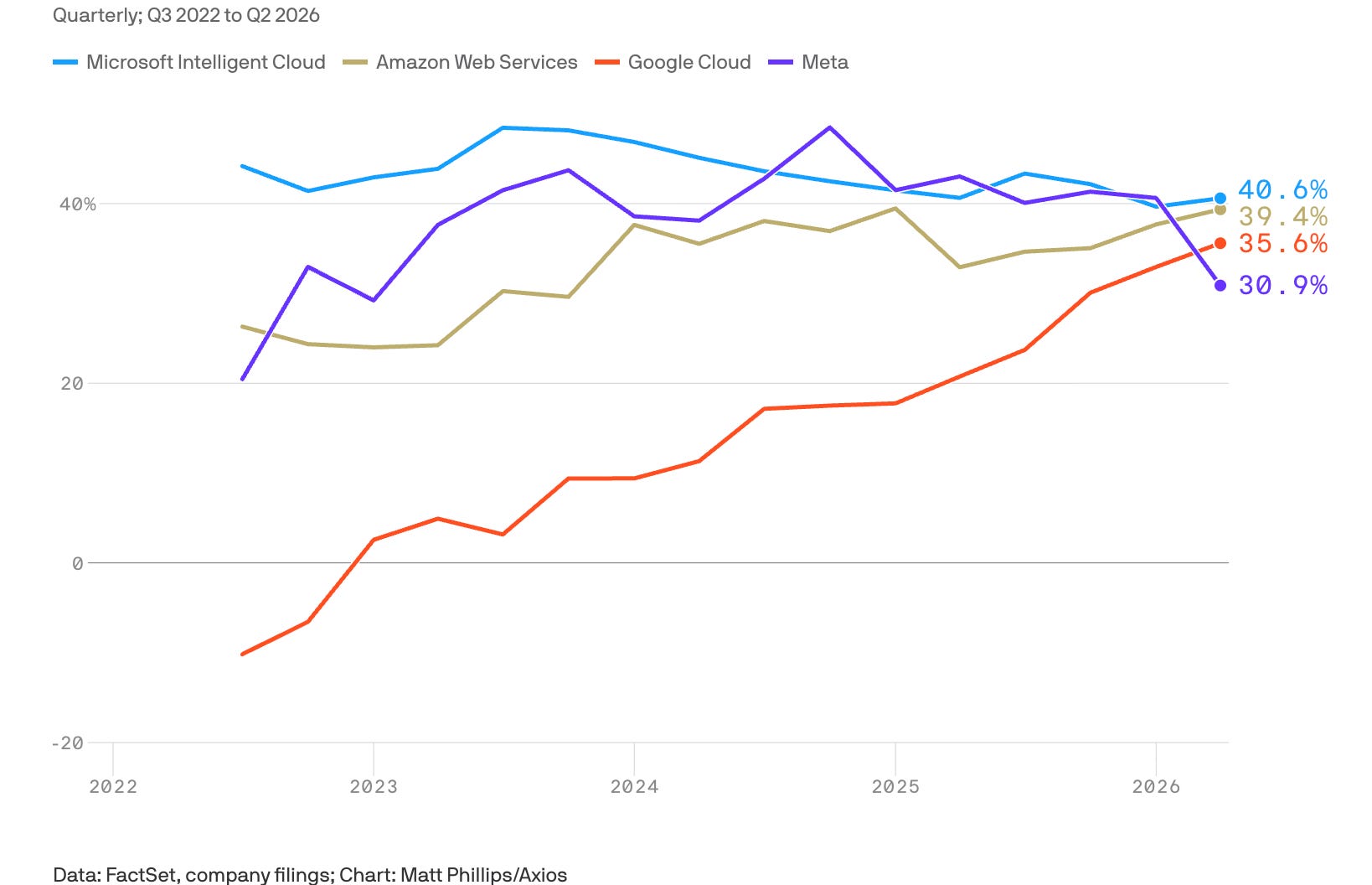
Alphabet, Amazon, Meta, Microsoft and Oracle are expected to spend somewhere between $750 and $800 billion in capital expenditure during 2026.
That’s not a small number and, in fact, is larger than the economy of many countries.
The number changes depending on how the spending is counted. S&P Global estimates approximately $750 billion, while the latest earnings analysis from Axios puts the AI buildout at roughly $800 billion.
Lens Check: Lens 01 — High confidence.
Lens 1 was about why physical infrastructure is the new moat and everything in AI depends on it scaling first.
So when I applied Lens 01 the question changed from how much they are spending to what output we are getting from that spending or simply put what’s the ROI.
We know the capital being committed, the data centers being built and apparently every earnings cycle gives us another larger number. In my investigation, I could not find a corresponding number for intelligence output.
The companies are not reporting tokens generated per dollar of capital committed, utilization rates across the existing AI infrastructure or the business value created per megawatt of capacity. They report cloud growth and AI demand, but they do not separately report the sales and profits directly attributable to the AI data center investments.
I am not suggesting that the spending is unnecessary. What captured my attention is how precisely we can measure the input while the output from that infrastructure is still difficult to measure. Then I started thinking about what this means for an enterprise that is building its AI roadmap on top of these five companies.
Organizations like yours and mine.
The question I would ask your CIO is which of your AI capabilities are hosted on which platform.
Then another question follows.
What happens to the roadmap if one of those platforms reaches a capacity constraint, changes its pricing or is slowed by a regulatory event during the next eighteen months?
Story Two: Meta Compute and the Input Announcement
In January 2026, Zuckerberg announced a new top-level initiative called Meta Compute. The plan is to build “tens of gigawatts” of AI infrastructure this decade and hundreds of gigawatts or more over time.
Then in July, Meta reported its Q2 results and narrowed its 2026 capital expenditure guidance between $130 billion to $145 billion.
First came the infrastructure ambition and then the financial commitment behind it.
Lens Check: Lens 01 and Lens 04 — High confidence. Lens 02 — Medium confidence.
When I looked at this through Lens 01 (Physicial Infrastrcuture need to scale before digital), Meta is clearly scaling the infrastructure before there is a stated target for the intelligence output. That part was easy to see.
But, Lens 04 (Value by Mega Watt) is the part that made me stop. The announcement tells us how much infrastructure Meta plans to build, while I could not find a public quantitative target for utilization, efficiency or value created per megawatt of power consumed.
So, for this framework, I would tag it as an Input Announcement. It tells us what Meta plans to put into the system through capital, capacity and compute, but not yet what measurable output should come back from each unit of power being consumed.
I am not criticizing Meta for building the infrastructure.
They are building at a scale very few private organizations can attempt and apparently they believe controlling their own compute will become a strategic advantage. What captured my attention is that the industry can receive an infrastructure commitment as if the capability and output already exist.
While reviewing this, there was another part that started showing up through Lens 02 (Constraint Migration).
Tens of gigawatts will require more than data centers and chips. It will require power, land and access to the grid or another way to generate that power. My confidence is medium on this because the scale is clear but the complete power and interconnection path for all of that capacity is still not visible.
So the question that stayed with me was where will all of this power come from when every other infrastructure provider is also trying to secure it at the same time?
Story Three: The Constraint Has Migrated
When researching the third story I discovered a mistake in my assumption. I originally had the U.S. grid queue at 2,600 GW. But, that was the peak reached at the end of 2023.
The active generation and storage waiting in the queue was 2,061 GW at the end of 2025 with median time of 5 years for projects.
These are electricity generation and storage projects waiting to connect to the grid. Forget the data centers waiting for power.
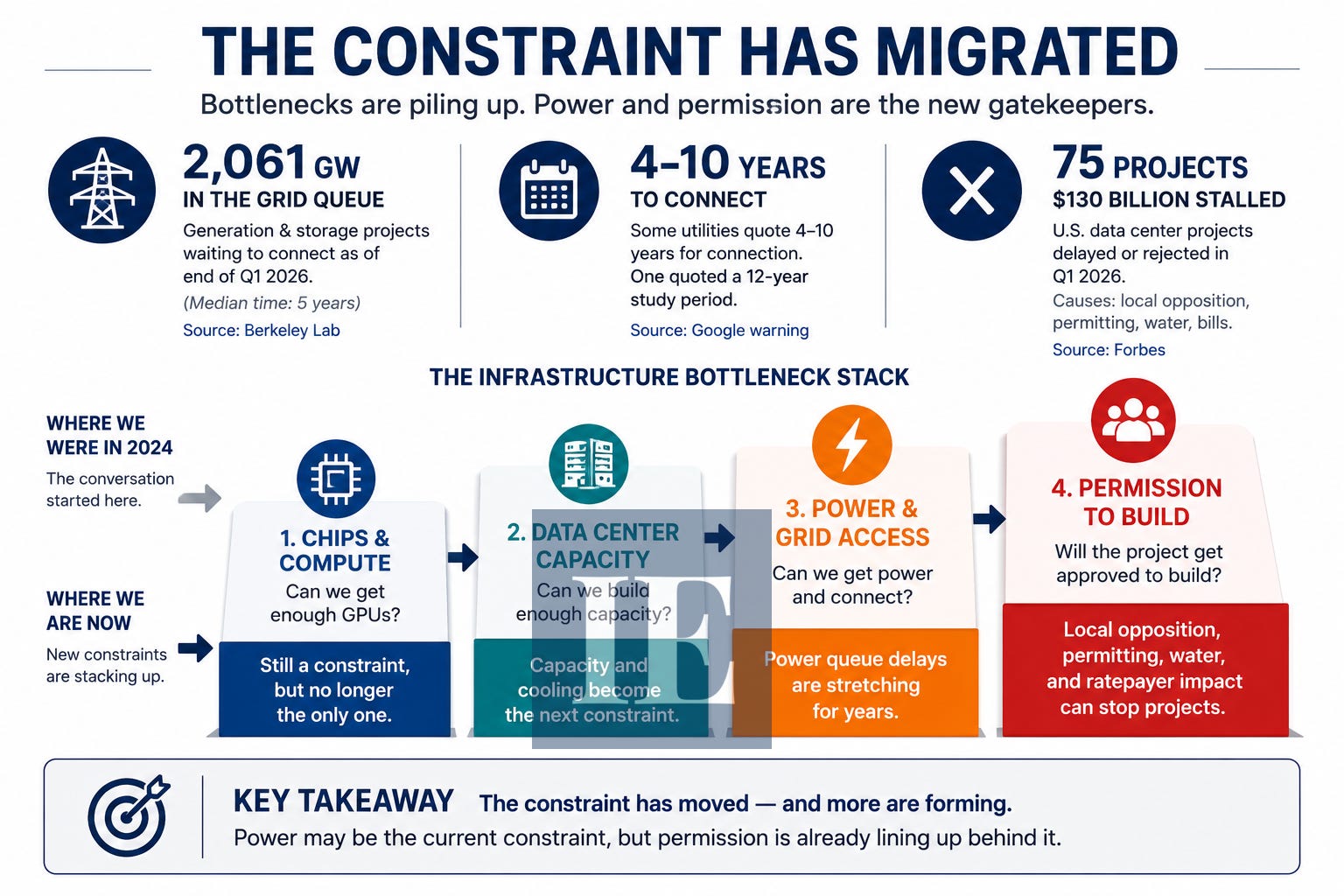
On the data center side, Google recently warned that some utilities are quoting connection timelines between four and ten years and one utility offered a 12-year study period before the project could move forward.
So the chips can be available and the data center can also be built, but apparently the power may arrive several years later.
Then I found another number.
At least 75 U.S. data center projects representing around $130 billion were delayed or rejected during the first quarter of 2026. I first read this as another power story but it was not only power. Local opposition, permitting, water usage and the impact on utility bills were also part of the problem. Forbes
Lens Check
Lens 02 — Constraint Migration: High confidence
In 2024 most of the conversation was about chips and whether companies could get enough GPUs.
Although the memory shortage has not subsided, the conversation is already moving into data center capacity, cooling and access to power.
Now I am seeing another constraint forming around whether these projects will actually receive permission to be built.
That does not mean the previous constraints disappeared. What it means is the constraints are piling on top of each other.
In January 2026, the U.S. changed its licensing policy for chips such as the Nvidia H200 from a presumption of denial to case-by-case review for approved customers in China.
The H200 can become available but the data center may still wait years for a grid study and even after that the local community may not allow it to be built.
I was looking for one infrastructure bottleneck and apparently there are different bottlenecks depending on where the project is in the process.
Power/electricty appears to be the current constraint, but permission is already showing up behind it.
Story Four: FERC’s 60-Day Clock
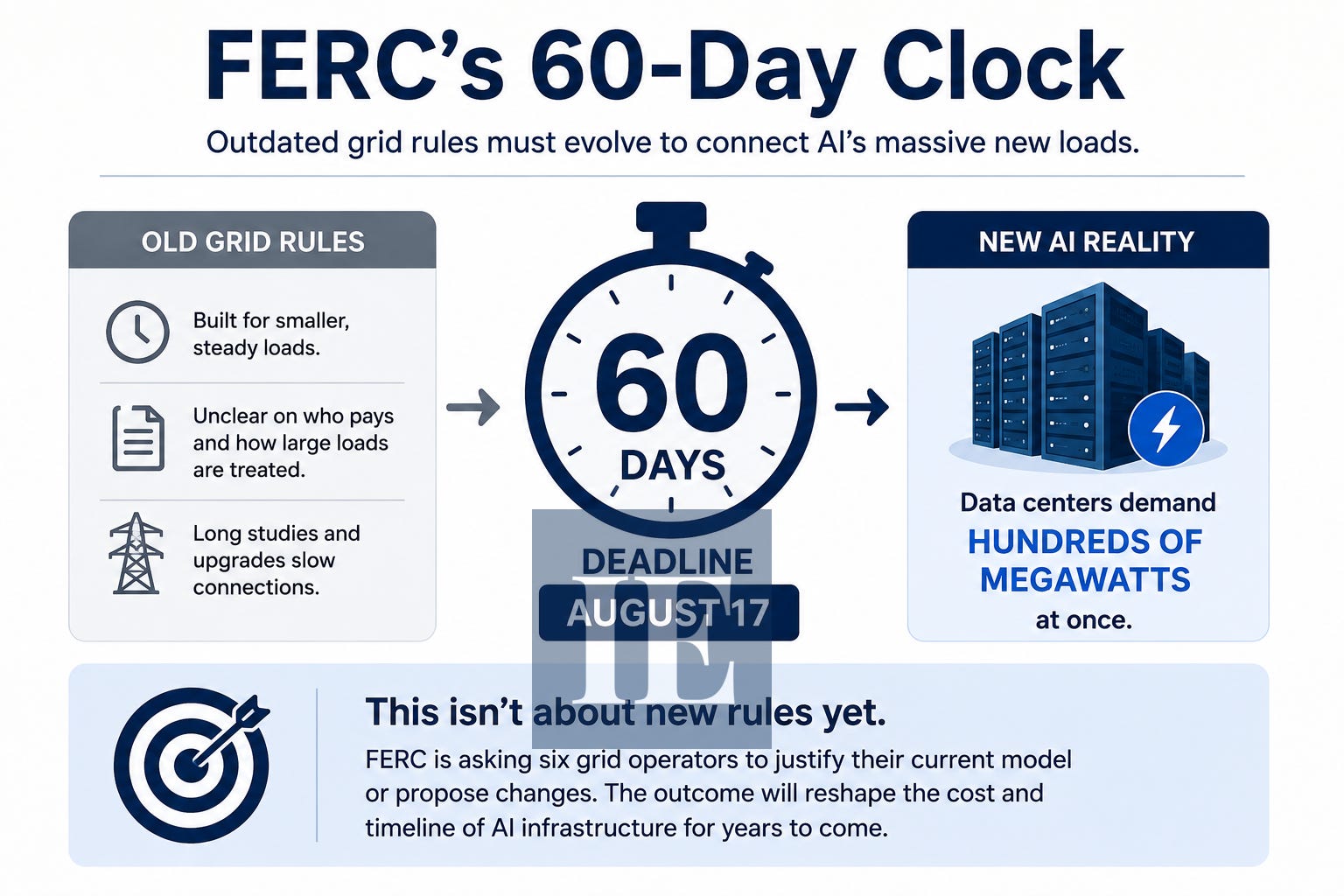
On June 18, the Federal Energy Regulatory Commission (FERC) issued separate Show Cause Orders to the six regional grid operators under its jurisdiction: PJM, MISO, SPP, CAISO, NYISO and ISO New England.
Each operator was given 60 days to explain why its existing rules are adequate for connecting large energy users such as data centers or to submit changes to those rules. That deadline is August 17, right around the time I am writing this.
I had to read this more than once because when I hear tariff I immediately think about pricing. But, these tariffs also include the rules for how large loads are studied, connected and who pays for the upgrades needed to serve them.
Lens Check
Lens 03 — Operating Model Collision: High confidence
The existing rules were developed for a different type of load arriving at a different pace.
Now a data center can request hundreds of megawatts at one location and may also have its own generation behind the meter. The grid operator needs to understand what happens if that load suddenly increases, reduces its usage or if the data center that requested the upgrades is never actually built.
Apparently, the old process does not have a clear answer for all of this.
FERC is asking the operators to address who pays for the upgrades, how flexible loads should be treated and whether new technologies can connect these facilities without waiting for all of the traditional grid upgrades.
I initially read the order as a new rule that would speed up data center connections.
But, it does not do that yet.
FERC has asked the operators to justify the current model or propose a different one.
You may be thinking How does all of this apply to you, as your focus is AI strategy, not power generation.
I agree you don’t have to read the tariff filings of utility providers.
But, the cloud and AI infrastructure they depend on is being built inside these regions. If the connection rules change, the cost and timeline of that infrastructure can also change.
I was following the AI infrastructure story through chips, data centers and power. I did not expect part of it to be sitting inside six electricity tariff proceedings.
Story Five: The Hedge Against the Queue
On July 28, INNIO announced an order for approximately 1.1 gigawatts of gas engine capacity from a developer and operator of large data center campuses. The company did not name the customer.
The order includes more than 200 engines that will be installed across the United States and the entire capacity is intended to provide behind-the-meter prime power.
What captured my attention was the size of the engines because these engines are not being installed only as backup in case the grid goes down. They are expected to regularly power the data centers.
Lens Check
Lens 02 — Constraint Migration: Medium-high confidence
I started connecting this order to what I found in Story Three.
If connecting to the grid can take several years, apparently some of the largest data center developers are not planning to wait. They are beginning to produce the power on-site.
I want to clarify that this is not a renewable energy story.
These are gas engines and using them at this scale will create questions about emissions, fuel availability and whether the local community will allow the generation to be built.
But, it does show how a company with enough capital may respond to the grid constraint.
For a mid-market company, obviously ordering more than 200 gas engines is not an option. You will experience this through the cloud and AI services they are already buying.
I do not yet know how much of this cost will eventually appear in AI service pricing. But the engines, fuel and the people needed to operate them have to be paid by someone and I do not think all of that cost will remain with the company building the data center.
Before reading this story I was assuming a long grid queue means the projects will wait longer.
Now I am not sure that is always what happens because some of the largest projects may simply move from waiting for power to producing it themselves.
The Lens Tagging Table
After looking at the five stories, I wanted to put them together in one place because the same story was sometimes showing more than one thing.
This is how I would tag them today.
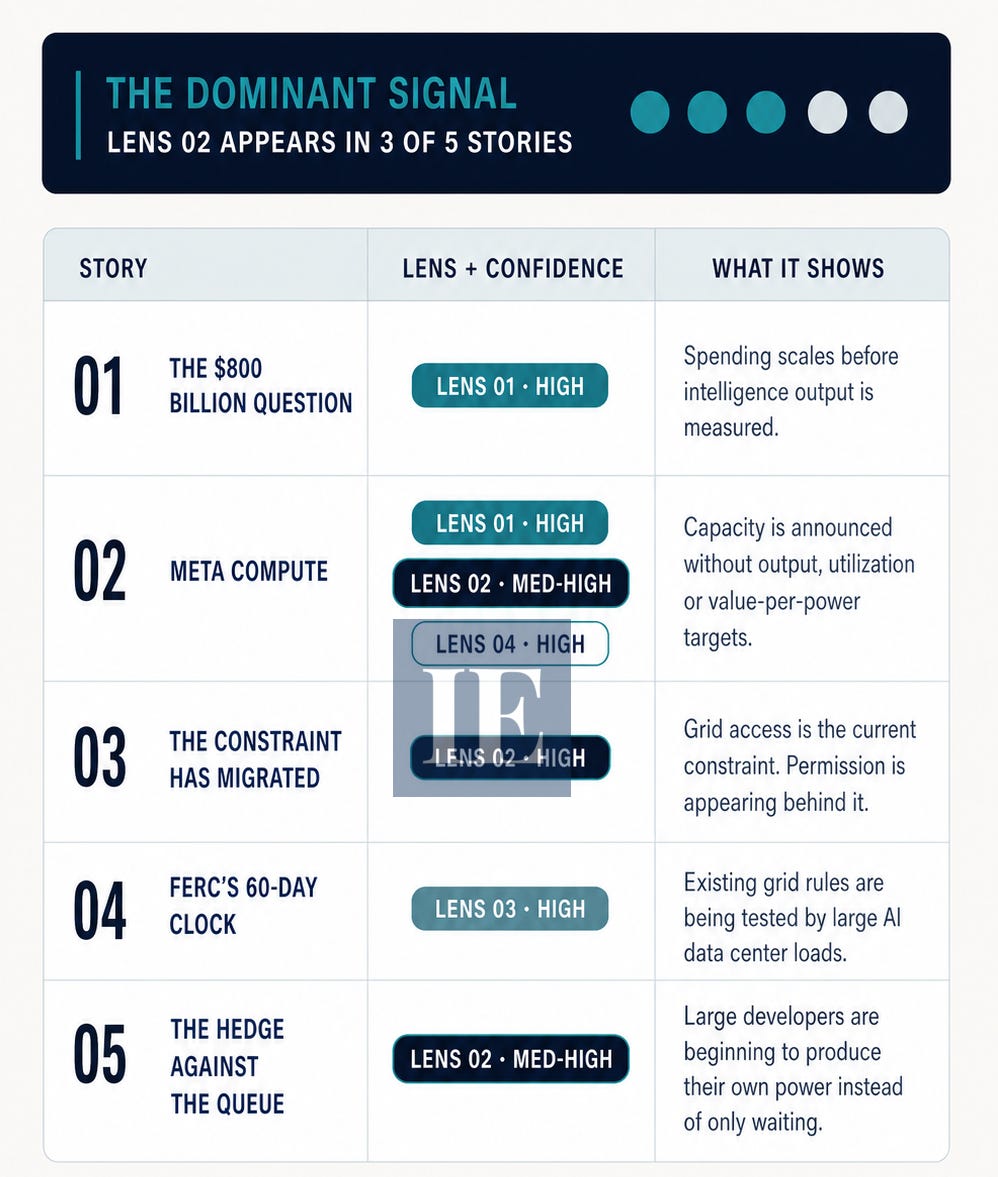
The table also helped me see that Lens 02 appeared in three of the five stories.
Apparently, the constraint is not only moving, it is also already changing how the infrastructure is being built.
What CIOs and Transformation Leaders Should Do Now
After going through the five stories I started thinking about what I would actually do differently if I was responsible for an AI roadmap today.
I do not think every executive needs to become an expert in electricity markets or start reading FERC filings. But, they should know where the AI services they depend on are actually running and what can affect that infrastructure.
The first action I would take is to build a simple vendor infrastructure watchlist.
For every AI platform, API or cloud service the company depends on, I would record which cloud provider hosts it, the region where it operates and whether we have any visibility into its capacity or grid position.
Then I would ask three questions during the next vendor conversation:
What output, utilization or efficiency commitment is connected to the infrastructure you are announcing?
What is the current constraint on delivering the capacity we are depending on?
What happens to our pricing and roadmap if the capacity is delayed or becomes more expensive?
If the vendor can only answer the first question by talking about more chips, data centers or gigawatts, then we are still measuring the input.
The answer to the second question may also keep changing. Today it could be grid access and tomorrow it may be permission to build in a specific location.
For a mid-market company, the vendor watch list and these three questions may be enough to start. Most mid-market organizations are not building their own infrastructure, but they are still depending on someone who is.
For a larger enterprise with its own data center capacity or larger cloud commitments, I would also use the answers when sequencing capital spending and renewing vendor contracts. If a critical service depends on infrastructure that may wait years for power, that risk should not appear for the first time when the pricing changes.
Based on what I found in these five stories, grid access and regulatory permission now belong somewhere in that conversation too.
What I Will Be Watching Next
The first thing I will be watching is what the six grid operators submit in response to the FERC orders after the August 17 deadline (which is today).
Do they defend the existing tariffs or propose new rules for large loads?
The answer will tell us how quickly the operating model is actually changing and I suspect most of this will appear in utility news before it appears in AI news.
I will also be watching for the first large infrastructure announcement that includes an output commitment. A clear number for utilization, efficiency or value created per megawatt.
I do not expect this immediately because today the industry is still rewarded for announcing the size of the input.
Next week I will move to Lens 05: The License to Build because after looking at the grid queue, the FERC order and the projects delayed by local opposition, I am starting to think the next constraint may not be technical.
It may be who receives permission to build, where and under what conditions.
I started this article by looking at large spending and infrastructure numbers. I ended up reading grid queues, utility tariffs, and gas engine orders.
This is where part of the AI infrastructure story is now being written.
Talk soon,
Sameer Khan