

Why Your AI Strategy Is Backwards: The Intelligence Supply Chain Framework
The Intelligence Supply Chain, Part 1. Framework 01 of the AI and the Physical Economy series.

Hey Transformation Leader,
The question your board is most likely answering today without knowing it.
Why Your AI Strategy Is Backwards?
Look at how your organization buys artificial intelligence today. A per-seat license here. A LLM model subscription there. A chatbot pilot that someone in marketing championed. Each line item sits on the software budget, gets approved like software, and gets forgotten like software.
Now ask a harder question. If intelligence is software, why is Microsoft signing a twenty-year contract to restart a nuclear reactor?
That single fact should stop you. Companies do not commit to twenty-year nuclear power purchase agreements to run AI software. They do it to secure a scarce, physical, capital-intensive input that they cannot get any other way, and the moment you understand why Microsoft did that, you understand the entire thesis of this newsletter and the foundation of the next thirteen weeks of writing.
Intelligence is no longer a feature you buy.
It is a manufactured good produced by a physical supply chain. That chain runs from power generation, through the grid, into silicon, through data centers, up into foundation models, through orchestration, and finally out to the application your team actually touches.
Like every industrial supply chain before it, the durable value does not stay where everyone is looking. It migrates, and it migrates in a direction most boards are budgeting against.
This is Framework#01, the Intelligence Supply Chain. It is the spine of everything that follows. Get it right, and every later decision gets clearer. Get it wrong, and you will spend the next two years funding the layer that is commoditizing fastest while your competitor quietly locks up the layer that compounds.
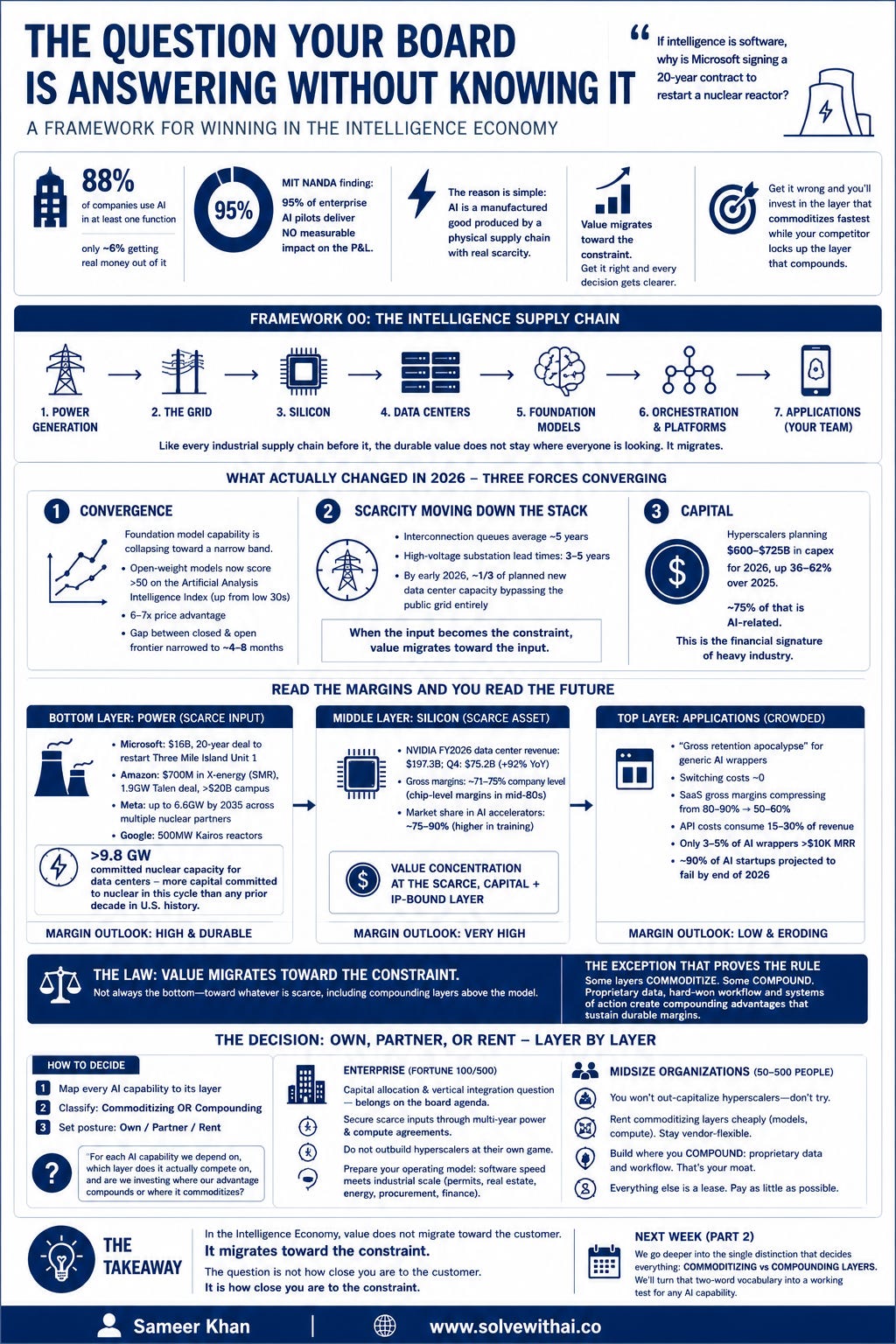
Table of Contents
What Changed in 2026
Where Value Is Moving
Read the Margins, and You Read the Future
The Law, and the Word That Makes It Defensible
Commoditizing vs. Compounding Layers
The Decision: Own, Partner, or Rent, Layer by Layer
The Strategic Audit
Key Takeaways
What Actually Changed in 2026
For most of the software and cloud era, the smart money sat close to the customer.
The application captured the value. The cloud infrastructure underneath was plumbing, abundant and cheap, and nobody built a strategy around plumbing. That intuition was correct for thirty years.
It is wrong now, and three forces converging in 2026 are the reason.
The first force is convergence. Foundation model capability is collapsing toward a narrow band.
As of mid 2026, the leading models cluster within a few points of each other on standard evaluations. Open weight models now score above 50 on the Artificial Analysis Intelligence Index, up from the low 30s a year earlier, while holding a 6x to 7x times price advantage.
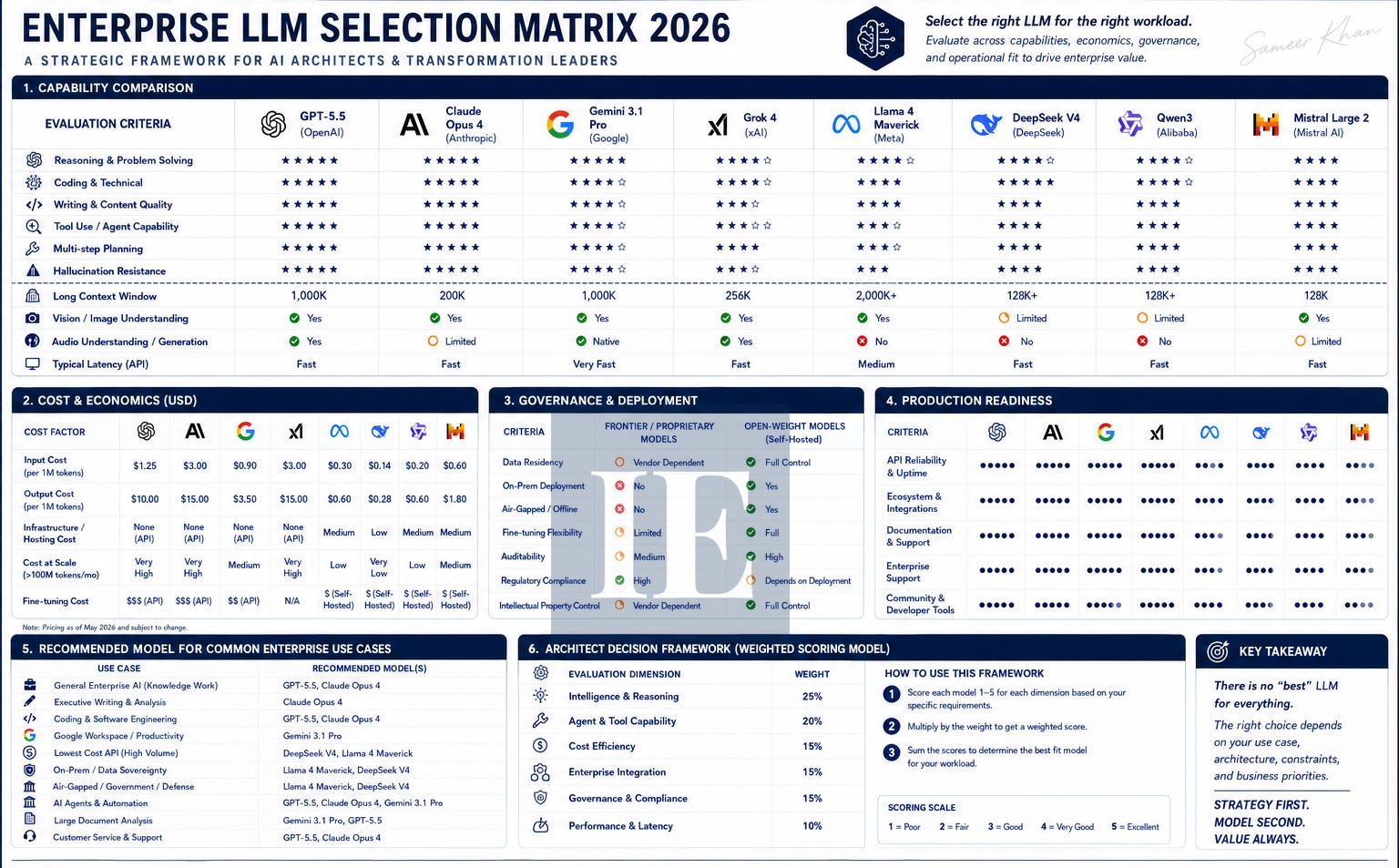
The gap between the closed frontier and the open frontier has narrowed to something like four to eight months. When everyone can call a comparable model from the same API, the differentiation that the application layer once rented evaporates.
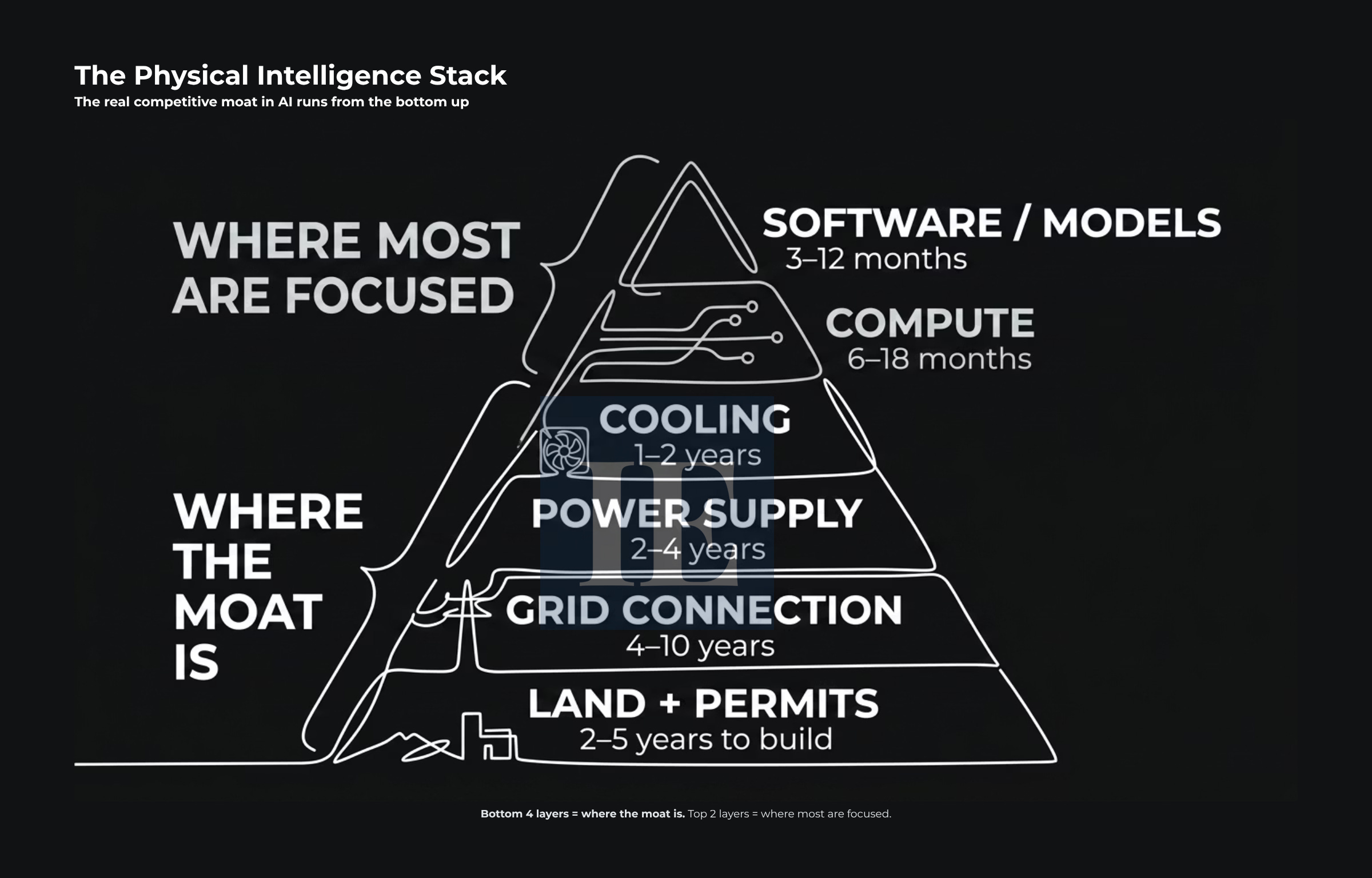
The second force is scarcity moving down the stack. The binding constraint on AI is no longer chips alone. It is power and the grid. Interconnection queues now average around five years. High voltage substation lead times run three to five years.
By early 2026, nearly a third of all planned new data center capacity is being designed to bypass the public grid entirely, because the grid cannot deliver in time. When the input becomes the constraint, value migrates toward the input.
That is not my opinion. It is what every industrial economy has done for a century.
The third force is capital.
Hyperscalers are planning somewhere between 600 and 725 billion dollars in capital expenditure for 2026, a jump of 36 to 62 percent over 2025.
Roughly three quarters of that is AI related. This is the financial signature of heavy industry, and it means the competitive structure of the entire AI era is being set right now, in the contracts and buildouts of this year, in ways that will define position for the rest of the decade.
Put those three together, and the conclusion is unavoidable. Intelligence has entered its industrial phase. The question is no longer which vendor you choose.
The question is where on the supply chain you decide to own, to partner, or to rent.
Read the Margins, and You Read the Future
Follow the margins. Margin and scarcity are the same map.
Start at the bottom.
Power has become so strategic that the largest technology companies on earth are buying nuclear plants.
Microsoft signed a roughly 16 billion dollar, twenty-year agreement to restart Three Mile Island Unit 1, and a separate 10.5 gigawatt renewable deal with Brookfield.
Amazon put 700 million dollars into small modular reactor developer X Energy, signed a 1.9 gigawatt agreement with Talen’s Susquehanna plant, and committed to a campus worth more than 20 billion dollars.
Meta lined up TerraPower, Oklo, and Vistra to reach as much as 6.6 gigawatts by 2035, plus a twenty year nuclear agreement with Constellation.
Google contracted 500 megawatts of Kairos Power reactors.
SpaceX went public with the largest IPO ever to launch data centers in space.
Committed nuclear capacity for data centers now exceeds 9.8 gigawatts, more capital committed to nuclear in this single cycle than in any prior decade in United States history.
When the most sophisticated capital allocators in the world race to lock up a layer competitors cannot quickly replicate, they are telling you where the value sits.
Move up one layer to silicon.
Nvidia reported 197.3 billion dollars in data center revenue for fiscal 2026, then 75.2 billion in a single quarter, up 92 percent year over year. Gross margins run around 71 to 75 percent at the company level, with chip-level margins on its flagship parts reported in the mid eighties.
Market share in AI accelerators sits somewhere between 75 and 90 percent, higher still in training. That is what value concentration at a scarce, capital and intellectual property bound layer looks like in numbers.
Now go all the way to the top, to the application layer where the old intuition told you the money would be.
The picture inverts.
Generic AI wrapper businesses are living through what analysts have started calling a gross retention apocalypse. Switching costs sit near zero. AI features are compressing classic SaaS gross margins from the comfortable 80 to 90 percent range down to 50 to 60 percent.
API costs alone consume 15 to 30 percent of revenue for even the successful ones.
Only 3-to 5% of AI wrappers clear ten thousand dollars in monthly recurring revenue, and roughly 90 percent of AI startups are projected to fail by the end of 2026.
Read those three layers in sequence.
The scarcest, most capital bound layers carry the fattest, most durable margins. The most crowded layer, the one closest to the customer, carries the thinnest and fastest eroding margins. You can see where value will sit next year by reading where the physical constraint sits today.
The Law, and the Word That Makes It Defensible
Here is the law of Framework 01 (Intelligent Supply Chain), stated precisely. Value migrates toward the constraint.
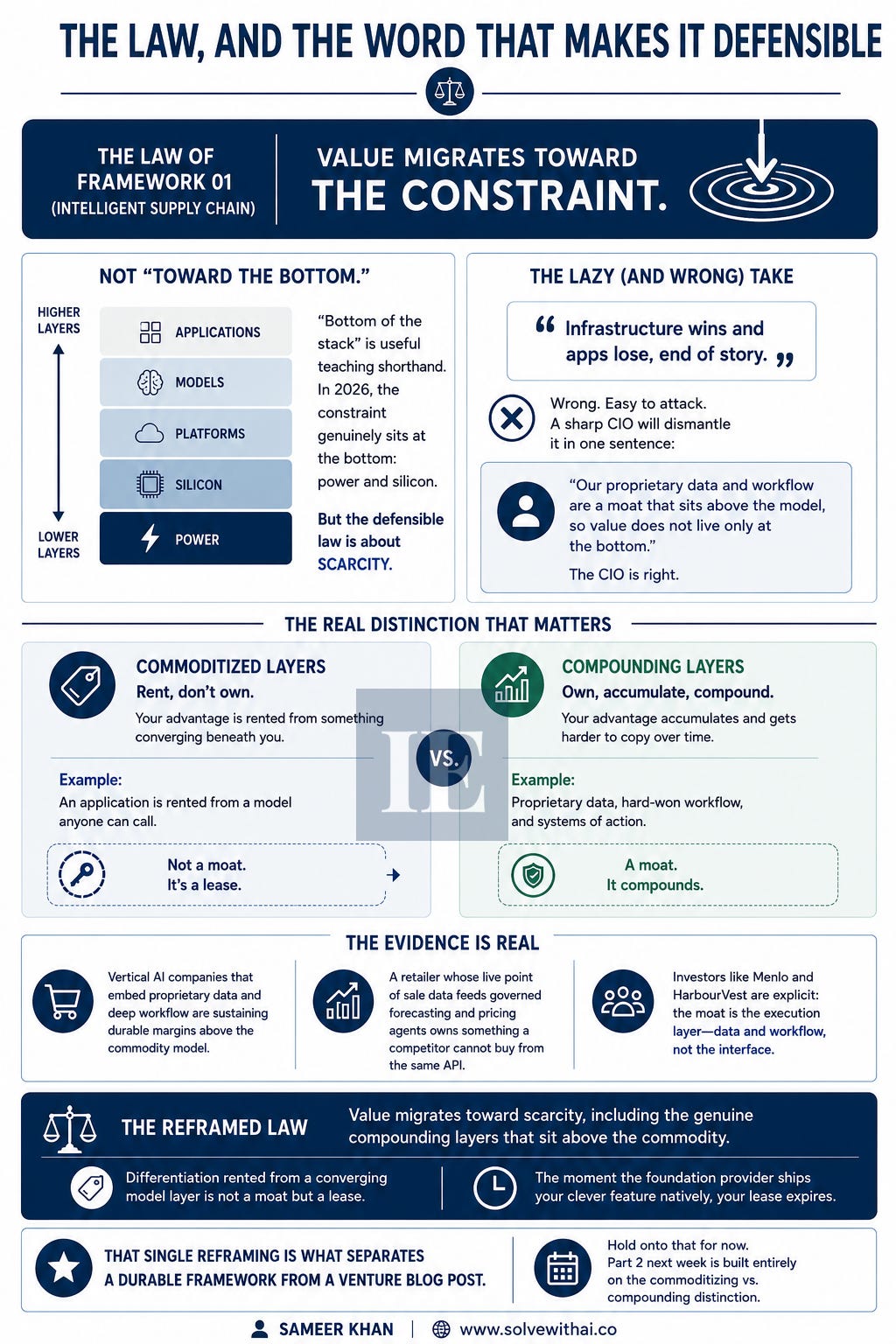
Not toward the bottom of the stack in the above diagram but toward the constraint.
Bottom of the stack is useful teaching shorthand, and I will keep using it, because in 2026 the constraint genuinely sits at the bottom, in power and silicon.
But the defensible law is the one about scarcity, and that distinction matters more than it looks.
It matters because the lazy version of this argument, the one every venture blog is now publishing, says infrastructure wins and apps lose, end of story.
That version is both wrong and easy to attack. A sharp CIO will dismantle it in one sentence: our proprietary data and workflow are a moat that sits above the model, so value does not live only at the bottom, and the CIO is right.
So let me give that objection its due, because it is the most important nuance in this entire framework.
There is a real exception to the downward pull, and it has a name.
Some layers are commoditized and some layers compound.
A commoditizing layer is one where your advantage is rented from something converging beneath you, the way an application is rented from a model anyone can call.
A compounding layer is one where your advantage accumulates and gets harder to copy over time, the way proprietary data, hard-won workflow, and systems of action do.
The evidence for compounding layers is as real as the evidence for the downward migration. Vertical AI companies that embed proprietary data and deep workflow are sustaining durable margins above the commodity model.
A retailer whose live point of sale data feeds govern forecasting and pricing agents owns something a competitor cannot buy from the same API.
The investors articulating this most clearly, Menlo and HarbourVest among them, are explicit that the moat is the execution layer data and workflow, not the interface.
Value migrates toward scarcity, including the genuine compounding layers that sit above the commodity. Differentiation rented from a converging model layer is not a moat but a lease.
The moment the foundation provider ships your clever feature natively, your lease expires.
That single reframing from the bottom always wins to value moves toward whatever is scarce, whether that is power at the bottom or proprietary data above the model, is what separates a durable framework from a venture blog post.
Hold onto that for now because part 2 next week is built entirely on the commoditizing versus compounding distinction.
Owning the Bottom Is a Guaranteed Cost, Not a Guaranteed Win
Before we turn the framework into a decision, one more piece of honesty, because the consulting world will not give you this one and you need it.
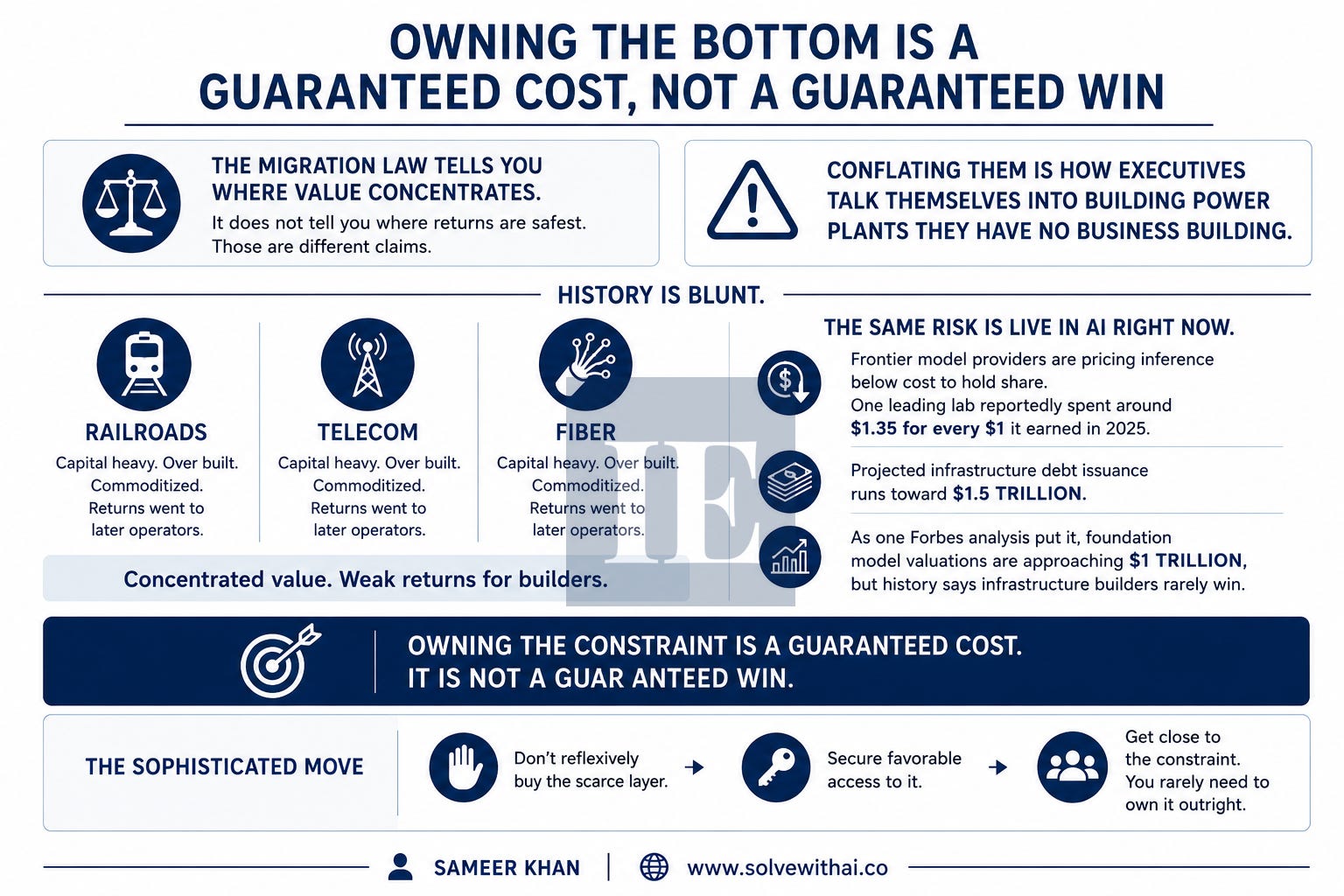
The migration law tells you where value concentrates. It does not tell you where returns are safest. Those are different claims, and conflating them is how executives talk themselves into building power plants they have no business building.
History is blunt here.
Railroads, telecom, and fiber were all capital heavy infrastructure that concentrated enormous value, and all three were over built and commoditized, with the returns often accruing to later operators rather than the original builders.
The same risk is live in AI right now.
Frontier model providers are pricing inferen ce below cost to hold share. One leading lab reportedly spent around 1.35 dollars for every dollar it earned in 2025.
Projected infrastructure debt issuance runs toward 1.5 trillion dollars. As one Forbes analysis put it, foundation model valuations are approaching a trillion dollars, but history says infrastructure builders rarely win.
So owning the constraint is a guaranteed cost, but the point to be noted is that it is not a guaranteed win.
The sophisticated move is rarely to reflexively buy the scarce layer. It is to secure favorable access to it.
The key message is to get close to the constraint. You rarely need to own it outright.
The Decision: Own, Partner, or Rent, Layer by Layer
The framework earns its keep only when it resolves into a decision your leadership team can actually make, so here is the instrument.
Step 1: Take every AI capability your business depends on.
Step 2: Map each one to its layer in the supply chain.
Step 3: Classify each layer as commoditizing or compounding.
Step 4: Set an explicit posture for each: own, partner, or rent.
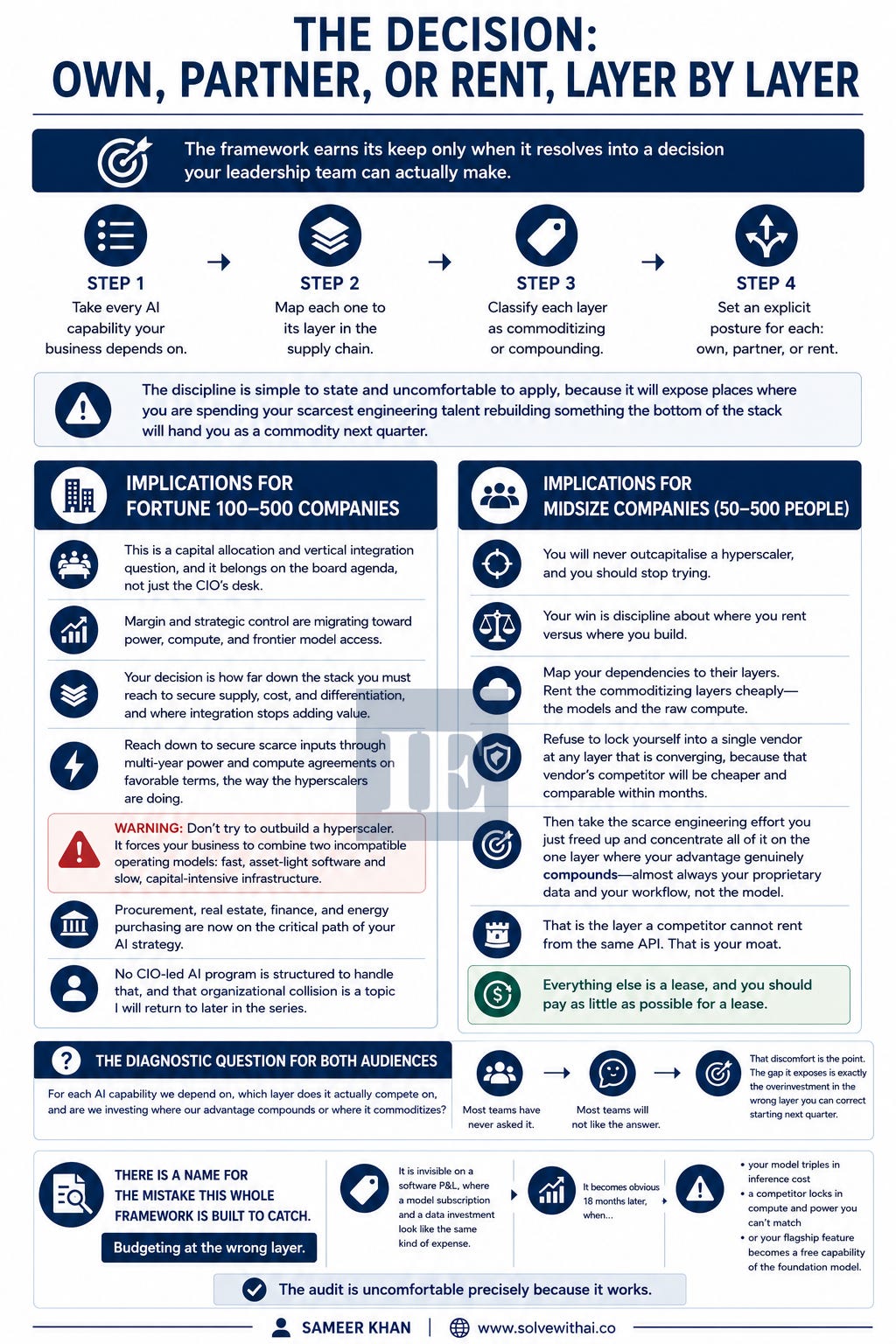
The discipline is simple to state and uncomfortable to apply, because it will expose places where you are spending your scarcest engineering talent rebuilding something the bottom of the stack will hand you as a commodity next quarter.
The right posture differs sharply by the size and capital position of your organization, so let me separate the two audiences.
If you lead an enterprise (a Fortune 100 or 500):
This is a capital allocation and vertical integration question, and it belongs on the board agenda, not just the CIO’s desk. Margin and strategic control are migrating toward power, compute, and frontier model access.
Your decision is how far down the stack you must reach to secure supply, cost, and differentiation, and where integration stops adding value.
Reach down to secure scarce inputs through multi-year power and compute agreements on favorable terms, the way the hyperscalers are doing.
Warning: Don’t try to outbuild a hyperscaler. It forces your business to combine two incompatible operating models: fast, asset-light software and slow, capital-intensive infrastructure.
Procurement, real estate, finance, and energy purchasing are now on the critical path of your AI strategy.
No CIO led AI program is structured to handle that, and that organizational collision is a topic I will return to later in the series.
If you lead a midsize organization (between roughly 50 and 500 people):
You will never outcapitalise a hyperscaler, and you should stop trying.
Your win is discipline about where you rent versus where you build. Map your dependencies to their layers. Rent the commoditizing layers cheaply, the models and the raw compute, and refuse to lock yourself into a single vendor at any layer that is converging, because that vendor’s competitor will be cheaper and comparable within months.
Then take the scarce engineering effort you just freed up and concentrate all of it on the one layer where your advantage genuinely compounds, which is almost always your proprietary data and your workflow, not the model.
That is the layer a competitor cannot rent from the same API. That is your moat. Everything else is a lease, and you should pay as little as possible for a lease.
The diagnostic question for both audiences:
For each AI capability we depend on, which layer does it actually compete on, and are we investing where our advantage compounds or where it commoditizes?
Most teams have never asked it.
Most teams will not like the answer.
That discomfort is the point, because the gap it exposes is exactly the overinvestment in the wrong layer that you can correct starting next quarter.
There is a name for the mistake this whole framework is built to catch. Budgeting at the wrong layer. It is invisible on a software profit and loss statement, where a model subscription and a data investment look like the same kind of expense.
It becomes obvious eighteen months later, when your model triples in inference cost, a competitor locks in compute and power you can’t match, or your flagship feature becomes a free capability of the foundation model.
The audit is uncomfortable precisely because it works.
Takeaway and Where We Go Next
If I strip this entire piece down to one sentence, here is what remains.
In the Intelligence Economy, value does not migrate toward the customer. It migrates toward the constraint.
That is the inversion of the software era intuition, and it is the foundation of everything in this series. Intelligence is manufactured. It is produced by a physical supply chain with real scarcity at specific layers.
Value pools where the scarcity is, sometimes at the bottom in power and silicon, sometimes above the model in proprietary data and workflow, never reliably at the application layer where the old playbook told you to look.
The strategic question is not how close you are to the customer. It is how close you are to the constraint.
So here is the reflection to take into your next leadership meeting. Pull up your AI budget. For every dollar on it, ask which layer it funds, and whether that layer is one where your advantage compounds or one where it commoditizes beneath you.
If most of your spend is aimed at the commoditizing layer, you are not wrong to be investing in AI. You are investing in the most fragile part of it.
Next week, in Part 2, we go deeper into the single distinction that decides everything: commoditizing layers versus compounding layers.
We will turn that two word vocabulary into a working test you can run on any capability you depend on, so you can tell, before you commit capital, whether you are building a moat or signing a lease.
The supply chain is the map. The constraint is the destination. Now you know which way the value flows.
Talk soon,
Sameer Khan
Creator of Solve with AI.