

How Physical Infrastructure Became AI’s New Moat
Why Your Next AI Decision Isn’t About Models

Hey Transformation Leader,
When you ask a room full of executives what’s stopping their AI rollout, almost everyone points at the same thing. Model quality. Talent. Governance. Maybe budget. Almost nobody says power.
That’s the problem. Because in 2026 and beyond, power is the answer.
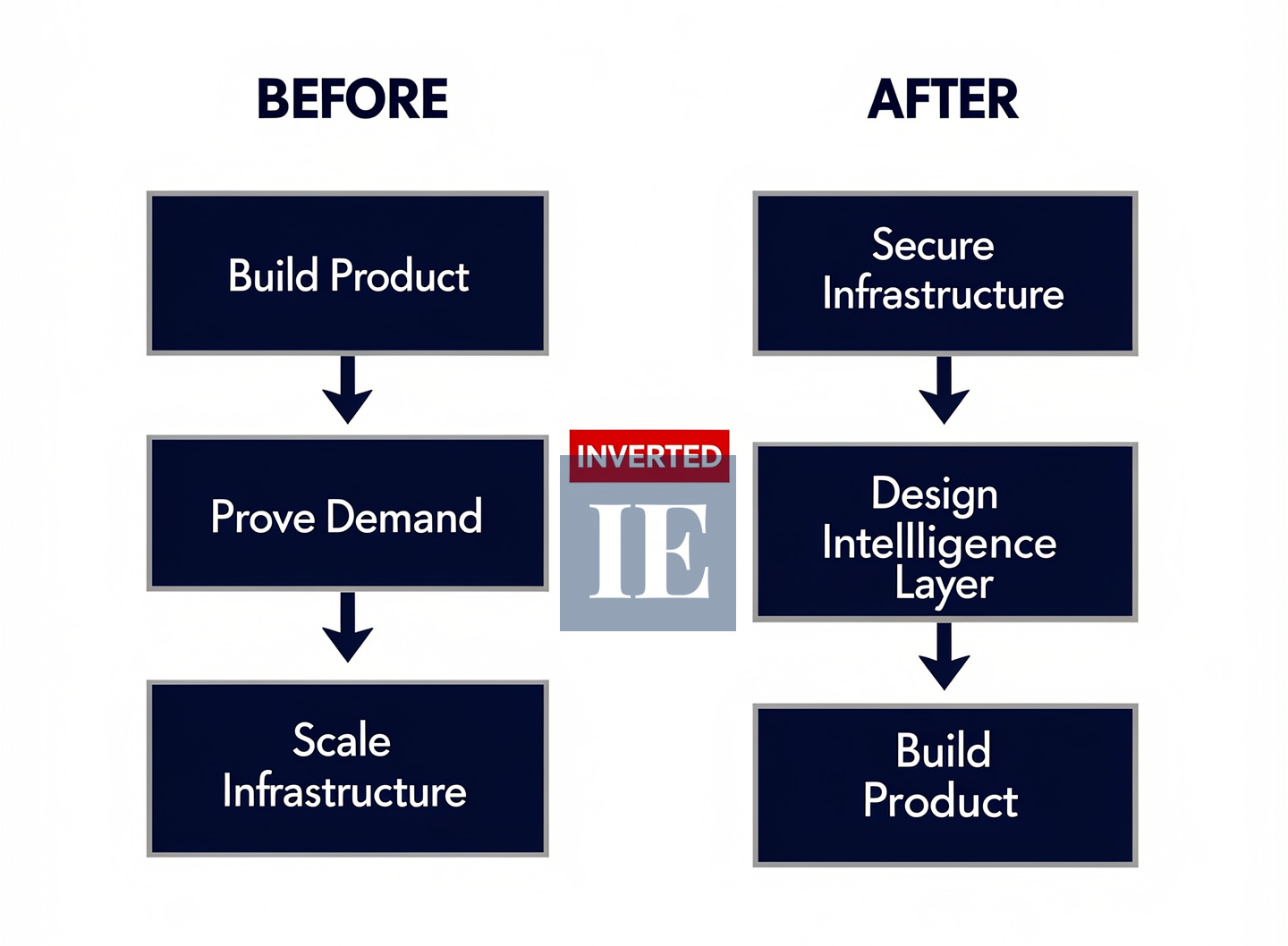
For the last decade, every technology rollout you’ve ever run followed the same quiet sequence.
Build the product.
Prove the demand.
Scale the infrastructure underneath it once you know it works.
Cloud made that sequence feel almost automatic. Need more compute? Spin up another instance. Need more storage? Click a button.
Infrastructure became elastic, invisible, and something you paid for after the fact, not something you planned for years in advance.
AI just broke that sequence.
How?
Here is the uncomfortable truth sitting underneath every AI roadmap right now: the companies that will have usable AI capacity in 2028 already made that decision in many cases, back in 2024 and 2025, when the workloads that will eventually run on that capacity weren’t even fully specified yet.
Power, land, cooling, permitting, and grid interconnection now have to be secured years before the intelligence layer on top of them is designed.
The infrastructure comes first, and the product comes later. That is a full inversion of the sequence you learned, and most executives are still planning against a reality that no longer exists.
I call this the Infrastructure Inversion, and once you see it, you can’t unsee it in every AI budget conversation you’re having right now.
Table of Content
The Infrastructure Inversion
Why Power Became the Bottleneck
Intelligence Is Manufactured
The Readiness Curve
Enterprise Playbook
Mid-Market Playbook
Key Takeaways
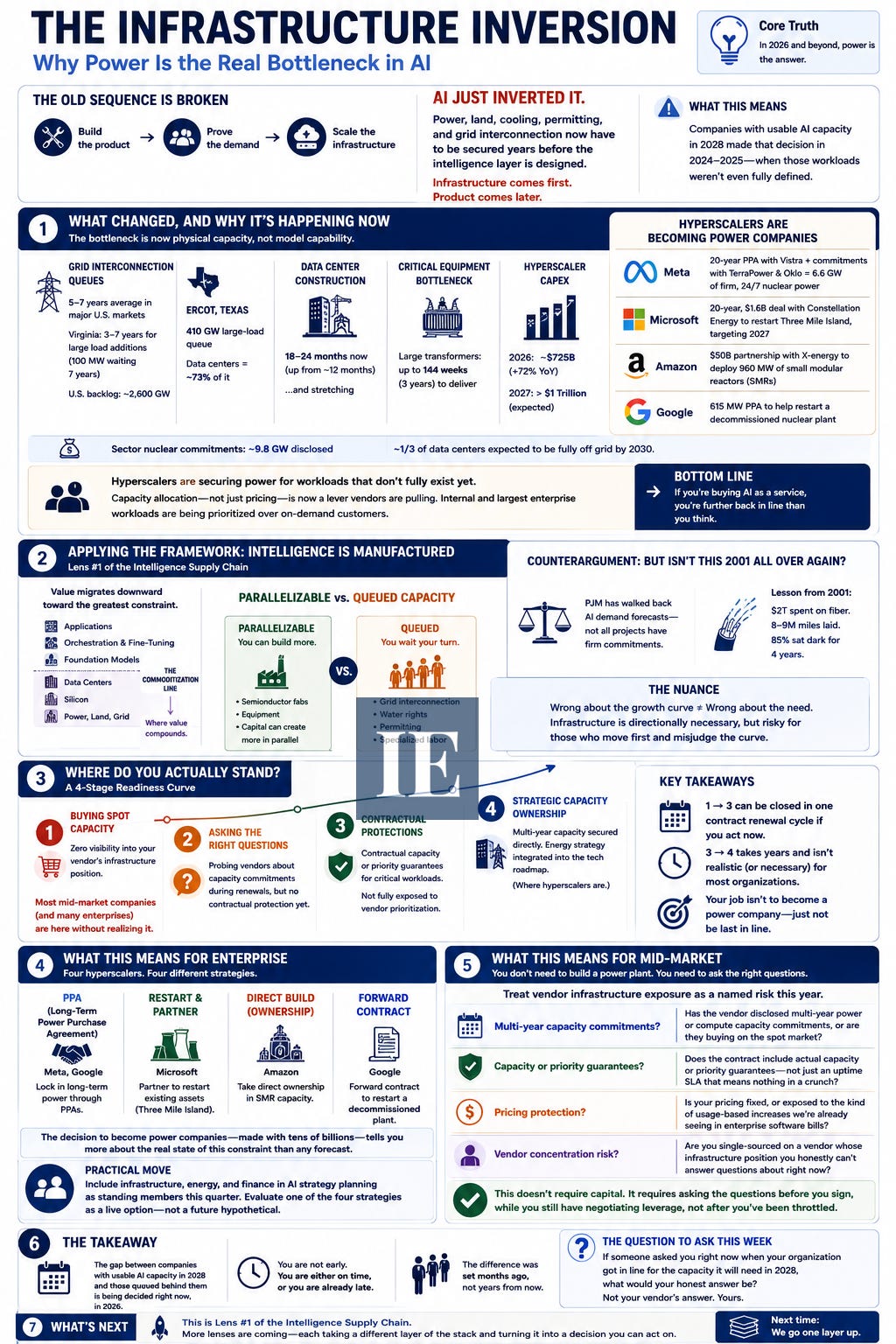
What Changed, and Why It’s Happening Now
The bottleneck in AI stopped being about model capability a while ago. It is now, almost entirely, about physical capacity. Megawatts. Substations. Water rights. Buildout timelines measured in years, not sprints.
This might be an unusual statement, as you normally hear about models and compute.
Grid interconnection queues in major U.S. markets now average 5-7 years. In Virginia, the epicenter of American data center growth, Dominion Energy’s queue for large commercial load additions stretches beyond three years just for substation service, with some 100 megawatt connections reportedly waiting seven years to get power flowing.
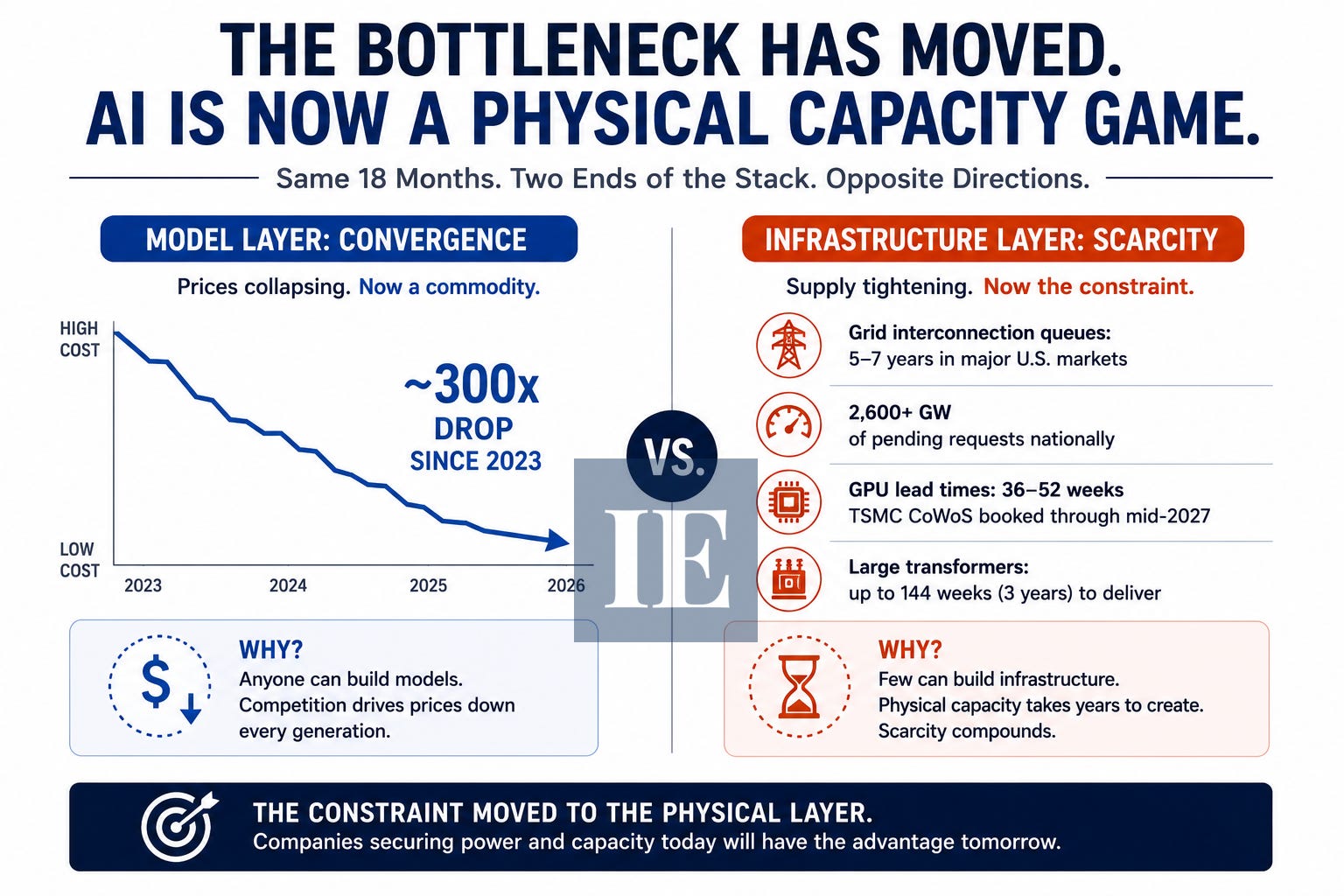
ERCOT in Texas is sitting on a 410-gigawatt large-load interconnection queue as of this year, and data centers now account for roughly 73% of it. Nationally, the U.S. interconnection backlog has ballooned to around 2,600 gigawatts.
Compare that to hyperscale data center construction itself, which now runs eighteen to twenty-four months, up from about twelve months before the current squeeze. Even that number keeps stretching, because the equipment inside these buildings has its own bottleneck.
Large transformers, the kind that step generation down to usable voltage, now take up to 144 weeks to deliver. That’s 3 years just for transformers.
This is why hyperscaler capital spending looks the way it does. Combined 2026 capex across Amazon, Google, Meta, and Microsoft is around $ 725 billion, up roughly 72% year over year.
Analysts expect that figure to cross a trillion dollars in 2027. Numbers that large only make sense if these companies believe capacity, not demand, is the thing standing between them and their next competitive move.
The four largest, most capital-rich, most technically sophisticated companies on earth have stopped waiting on the grid entirely.
If I say they are becoming power companies, it will not be incorrect.
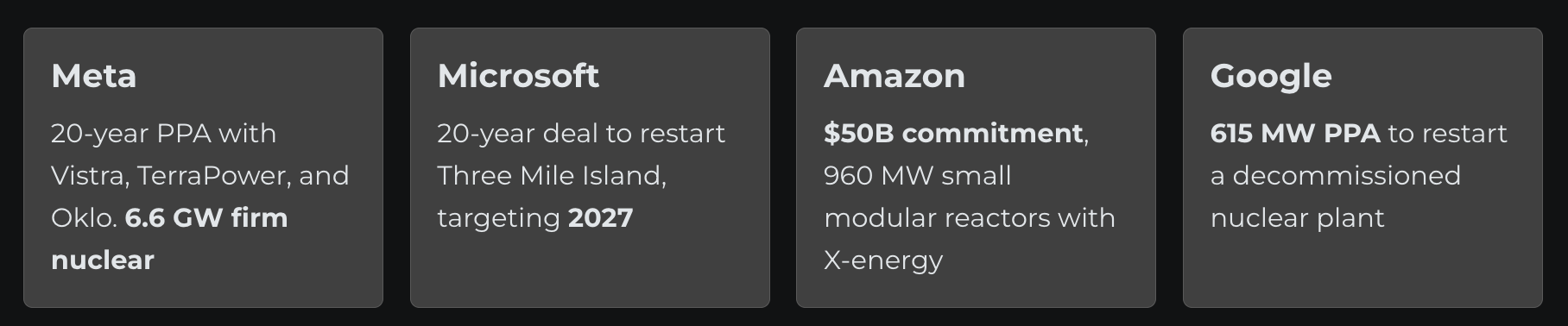
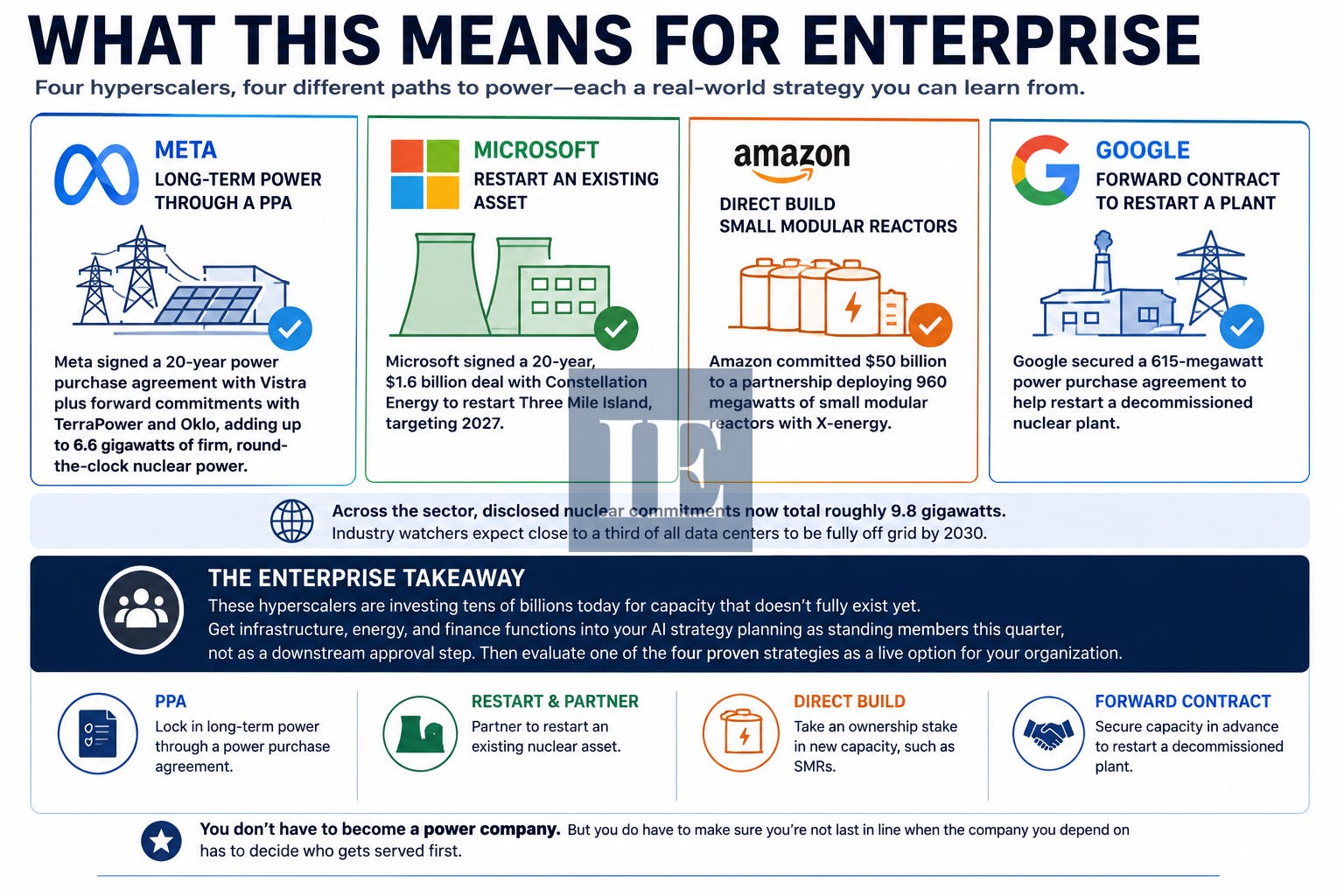
Meta signed a 20 year power purchase agreement with Vistra plus forward commitments with TerraPower and Oklo, adding up to 6.6 gigawatts of firm, round the clock nuclear power.
Microsoft signed a 20 year 1.6 billion deal with Constellation Energy to restart Three Mile Island, targeting 2027.
Amazon committed 50 billion dollars to a partnership deploying 960 megawatts of small modular reactors with X-energy.
Google secured a 615 megawatt power purchase agreement to help restart a decommissioned nuclear plant.
Across the sector, disclosed nuclear commitments now total roughly 9.8 gigawatts, and industry watchers expect close to a third of all data centers to be fully off grid by 2030.
Think about what that means for a moment.
They committed tens of billions of dollars to secure power for workloads that don’t fully exist yet. That is a company betting its capital on the belief that the physical layer, not the software layer, is where the real constraint lives.
Microsoft’s own CEO confirmed on a recent earnings call that internal workloads and the largest enterprise commitments are now being prioritized over on demand customers.

Capacity allocation, not just pricing, is now a lever vendors are actively pulling. If you’re a mid-market company buying AI as a service, you are, by definition, further back in that line than you think you are.
Applying the Framework: Intelligence Is Manufactured
If you’ve been reading this newsletter, you already know the core thesis of the Intelligence Economy is that Intelligence is manufactured. Value migrates to the bottom of the stack.
The Infrastructure Inversion is Lens #1 of the Intelligence Supply Chain. It’s the operational mechanism behind the claim we’ve been building toward. Value migrates downward, toward power, land, and grid access, because that’s the layer with the longest lead times and the highest capital intensity.
Long lead times plus capital intensity create a moat. An actual, physical, multi-year moat that a competitor with more capital and more urgency cannot simply buy their way around, because the constraint isn’t money but a queue position.
That distinction matters more than it sounds like it should.
Most executives hear power shortage and think in market terms. Pay more, get more. But grid interconnection doesn’t work that way. It is a queued, non-parallelizable resource. You cannot outbid your way to the front of a 7 year interconnection line the way you can outbid a competitor for scarce chips.
This reframes the entire executive question. It’s not how much should we budget. It’s when did we get in line.
Here’s a second piece of this that even sophisticated readers usually miss.
For years, the assumption was that semiconductor capacity could always scale faster than physical grid capacity, because chip fabs are the fast, flexible lever and the grid is the slow one.
That assumption just quietly died.
U.S. semiconductor fab construction now runs 36-60 months for a fully operational facility, whereas grid interconnection for large industrial loads runs 3-7 years. Those two numbers have converged.
The AI industry has lost its fastest scalable infrastructure lever at exactly the moment it needs it most, and almost nobody outside specialist supply chain circles has connected those two facts out loud.
Fab capacity is parallelizable. You can build five fabs in five different places at once if you have the capital, the way the CHIPS Act tried to encourage.
Grid capacity in a given region is shared and queued. Every data center, every manufacturer, every electrification project in that region is competing for the same limited interconnection slots.
That’s the term worth carrying forward from this lens: parallelizable versus queued capacity. It’s a more honest, more useful distinction than the old fast chips, slow grid story, and it applies to more than just power.
Water rights, specialized construction labor, permitting staff capacity. Anywhere a bottleneck is shared and queued rather than something you can simply buy more of, this lens applies.
I want to be straight with you about something, because a framework that’s never confronted its own weak points isn’t worth much.
There’s a real counterargument here, and it deserves airtime.
PJM, the largest grid operator in the country, has publicly walked back parts of its own AI demand forecast, saying its project pipeline included data center announcements without firm construction commitments attached.
That’s the same pattern that produced the fiber glut of 2001, when 1990s telecom carriers spent roughly 2 trillion dollars and laid 8-9 million miles of fiber, betting on internet traffic doubling every ninety days.
Actual traffic growth was closer to doubling annually, a real number, just far below the story used to justify the spending. 85% of that fiber sat dark for four years after the crash.
Here’s the nuance worth holding onto, because it’s more sophisticated than either the hype version or the skeptic’s version of this story.
Being wrong about the growth curve and being wrong about the need for the infrastructure is a double whammy.
The 1990s carriers were wrong about the speed of demand. They were not wrong that the internet would eventually need that fiber. It became the physical backbone of the modern internet economy, just years later than the pitch deck promised, and only after a brutal capital destruction cycle wiped out the companies that moved first and misjudged the curve.
That’s the honest version of the Infrastructure Inversion.
Building ahead of proven demand is directionally necessary. It is also genuinely risky for whoever moves first and gets the growth curve wrong. Both things are true at once, and any framework that only tells you one side of that isn’t giving you a real decision tool. It’s giving you a pep talk.
Where Do You Actually Stand
Before we get to what to do about this, it’s worth asking a more honest question first.
Where does your organization actually sit on this, right now, today?
I think about readiness here on a simple 4 curve, and most companies I talk to can place themselves on it in about ten seconds once they hear it described.
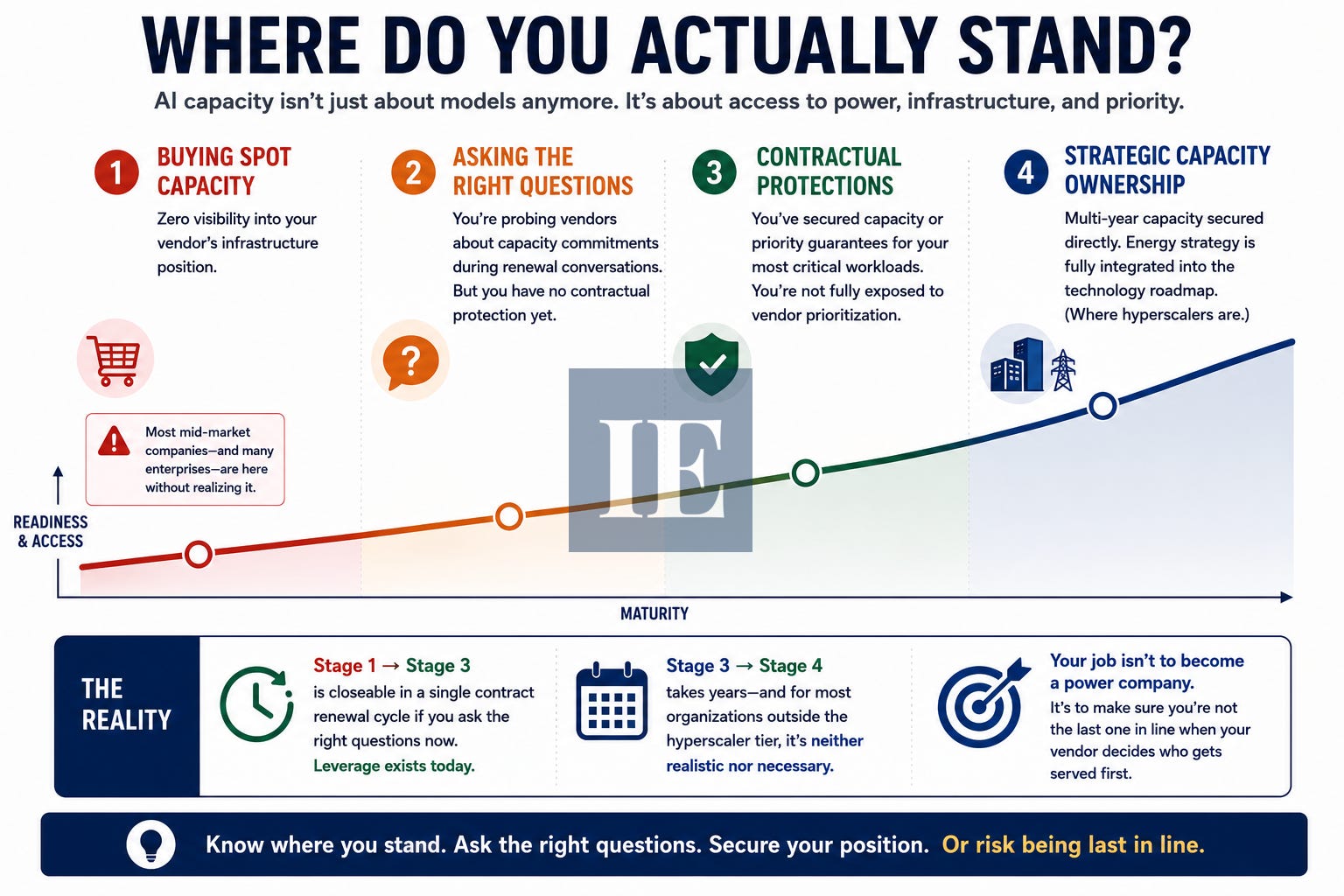
Stage one is buying spot capacity with zero visibility into your vendor’s own infrastructure position, which is where most mid-market companies and a surprising number of enterprises still sit, often without realizing it.
Stage two is asking the right questions: you’ve started probing vendors about capacity commitments during renewal conversations, but you haven’t yet built any contractual protection around the answers.
Stage three is where you’ve secured some contractual capacity or priority guarantees, at least for your most critical workloads, so you’re not entirely exposed to a single vendor’s internal prioritization decisions.
Stage four is where the four hyperscalers already sit, multi-year capacity secured directly, with energy strategy fully integrated into the technology roadmap rather than treated as someone else’s problem.
Almost nobody starts at stage four, and that’s fine.
What matters is knowing honestly where you are, because the gap between stage one and stage three is closeable in a single contract renewal cycle if you ask the right questions now, while you still have leverage.
The gap between stage three and stage four takes years and, for most organizations outside the hyperscaler tier, simply isn’t a realistic or necessary destination.
I want to make it super clear that your job isn’t to become a power company but the last one in line when the company you depend on has to decide who gets served first.
What This Means for Enterprise
Look at how the four hyperscalers actually answered this question, because each of them chose a different path and each path is now a named, dated, real world case study you can map your own organization against.
Meta bought long-term power through a PPA.
Microsoft partnered by restarting an existing asset at Three Mile Island.
Amazon built, taking a direct ownership stake in small modular reactor capacity.
Google bought again, through a PPA that helped restart a decommissioned plant.
Four of the most capital rich, best informed companies in the world, with every reason to simply wait for the grid to catch up, instead chose to become power companies.
That decision, made with tens of billions of dollars rather than commentary, tells you more about the true state of this constraint than any forecast, including PJM’s own walk-back.
The practical move: get infrastructure, energy, and finance functions into your AI strategy planning as standing members this quarter, not as a downstream approval step brought in after the roadmap is already set.
Then pick one of those four hyperscaler strategies, PPA, restart and partner, direct build, or forward contract, and evaluate it as a live option for your organization, not a hypothetical you’ll revisit someday.
What This Means for Mid-Market
You don’t need to build a power plant. You need to know whether your vendor already has.
Practically, that means treating vendor infrastructure exposure as a named risk category in every AI and cloud contract renewal this year, the same way you already treat cybersecurity or data residency.
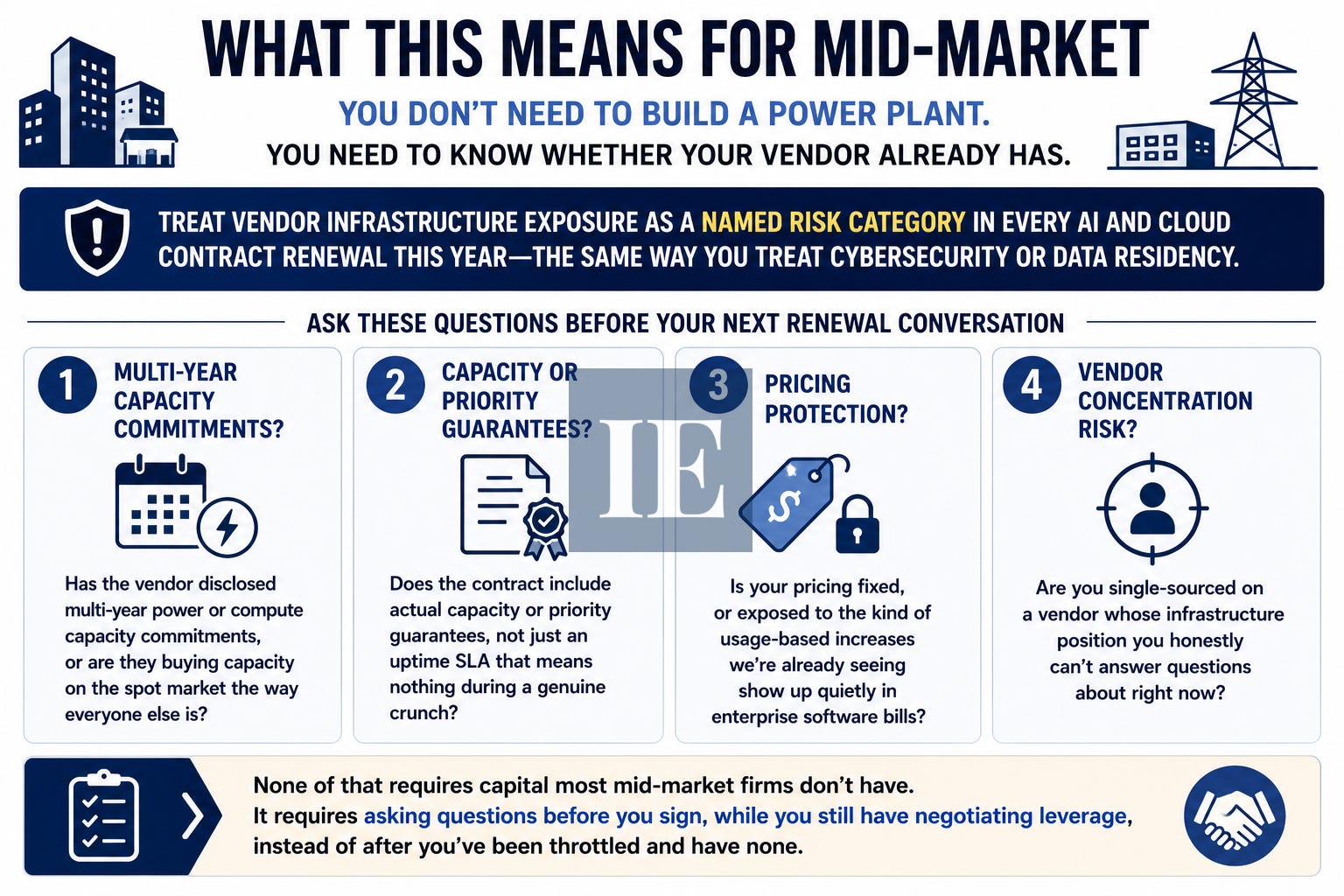
A short checklist is worth running through before your next renewal conversation: has the vendor disclosed multi-year power or compute capacity commitments, or are they buying capacity on the spot market the way everyone else is?
Does the contract include actual capacity or priority guarantees, not just an uptime SLA that means nothing during a genuine crunch?
Is your pricing fixed, or exposed to the kind of usage-based increases we’re already seeing show up quietly in enterprise software bills?
Are you single-sourced on a vendor whose infrastructure position you honestly can’t answer questions about right now?
None of that requires capital most mid-market firms don’t have. It requires asking questions before you sign, while you still have negotiating leverage, instead of after you’ve been throttled and have none.
The Takeaway
Here is what I want to leave you with.
The gap between the companies with usable AI capacity in 2028 and the ones queued behind them is being decided right now, in 2026, not in some future budget cycle you haven’t planned yet.
You are not early to this decision. You are either on time, or you are already late, and the difference was set months ago, not years from now.
So here’s the question worth bringing to your own leadership team this week. If someone asked you right now when your organization got in line for the capacity it will need in 2028, what would your honest answer be? Not your vendor’s answer. Yours.
That question is Lens #1 of the Intelligence Supply Chain.
There are more lenses coming, each one taking a different piece of this stack and turning it into a decision you can actually act on. Next time, we go one layer up.
Talk soon,
Sameer Khan