

AI Is Not Your Bottleneck. Your Decision System Is
The Shift No One Is Designing: From Execution to Decision Systems

Hey Productivity Explorer,
You’ve likely seen this pattern, where a team rolls out AI across workflows, speeds up execution, and increases output, and for a short period, it feels like a real step-change in performance.
I worked with a growth leader who did exactly this, adopting AI early and enabling his team to produce more campaigns, more content, and more analysis in less time.
Within a quarter, output was up close to 30%, and on the surface, it looked like a clear win in efficiency and speed.
But just as quickly, progress stalled, and despite all the added activity, there was no meaningful lift in results or insight.
They had removed the execution bottleneck, but nothing actually improved.
The team could now run more experiments, generate more content, and analyze results faster, but they were still deciding what to do using the same assumptions and the same loose processes.
So the system produced more work without improving outcomes, creating the illusion of progress while performance stayed flat.
This is the mistake most companies are making right now, because they treat AI as a productivity layer instead of a shift in how decisions are made.
The constraint has already changed.
The old constraint was execution capacity, which limited how much a team could produce, but AI has largely removed that limit by making multi-step work fast and reliable.
The new constraint is decision architecture, which defines what gets done, what gets prioritized, and how effort is directed.
If that does not change, AI will scale your existing decisions, not improve them.
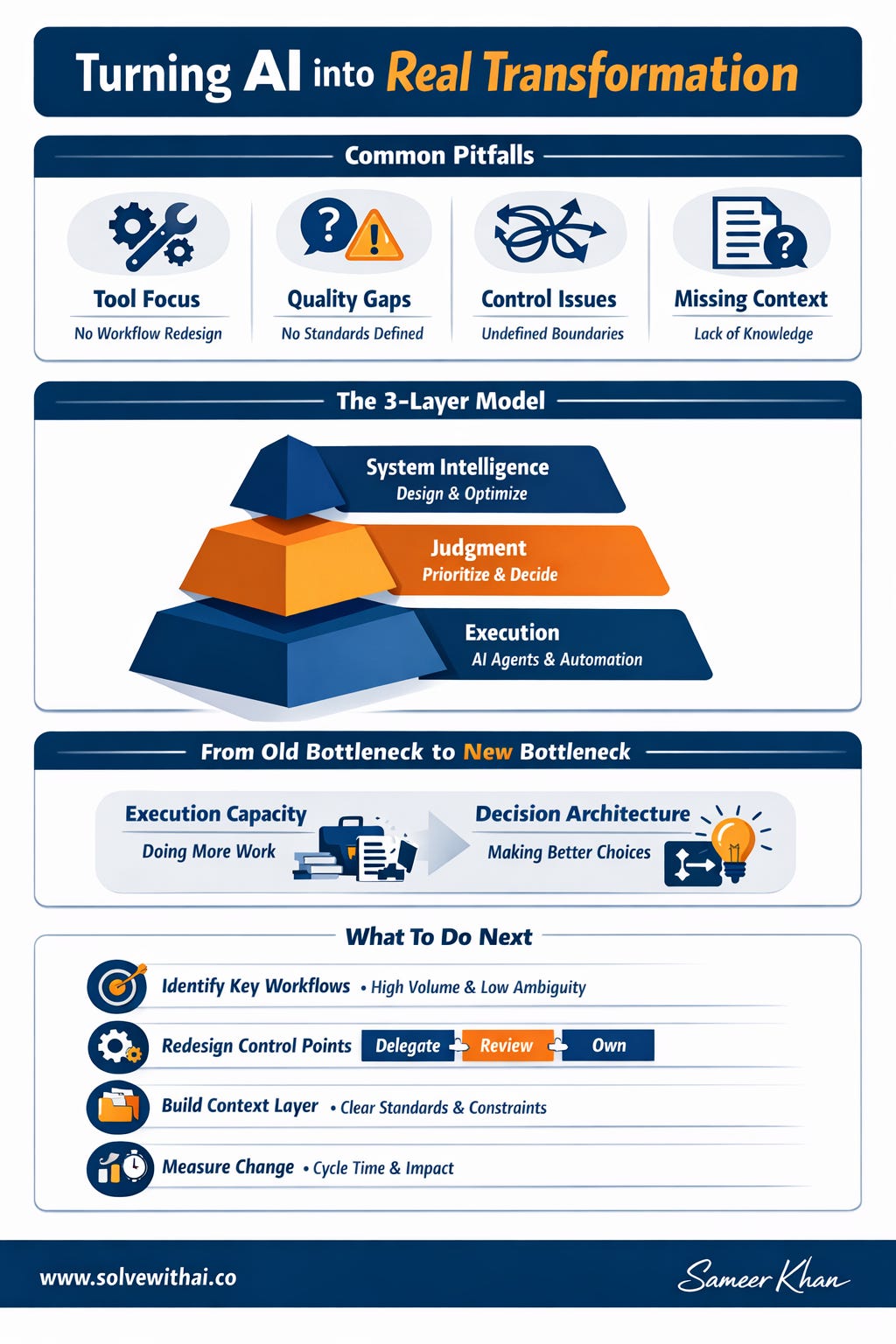
Table of Contents
The Misdiagnosed Problem
From Doing Work to Designing Work
The 3-Layer Model of AI-Native Organizations
Delegate – Review – Own
Where AI Transformations Break
The Growth Shift
Maturity Curve
What to Do Next
The Real Shift: From Doing Work to Designing Work
Keep reading with a 7-day free trial
Subscribe to Intelligence Economy to keep reading this post and get 7 days of free access to the full post archives.