

The War of Inference
Why Only One Company is Leading Inference Game

Hey Productivity Explorer,
If you visit history books, you may learn that in the early days of electricity, most investors focused on building power plants.
Power generation looked like a scarce asset. But over time, the real economic value shifted to how electricity was used. Factories, appliances, and entire industries formed around the continuous consumption of power. The companies that understood this shift early built massive businesses.
AI is entering a similar phase.
Over the past two years, most headlines have focused on training frontier models. Billions of dollars have been spent building larger and larger systems. But training happens occasionally. The real economic activity begins after the model is built.
In my own work leading AI and digital initiatives inside large enterprises, I see the same pattern emerging. The challenge is rarely building a model. The challenge is running AI reliably across thousands of daily decisions, workflows, and customer interactions.
That is the inference economy, and it is where the real AI revenue will be generated.
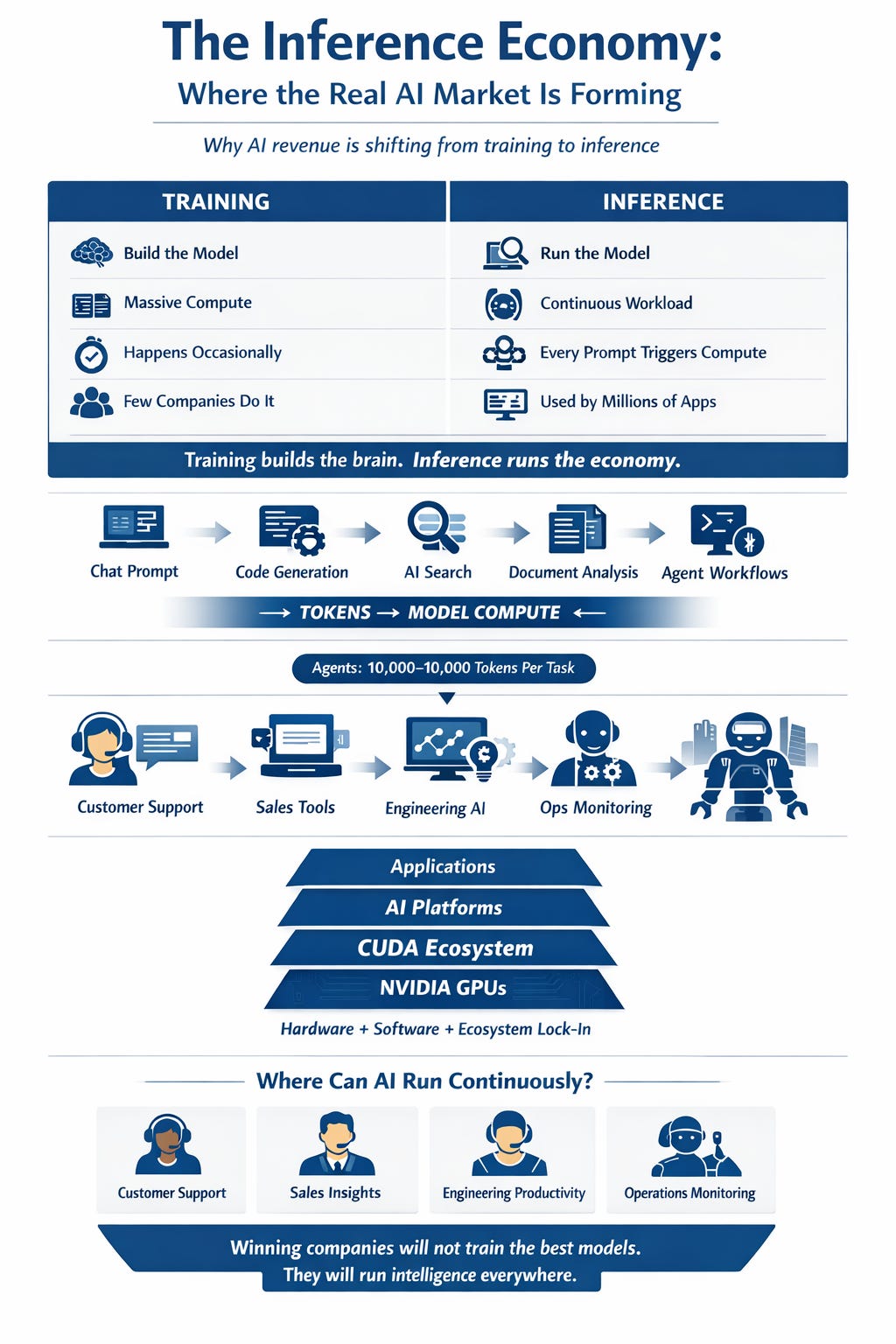
Table of Contents
1. The Pattern We Have Seen Before
2. Training vs Inference
3. The Token Explosion
4. The Jevons Paradox of AI
5. The Rise of the Inference Economy
6. Why NVIDIA Wins
7. What This Means for Your Business
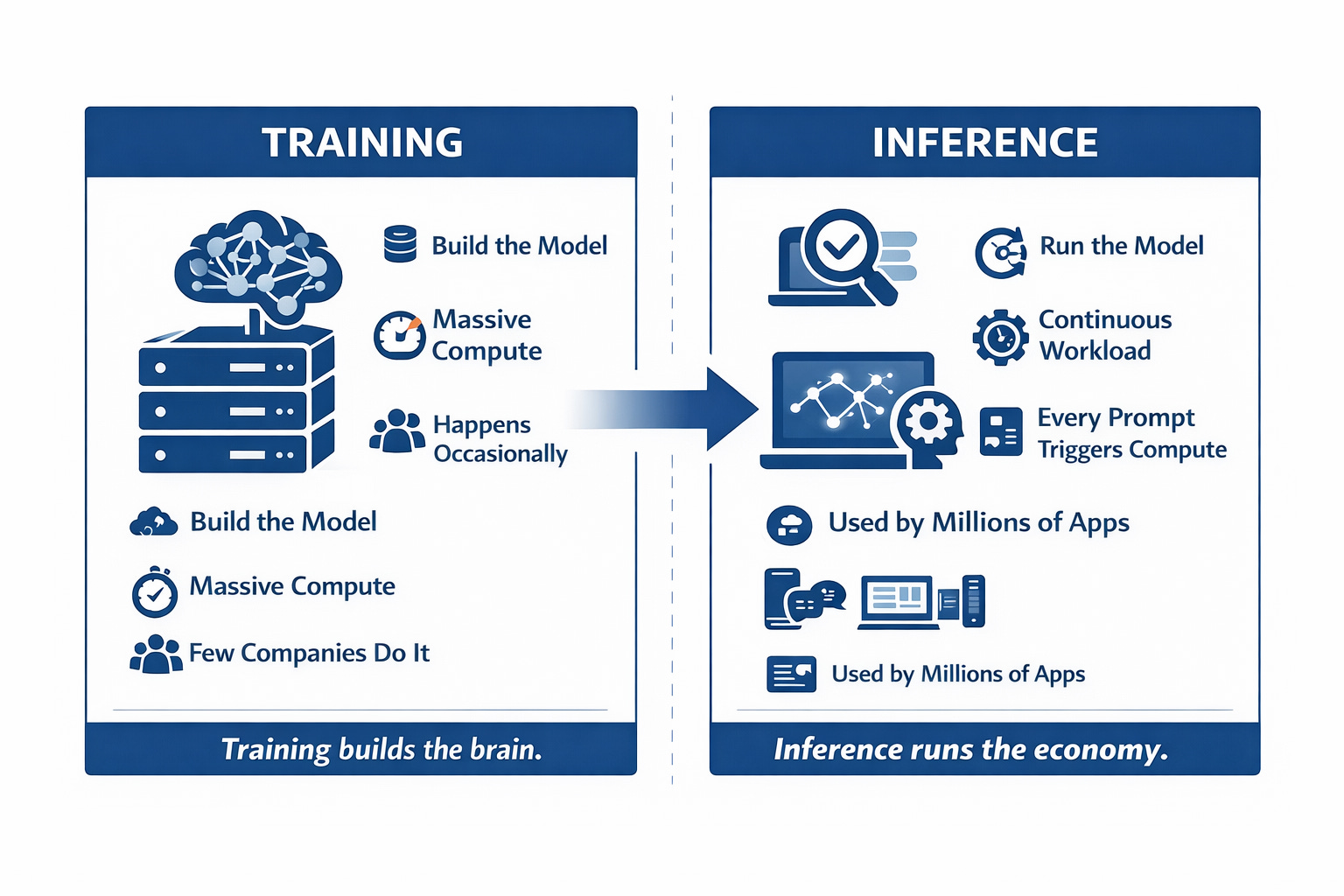
Training Builds the Brain. Inference Runs the Economy
When people talk about the AI race, they usually focus on training models. That is the phase where companies spend hundreds of millions of dollars building systems like GPT-4 or Gemini.
Training is expensive. It requires massive datasets, thousands of GPUs, and months of work.
But here is the part most people miss.
Training happens occasionally.
Inference happens every time you use AI.
When you ask ChatGPT a question, the model is running inference. When a developer uses GitHub Copilot to generate code, that is inference. When someone searches using Perplexity AI and gets an AI-generated answer, that is inference.
Every interaction triggers compute.
Now think about how this looks at scale.
If one person asks a chatbot a question, that might generate a few hundred tokens. But if an AI system inside a company handles thousands of customer support requests per hour, the model is running inference continuously.
The same thing happens in enterprise workflows.
Sales team uses AI to analyze pipeline data, which triggers an inference.
Support bot answering customer questions triggers inference.
Software engineer generating code suggestions triggers inference.
Now add AI agents to the picture.
An agent does not just call a model once. It may break a problem into steps, retrieve documents, run reasoning loops, and call the model multiple times before producing an answer. One task can generate tens of thousands of tokens.
That is why inference is quickly becoming the real engine of the AI economy.
Training builds the capability.
Inference is what turns that capability into millions of real decisions every day.
The Token Explosion
To see why inference demand is growing so quickly, you need to understand tokens.
A token is a small unit of text that a model processes. It might be a word, part of a word, or a piece of punctuation. Every time you interact with an AI system, the model reads input tokens and generates output tokens.
You may not notice it, but tokens are the currency of the AI economy.
For example, when you ask ChatGPT a question like:
“Summarize this report”
The model processes:
the prompt you typed
the context of the conversation
the document you uploaded
the response it generates
All of that becomes tokens.
Now scale that simple interaction across millions of users.
Search engines like Perplexity AI generate AI summaries for every query. Developers using GitHub Copilot receive code suggestions dozens of times per hour. Tools inside Microsoft Copilot process documents, emails, spreadsheets, and meetings throughout the workday.
Each of these interactions produces tokens.
Now consider what happens with AI agents.
A simple chatbot request might generate a few hundred tokens.
But an agent solving a task can generate 10,000 to 100,000 tokens because it:
plans a sequence of steps
retrieves documents
calls external tools
runs reasoning loops
generates intermediate outputs
One user request can trigger dozens of model calls.
This is why many AI platforms now report processing billions of tokens per minute.
And that token growth is what drives the explosion in inference demand.
The Jevons Paradox of AI
At this point you might assume something logical will happen.
If AI becomes more efficient, compute demand should fall.
History shows the opposite usually happens.
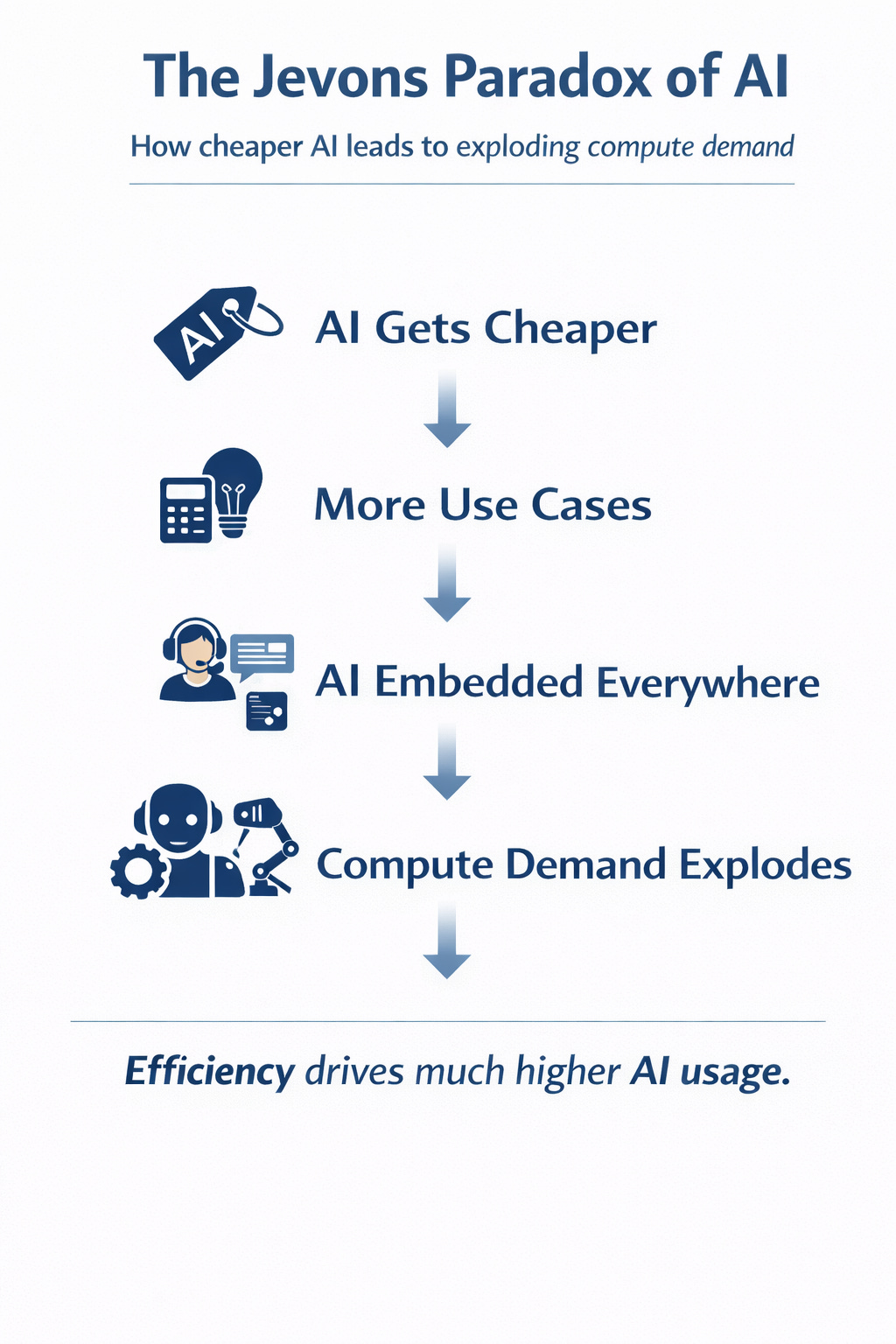
In the 1860s, economist William Stanley Jevons studied coal consumption during the Industrial Revolution. Engineers had invented more efficient steam engines, which meant factories could use less coal per machine.
Many people assumed coal demand would decline.
Instead, coal consumption skyrocketed.
Because cheaper and more efficient engines made it economical to build more factories, expand railways, and power entire industries. Efficiency lowered the cost of using the technology, which encouraged people to use much more of it.
This phenomenon became known as Jevons Paradox.
You are seeing the same pattern emerging with AI.
Models are becoming more efficient. Hardware continues to improve. Token costs for models such as GPT-4 and Claude have already fallen significantly since their early releases.
But instead of reducing demand, lower costs start unlocking entirely new use cases.
When AI becomes cheaper to run, companies begin embedding it into everyday workflows. A customer support team may start with a chatbot that answers basic questions. Soon the same system summarizes tickets, suggests responses for agents, and automatically routes issues to the right teams.
Inside organizations, employees begin using AI to search internal knowledge bases, summarize long reports, and analyze documents. What starts as an occasional productivity tool quickly becomes integrated into the systems people use throughout their day.
Sales teams rely on AI to review pipelines and draft outreach. Engineers receive code suggestions while writing software. Operations teams use AI systems to monitor processes, detect anomalies, and recommend actions.
As adoption spreads, AI stops being something people use occasionally. It becomes something that runs continuously in the background, supporting decisions and automating workflows across the business.
Efficiency does not shrink compute demand.
It expands it.
Why Inference Is Becoming the Real AI Market
Once you understand token growth and Jevons Paradox, a larger shift becomes clear. The AI economy is moving from episodic training jobs to continuous inference workloads.
Training still matters. Companies like OpenAI, Google, and Anthropic continue to invest billions building new frontier models.
But only a small number of organizations train models at that scale.
Inference is different.
Every company deploying AI runs inference. Every AI application depends on it. Every automated workflow triggers it.
You can see this shift already happening.
Customer service systems now use AI to answer questions, summarize conversations, and assist agents in real time. Sales teams use AI tools to analyze pipeline activity and generate outreach messages. Software developers receive code suggestions while they write and review code.
Each of these actions triggers inference.
Now add AI agents into the picture.
Agents do not just call a model once. They break problems into steps, retrieve data, reason through options, and call models repeatedly before completing a task. A single agent workflow can trigger dozens of inference calls.
Then consider where AI is heading next.
Robotics systems running perception models. Autonomous vehicles processing sensor data. Industrial systems monitoring operations in real time. These environments require AI systems that run continuously.
Training builds the models that make these capabilities possible.
Inference is what turns them into daily economic activity at global scale.
Why NVIDIA Is Winning This Phase
If inference becomes the dominant workload in AI, the next question is straightforward.
Who provides the infrastructure to run it?
Right now, the clear leader is NVIDIA.
The reason is not just hardware. It is the ecosystem the company has built over more than a decade.
Most modern AI systems run on NVIDIA GPUs because of CUDA, the programming platform that developers use to build accelerated computing applications. Over time, CUDA became the default standard for training and running deep learning models.
Once that ecosystem formed, it created a powerful network effect. AI frameworks, research libraries, and enterprise tools were optimized around NVIDIA’s stack. Developers built skills around it. Companies built infrastructure around it.
On top of that hardware layer, NVIDIA built software specifically optimized for inference workloads. Libraries such as TensorRT help models run faster and more efficiently in production systems.
Then there is the hardware roadmap. Architectures like Hopper and the newer Blackwell chips are designed to handle massive AI workloads, particularly large scale inference.
This combination of hardware, software, and developer adoption makes NVIDIA the default infrastructure layer for much of today’s AI economy.
That does not mean competition will not emerge. Large cloud providers are already developing their own AI chips. But switching ecosystems is expensive. Once companies build systems around a particular stack, they tend to stay there.
For now, NVIDIA sits at the center of the inference economy.
What This Means for You
Most discussions about AI still revolve around building models. You hear about new benchmarks, new architectures, and which company trained the next frontier system.
But if you are running a business, that is not the most important question.
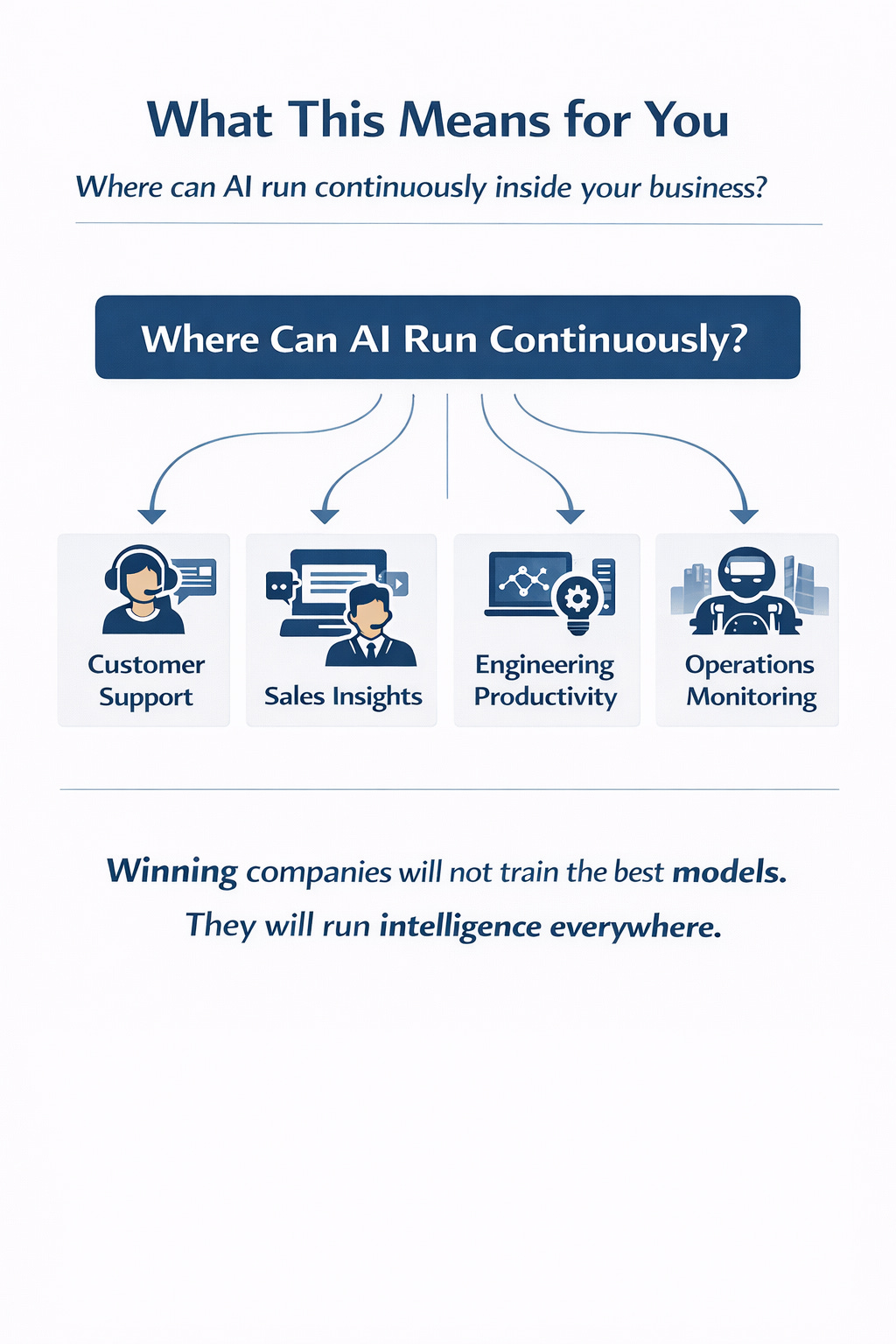
The real question is where AI can run continuously inside your workflows.
Most organizations will never train their own models. Instead, they will rely on platforms such as ChatGPT, Claude, or Microsoft Copilot and integrate them into their operations.
The opportunity is not in building the brain.
It is in deciding where intelligence should run inside your company.
You might deploy AI to triage customer support requests before an agent sees them. Your sales organization might use AI to summarize calls and identify deal risks. Engineering teams might rely on AI systems that assist with writing and reviewing code.
Each of these use cases runs inference.
One prompt generates a response.
One workflow triggers multiple model calls.
An AI agent solving a complex task can trigger dozens.
Multiply that across thousands of employees, customers, and daily operations.
That is the inference economy in practice.
The companies that gain the most from AI will not necessarily be the ones that build the best models.
They will be the ones that figure out where AI should run across their business and deploy it at scale.
Talk soon,
Sameer Khan
Creator of Solve with AI.