

Who Will Own the Operating System of Software Development?
Why OpenAI, Anthropic, and Google are competing to control how software work gets done

Hey Productivity Explorer,
Since the rise of vibe coding, you have probably been told the same story about AI in software development.
It helps you write code faster.
Autocomplete gets better. Chat answers your questions. Pair programming feels more fluid.
That framing is not wrong. It is just incomplete.
GitHub reported that developers using Copilot complete tasks up to 55% faster. Surveys show that over 70% of developers use AI coding tools regularly, and in some teams, 30–40% of code is now AI-generated. McKinsey estimates generative AI can improve developer productivity by 20–45% on typical tasks.
So yes, AI is making you faster.
But notice what all of these gains have in common.
They assume you are still doing the work.
You are still deciding what to build. You are still breaking down tasks. You are still driving execution step by step, with AI responding to you.
That is the copilot model.
And that is exactly the assumption that is starting to break.
The center of gravity is shifting away from “AI as assistant” toward “AI as operator.”
The real change is not that models got better at writing code. The real change is that AI systems can now take on multi-step work. They can read codebases, modify files, run commands, execute plans, and iterate toward a goal with limited supervision.
Once that becomes possible, the problem changes.
You no longer need a better autocomplete tool. You need a system that can manage work.
This is where the concept of agent orchestration comes in.
OpenAI describes this direction clearly as a command center for agents. That phrasing reframes AI from a feature inside the IDE (integrated development environment) to a control layer above it.
Instead of asking:
Which model writes better code?
The more important question becomes:
Which system can plan, assign, execute, and verify software work across humans and agents?
That shift is subtle, but it has major implications.
In the copilot model, the developer is always in the loop, driving every step. The AI responds.
In an orchestration model, the developer defines intent, constraints, and boundaries. The system coordinates execution across one or more agents. Work happens in parallel. The human steps in at key checkpoints for review, approval, and correction.
This is a different operating model.
It introduces new challenges that did not exist in the copilot era:
How do you break work into tasks that agents can execute safely?
How do you coordinate multiple agents working on related parts of a system?
How do you manage long-running tasks that span minutes or hours?
How do you control what tools an agent can access and what actions it can take?
How do you review and verify outputs at scale?
This is where the competitive landscape is moving.
OpenAI, Anthropic, and Google are no longer just competing on model performance or coding assistance features. They are each building toward a broader goal: owning the layer that manages software work itself.
The control plane that brings humans back into the loop at the right moments.
It sits above the IDE, above individual tools, and even above individual models. It becomes the place where software development is actually managed.
The AI Copilot era focused on helping developers write code. The next phase is about systems that manage how software gets built.
Table of Contents
The Copilot Era Is Ending
The Shift from Copilots to Orchestration
OpenAI and the Rise of the Agent Command Layer
Anthropic and Developer-in-the-Loop Systems
Google’s Full Stack Approach
From Tools to Workflows
What Changes Inside Engineering Orgs
The Control Points That Matter
What Leaders Should Do Now
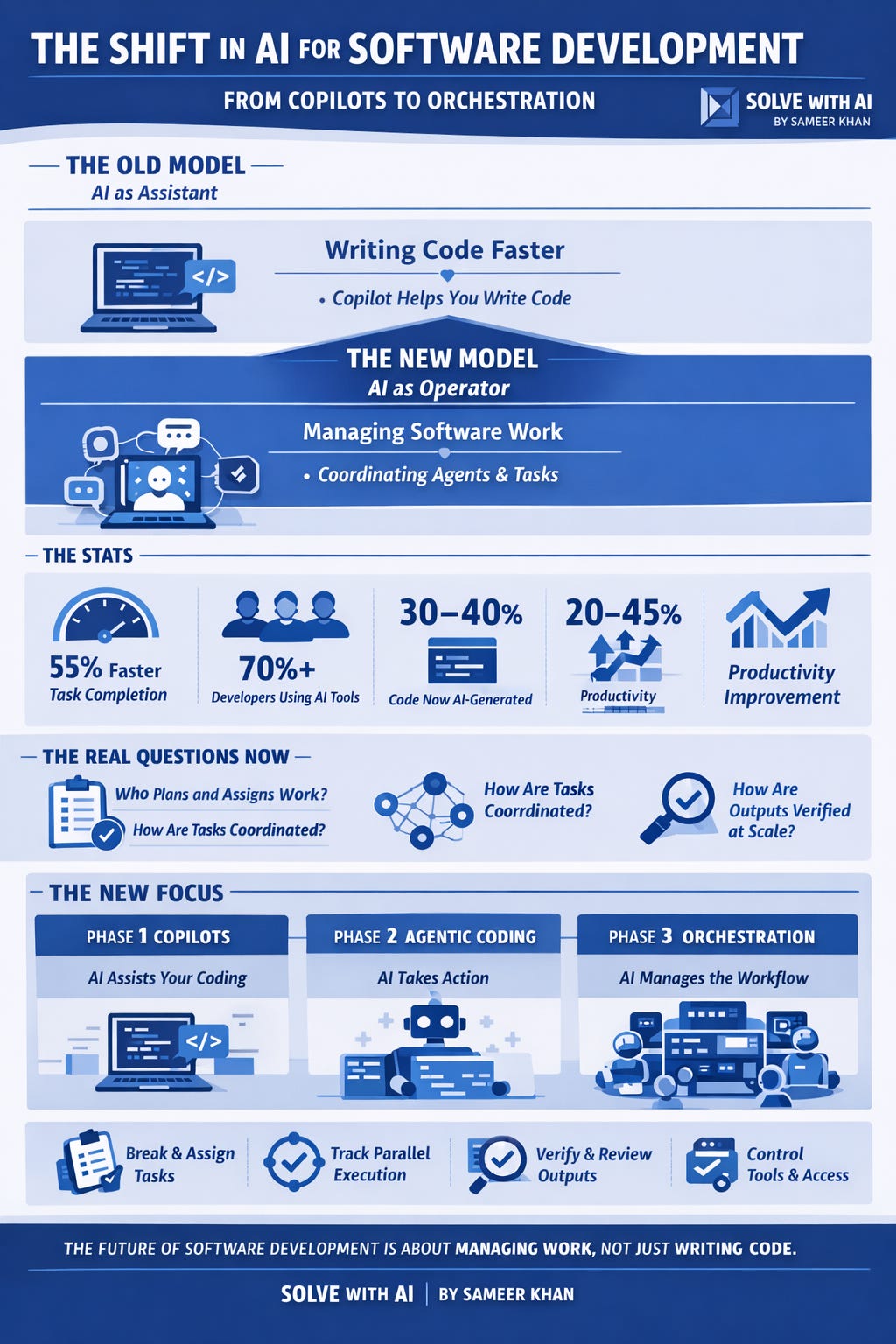
The Market Has Shifted in Three Steps
If you zoom out, the evolution of AI in software development has happened in three clear phases. Most teams are still operating in phase one.
The market has already moved to phase three.
Keep reading with a 7-day free trial
Subscribe to Intelligence Economy to keep reading this post and get 7 days of free access to the full post archives.