

The Real Risk Behind the Claude Code Incident
This wasn’t about the model. It exposed the real risk in your AI system

Hey Productivity Explorer,
When the Claude Code leak broke earlier this week, I watched the takes roll in almost in real time. “Anthropic got hacked.” “AI model exposed.” “Major security breach.” People were sharing it like the sky was falling.
You likely assumed one of three things:
Claude got hacked.
The model was exposed.
This is another AI security failure.
Reality check: None of that is true.
Anthropic has said this was a release packaging mistake, not a breach. A public npm release accidentally included a source map that exposed a large part of the Claude Code application layer, reportedly over 500,000 lines of code.
No model weights were leaked.
No customer data or credentials were exposed, based on current disclosures.
This wasn’t a model failure.
It was a basic software release failure that exposed the system around the model, and that distinction is what most people are missing.
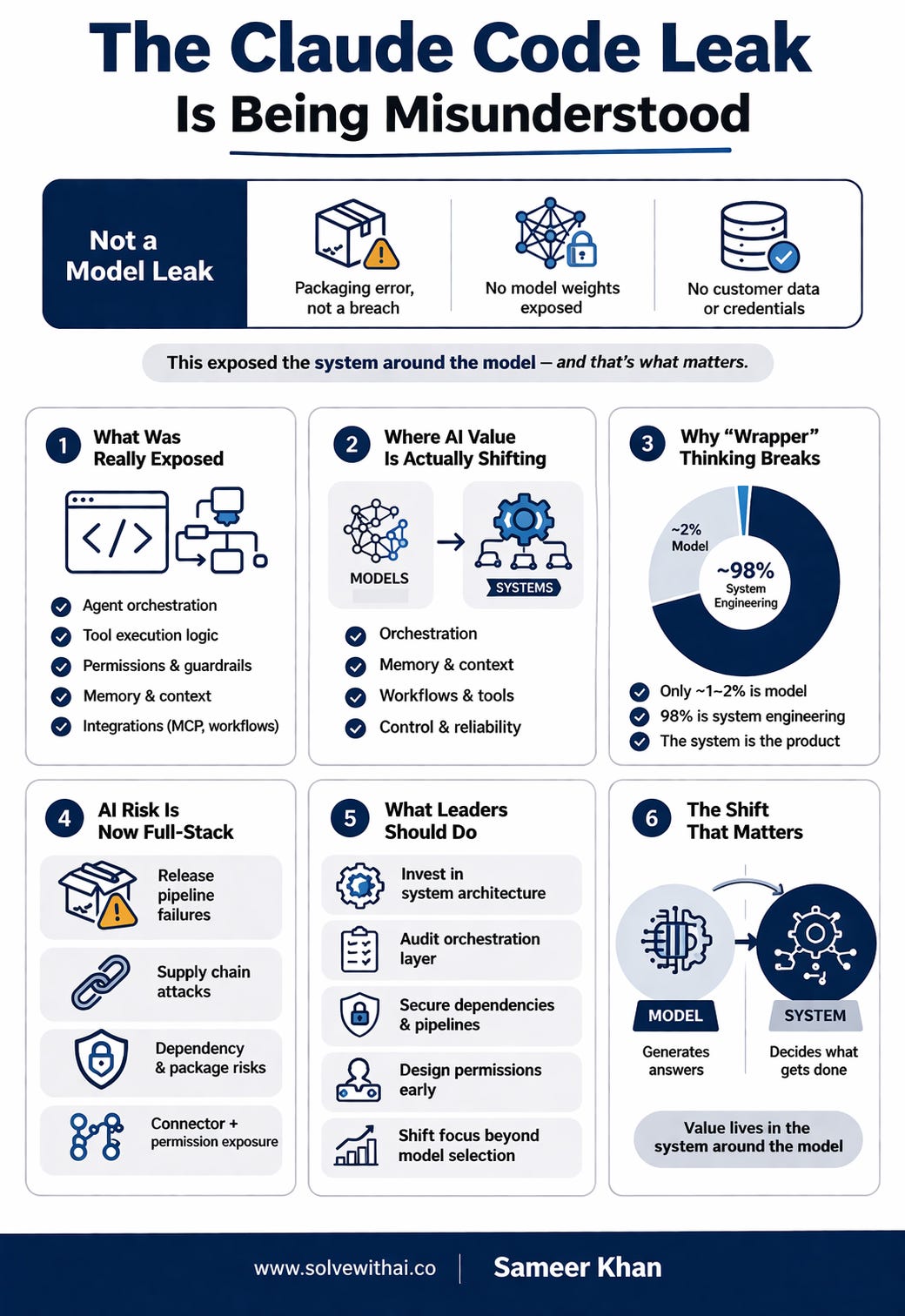
Table of Content
The leak is being misunderstood
What actually happened vs what people think
What was really exposed
The agent and system layer, not the model
Where AI value is actually shifting
From models to orchestration, memory, and workflows
Why the “wrapper” narrative breaks
The system layer is becoming the product
AI risk is now full-stack
From model risk to release, supply chain, and permissions
What leaders should do differently
Where to invest and what to fix now
What was really exposed
When you hear source code leaked, your brain probably goes straight to embarrassment and PR damage. Contained. Uncomfortable but not serious.
That framing misses everything that matters.
What got exposed was the orchestration layer. The part of Claude Code that makes it actually useful inside a real business.
Tool routing.
Permission architecture.
Memory that persists across sessions.
Hooks that fire automatically during the agent lifecycle.
Subagents that spin up, execute, and report back.
MCP integrations that connect everything into your existing stack.
Think about that for a second.
The model itself, the thing everyone obsesses over in benchmark comparisons, was never touched. What leaked was everything built around it to make it work in the real world.
That distinction matters more than most people realize. Because it tells you where the real engineering effort actually goes inside a frontier AI lab. It is not just training a smarter model. It is building the control system around the model that makes it reliable, governable, and deployable inside complex environments.
Where AI value is actually shifting
The leak did not just expose Anthropic’s code. It exposed something the market has been slow to admit.
The model is not where the value lives anymore.
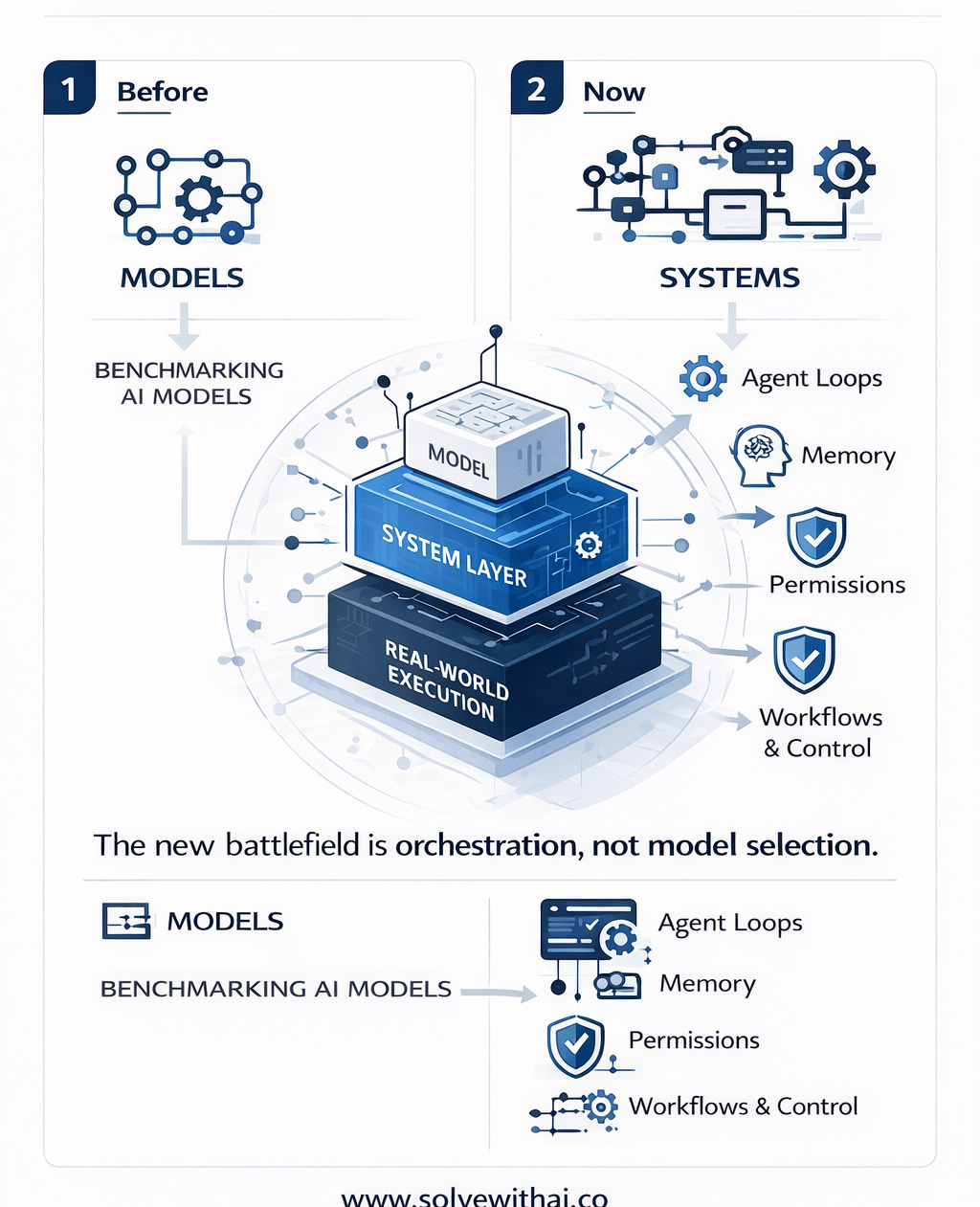
Think about how most conversations around AI tools still go inside your organization. Someone asks which model is best. Teams run benchmark comparisons. Leaders debate GPT versus Claude versus Gemini as if it were a horse race.
In fact, underneath all of that is a silent assumption that the model is the product.
This leak quietly dismantles that assumption.
What Anthropic built around Claude is not a thin convenience layer. It is an entire system. Agent loops that manage how tasks get broken down and executed. Context handling that decides what the model remembers and what it forgets.
Permission architecture that controls what the agent can and cannot touch.
Workflow logic that handles the messy, unpredictable edges of real work. That is the product's operating system.
Here is why that matters for you specifically.
Two organizations can run the exact same model and get completely different outcomes.
One gets reliable, governable, repeatable output.
The other gets chaos dressed up as capability.
The difference is rarely the model. It is the system built around it.
That is where enterprise value is concentrating right now. Not in who has access to the best model, because access is becoming a commodity. But in terms of who has built the better orchestration layer around it.
The leaders still debating model selection as their primary AI decision are looking at the wrong layer entirely. The real competition has already moved one level up.
Why the “wrapper” narrative breaks
You have probably heard it, and maybe you have even said it. Most AI products are just wrappers.
The implication being that if you strip away the branding, there is nothing underneath worth paying for. The model is the whole product, and everyone else is just reselling access to it with a nicer interface.
This leak makes that position very hard to defend.
Here is what engineers actually found inside when they dug into the code. Only about 1.6% of the leaked code directly involves the AI model itself. The rest is engineering: context management, multi-agent coordination, memory systems, tool orchestration, and permission handling.
Read that again. 1.6% is the model. Everything else is the system built around it.
The scale of that system is not trivial. The tool system uses a plugin architecture in which each capability, from file reading to Bash execution, is a discrete, permission-gated module.
Its base definition alone accounts for 29,000 lines of TypeScript. The largest single module is the query engine at 46,000 lines, handling all LLM calls, streaming, caching, and orchestration.
The leak revealed that Claude Code is not just a wrapper around a Large Language Model, but a complex, multi-threaded operating system for software engineering.
When something that sophisticated gets exposed, competitors pay attention. Not because they wanted to see Anthropic embarrassed, but because what was inside was genuinely valuable and genuinely hard to build.
Here is the uncomfortable truth for anyone still using the wrapper label. The products being built on top of frontier models are getting thicker, not thinner. The orchestration layer is expanding.
The permission and memory systems are becoming more sophisticated with every release cycle.
Five context compaction strategies, 14 cache-break vectors, 23 security checks on bash commands, and three subagent execution models. That kind of engineering depth does not happen by accident, and it does not get replicated overnight.
Enterprise buyers are not paying for raw model access. They are paying for trustworthy execution, reliable output, auditable decisions, and controllable autonomy. None of that lives in the model. It lives in everything built around it.
The wrapper was never just a wrapper. It was always the product.
AI risk is now full-stack
Within hours of the leak going public, something predictable happened. Threat actors moved fast.
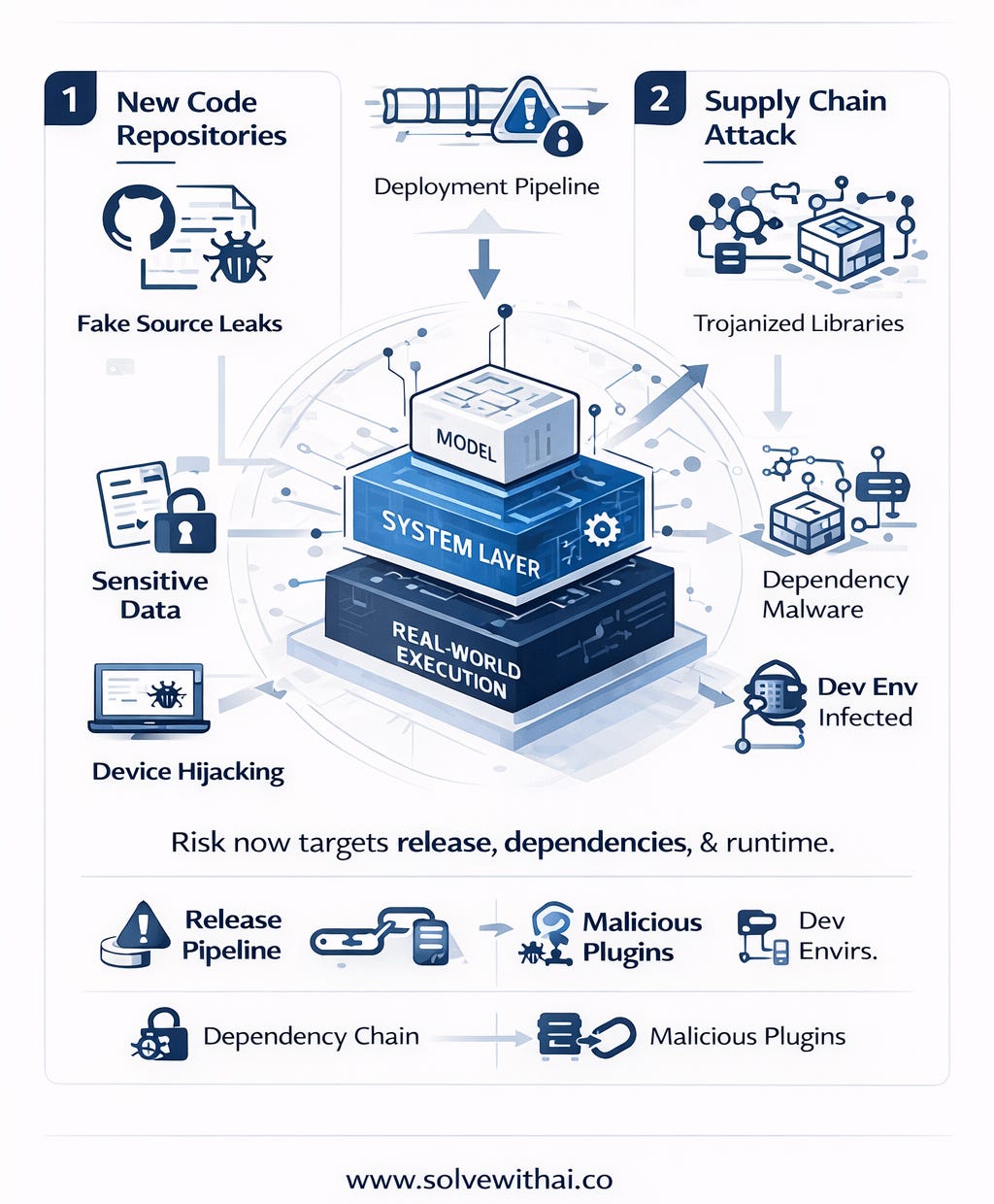
Zscaler’s ThreatLabz researchers found a malicious GitHub repository disguised as a leaked TypeScript source code for Claude Code, claiming to offer unlocked enterprise features and no usage restrictions.
The README file replicated the exact language researchers were using to describe the real leak. It looked legitimate. People downloaded it.
Inside was something far worse than leaked code. The malicious archive contained a dropper that silently installed two pieces of malware on your machine.
One stole your sensitive data.
The other hijacked your device entirely, turning it into a tool criminals could route their own attacks through without you ever knowing.
That happened within hours. Not days. Hours.
GitHub immediately disabled over 8,100 repositories within hours. But the code had already spread. Every fork was a potential delivery vehicle. Every curious developer downloading an unofficial copy was a potential target.
But here is the part most commentary skipped entirely.
A concurrent, separate supply chain attack on the axios npm package occurred hours before the leak itself.
Anyone who installed or updated Claude Code via npm on March 31 between 00:21 and 03:29 UTC may have pulled in a malicious version containing a Remote Access Trojan. Two completely separate incidents, colliding on the same morning, on the same platform, targeting the same users.
Think about what that morning looked like inside any organization running Claude Code. Your developers are updating a routine package. Two different attack vectors are live simultaneously. One is a trojanized dependency hiding inside a legitimate update. The other is a flood of fake repositories that look credible enough to fool people who know what they are looking for.
This is what modern AI risk actually looks like.
It is not a rogue model hallucinating in a board presentation. It is your release pipeline. Your dependency chain. Your developers are downloading what looks like an official repository because it appeared at the top of a Google search.
The real lesson is not to panic. It is that you cannot keep a lax runtime posture just because today’s headline was about source disclosure rather than direct compromise.
The risk surface of AI products is expanding fast.
You are no longer just governing what the model says.
You are governing everything around it, the packages it depends on, the connectors it integrates with, the repositories your team pulls from when something interesting leaks on a Tuesday morning.
What leaders should do differently?
The wrong response is to panic about frontier models or spend the next quarter debating which AI vendor to trust.
The right response is to look honestly at where your priorities are today and ask whether they match what this incident just revealed.
The leak showed you where the real engineering depth lives. It is not in the model. It is in everything around it. Which means if your AI strategy stops at model selection, you are building on a foundation that is missing most of the structure.
Here is what that means practically for you right now.
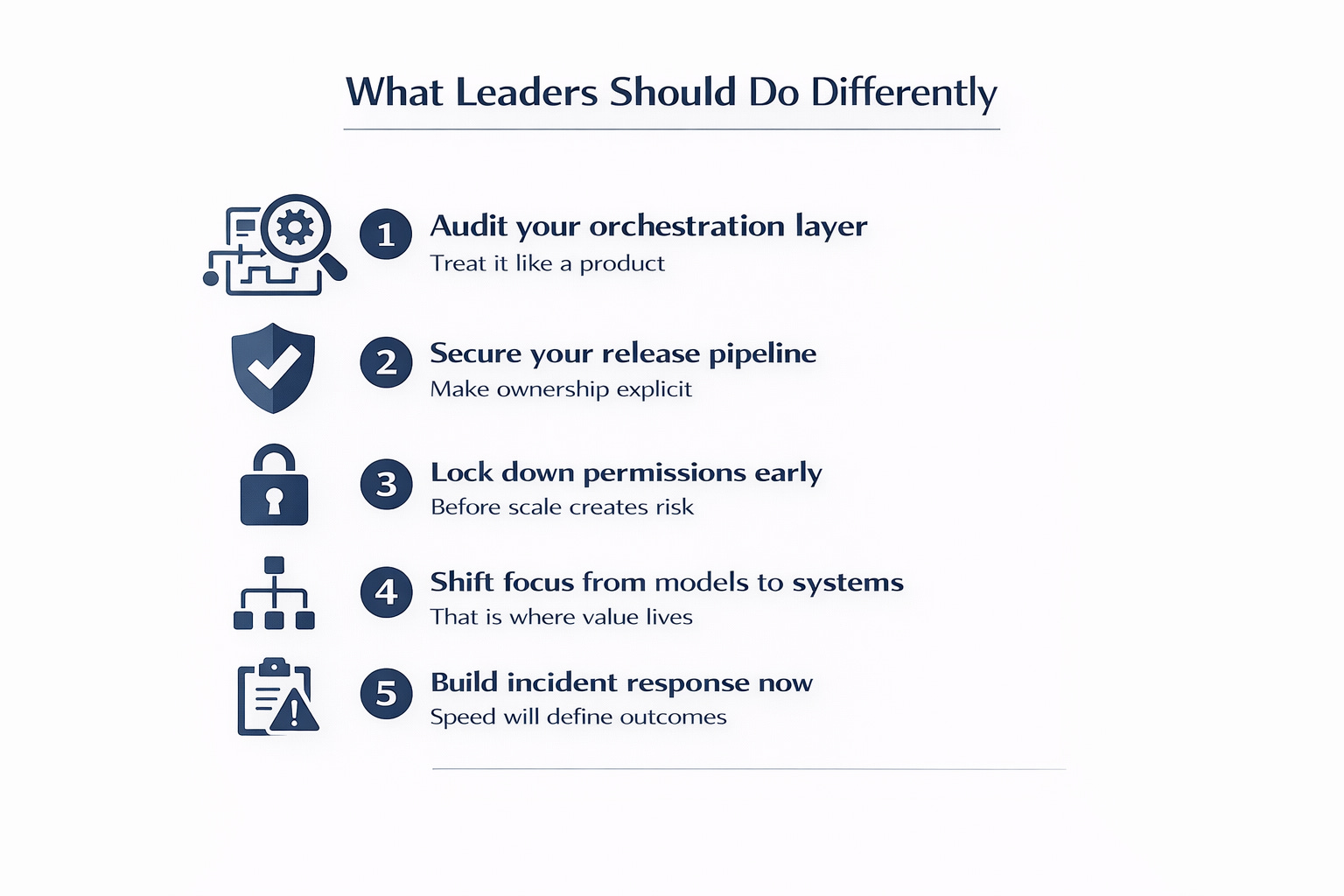
Step 1. Audit your orchestration layer like a product, not a side project.
Map out every workflow, permission control, memory system, and tool integration your AI agents touch today.
If you cannot describe how your agents make decisions and what guardrails exist around those decisions, that is your first gap.
This is where your competitive advantage either compounds or collapses, and most organizations have not even started designing it deliberately.
Step 2. Treat your release pipeline and dependency chain as critical infrastructure.
A single misconfigured field in package.json can expose an entire proprietary codebase to the public. If that is true for Anthropic with a reported $19 billion annualized revenue run rate, it is true for your team.
Audit your .npmignore files, your package configurations, and your build pipeline controls. Assign clear ownership. Make it someone’s job to catch this before it ships.
Step 3. Lock down your connector and permission architecture before your agent footprint grows.
As AI tools gain deeper access to codebases, filesystems, and external APIs, the consequences of downtime, rate limits, model deprecations, or unexpected incidents become more severe.
Every new integration your agent touches is a new surface area. Define what your agents can and cannot access, and design those boundaries now. Redesigning them after something goes wrong is significantly more expensive.
Step 4. Stop letting model selection dominate your AI investment conversations.
The next time your team sits down to evaluate AI tools, shift the first question from “which model is best” to “what is the system we are building around it.”
Benchmark comparisons are useful, but they are looking at 1.6% of where the value actually lives. The other 98.4% is the system your team designs, governs, and iterates on.
Step 5. Build your incident response muscle before you need it.
The Claude Code situation went from a routine npm release to active malware campaigns in hours. That speed is not going away. The organizations that handled it well already had clear ownership, clear processes, and clear communication lines before anything happened.
Run a tabletop exercise.
Decide today who owns AI-related incidents in your organization, what the escalation path looks like, and how fast you can respond.
Talk soon,
Sameer Khan
Creator of Solve with AI.