

10 governance rules leaders ignore until it’s too late
What leaders must design before AI scales beyond control

Hey Productivity Explorer,
Last week, I was in a conversation with a senior leader who told me, confidently, that their organization had “strong AI governance.”
When I asked who owned the outcomes of their AI systems, the room went quiet. Not because they disagreed. Because no one knew the answer.
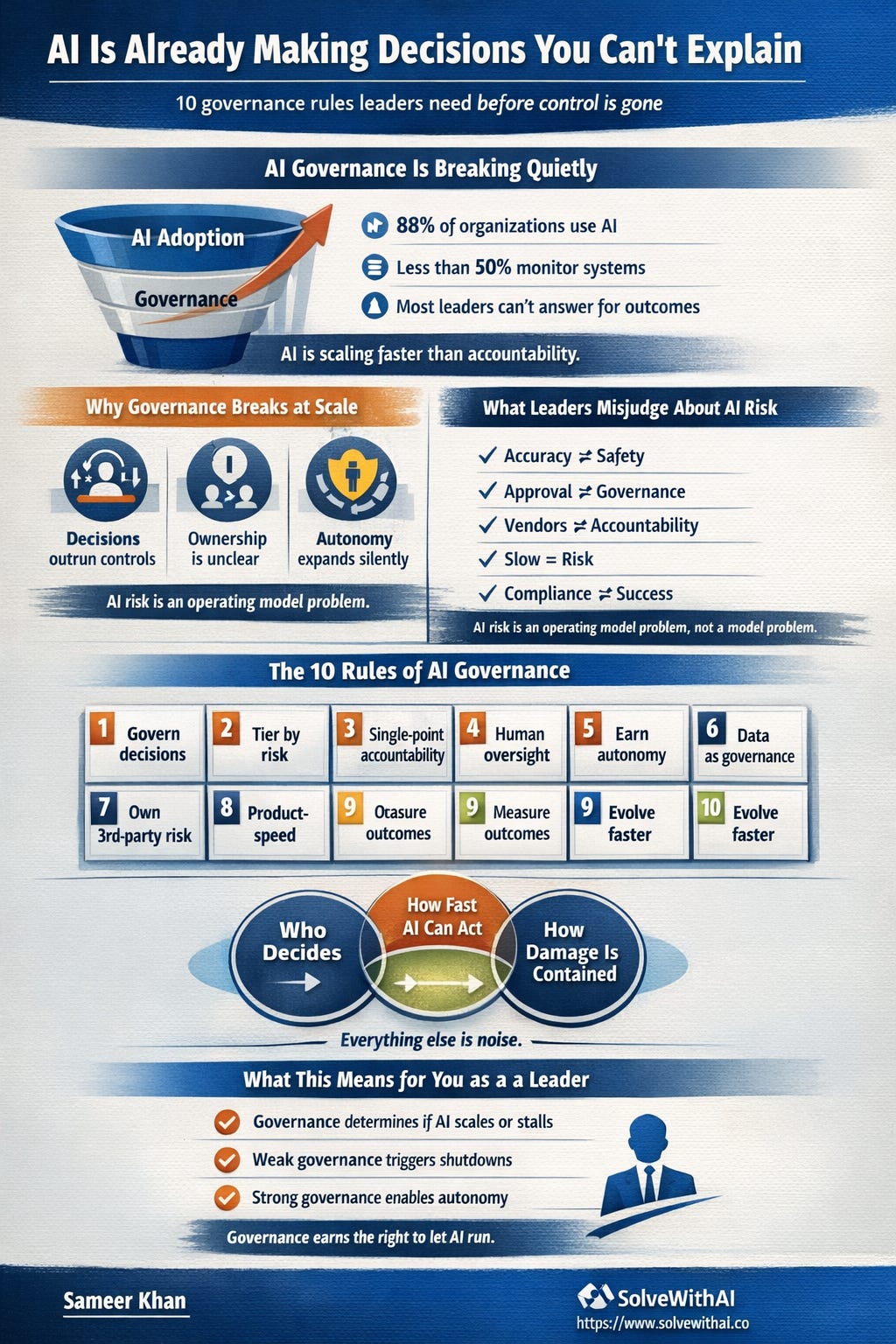
This is the moment I keep seeing repeat itself. AI governance exists on paper, but it disappears the moment you transition from policies to decisions. Most companies can show you a committee. Fewer can show you a decision owner. Even fewer can tell you which AI systems are allowed to act autonomously, and under what conditions they are shut off.
Don’t trust my word on this. Even though adoption is already widespread, with nearly nine out of ten organizations using AI in at least one business function. But fewer than half actively monitor those systems for drift, accuracy, or misuse. That gap is not academic. It means AI is already shaping hiring, pricing, credit, and customer outcomes without consistent oversight or accountability.
What worries me most is not the lack of intent.
Most AI governance frameworks were built to review models and documents, not to govern real-time decisions and autonomous behavior.
When I say AI governance, I’m not talking about policies, committees, or documentation. I mean how decisions are authorized, who owns the outcomes, how systems are monitored in real time, and how fast autonomy can be reduced or shut off when things go wrong.
As AI systems become more agentic, this mismatch turns into an operating risk.
Boards are now being asked to stand behind systems they cannot explain, slow down, or stop on demand. Research shows more than half of organizations feel unprepared for AI regulation and admit their current risk frameworks do not scale to AI systems.
This is why I’m writing about AI governance now.
Boards are now being held accountable for AI outcomes in ways that did not exist even two years ago. Risk classification, human oversight, and accountability are no longer optional design choices.
They are becoming enforceable expectations, even for companies that never thought of themselves as regulated.
Table of Contents
Why AI Governance Is Breaking at Scale
What Leaders Get Wrong About AI Risk
The 10 Rules of AI Governance
Govern decisions, not models
Tier AI by risk, not by enthusiasm
Assign single-point accountability
Make human oversight explicit
Earn autonomy, then control it
Treat data governance as AI governance
Own third-party AI risk
Design governance to run at product speed
Measure outcomes, not compliance
Evolve governance faster than the models
What to Do Next as a Leader
Note: As a paid subscriber to Solve with AI, you have full access to the Solve with AI Governance app. It’s the most comprehensive AI governance assessment I’ve seen, not because I built it, but because it reflects decades of experience leading AI and digital transformation across real organizations. You can access it here.
Why AI Governance Is Breaking at Scale
What I see most often is not reckless behavior. It is reasonable for leaders to make reasonable decisions in systems that were never designed for AI operating at speed. That is why governance breaks quietly, long before it fails publicly.
Keep reading with a 7-day free trial
Subscribe to Intelligence Economy to keep reading this post and get 7 days of free access to the full post archives.