

I Audited 20 AI Use Cases. Only 3 Were Worth Automating
The BUILD-$100M framework I run before I approve a single AI project.

Hey Productivity Explorer,
Over the past year, working across multiple AI engagements, I have audited dozens of opportunities.
Some of them sounded exciting. Two had already quietly burned through the budget before anyone asked what they were for.
So I did what I always do. I ran every single one through the same process, and by the end, something uncomfortable became obvious.
Only three were worth building right now.
The rest got staged, parked, or killed.
The problem was never the technology, the models, or the tools. The problem lived in the business case underneath each idea, and almost none of them had one that held up.
I realize this is not my problem but a general one you may be facing as well: at any given time, we float twenty ideas and have no honest way to choose among them.
That is exactly what this framework fixes. It is called BUILD-$100M, and every idea has to survive two gates before it earns a dollar. First, prove it matters, and then, prove you can actually deliver it.
Let me show you how it works, and what happened when I pointed it at all twenty.
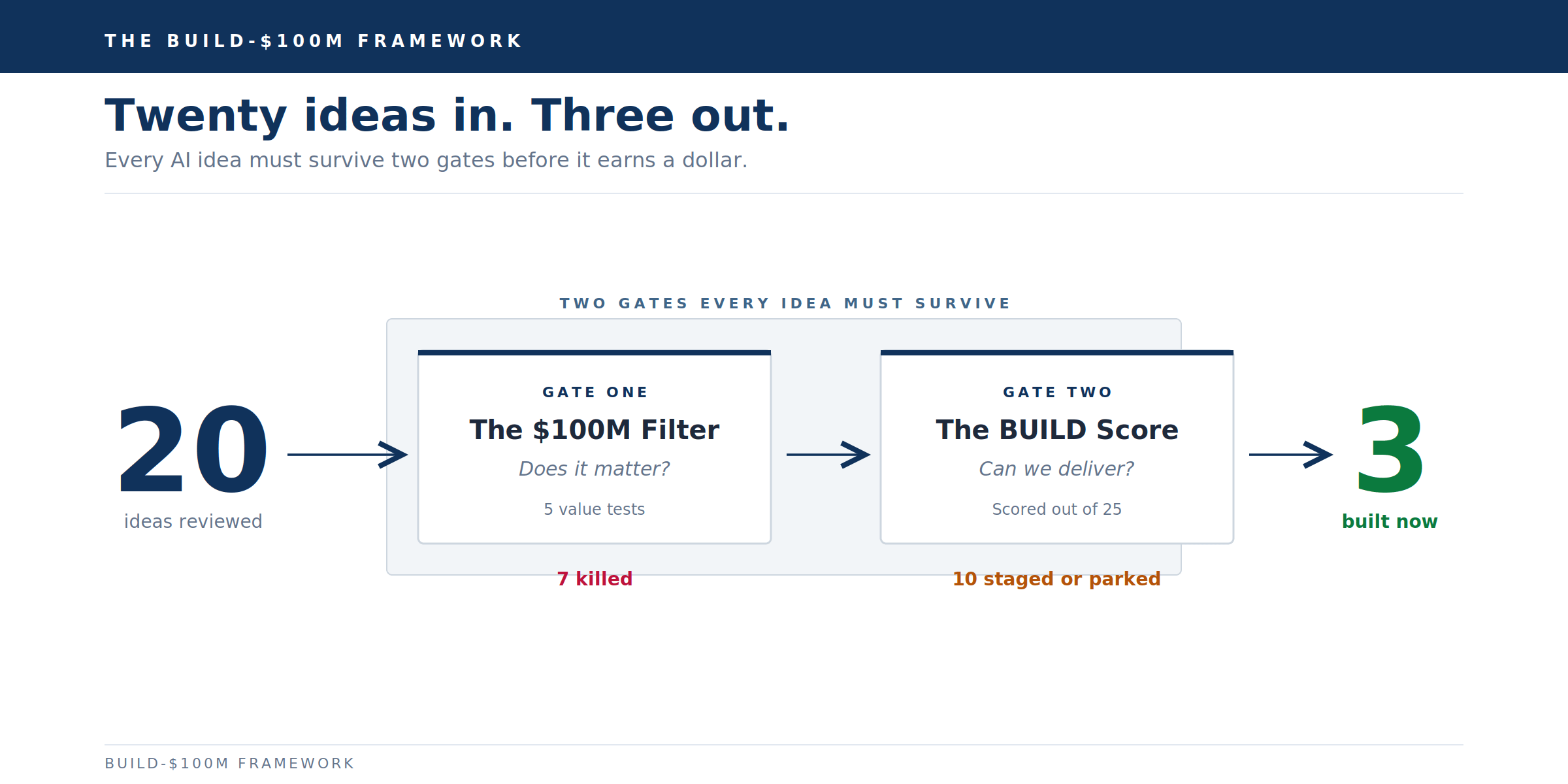
TABLE OF CONTENTS
Why Most AI Projects Fail Before They Ship
Gate 1: The $100M Filter
Gate 2: The BUILD Score
What Happened Across All 20
The Three Winners
The AI Theater Trap
What I Would Do If I Were Starting Today
Why most AI projects die before they ship
Walk into almost any company right now, and I will challenge that you will trip over AI ideas.
Chatbots (many)
Agents pile
Copilot experiments that three people are tinkering with on the side.
Internal assistant nobody has opened in a month.
Everyone has ideas, but almost nobody has measurable value.
The data backs this up in a way that should make every leader stop and breathe. MIT’s 2025 GenAI Divide study examined 300 deployments and found that 95 percent of enterprise generative AI pilots delivered no measurable impact on the bottom line. Only 5 percent created real value.
We are in 2026, and that’s still a big gap.
The researchers were clear that the failures were not caused by weak technology. They were caused by either one or a combination of the following:
Weak execution
Nobody owned the workflow
Nobody planned for adoption
The data was not ready
The value was never defined in the first place
They even found that most budgets were aimed at flashy sales and marketing tools, while the biggest returns were quietly sitting in unglamorous back-office automation.
Gartner saw the same wave coming and put a date on it. They predict more than 40 percent of agentic AI projects will be scrapped by the end of 2027, mostly because of unclear business value and runaway cost.
So the failure does not happen in production. It happens far earlier, before anyone writes a single prompt. It happens at the moment of approval, when a good sounding idea gets a green light it never earned.
Which is exactly why every opportunity has to clear two gates before it goes anywhere.
Gate 1: The $100M Filter
The first gate answers one ruthless question. Does this even matter?
I wrote an entire post on this topic.
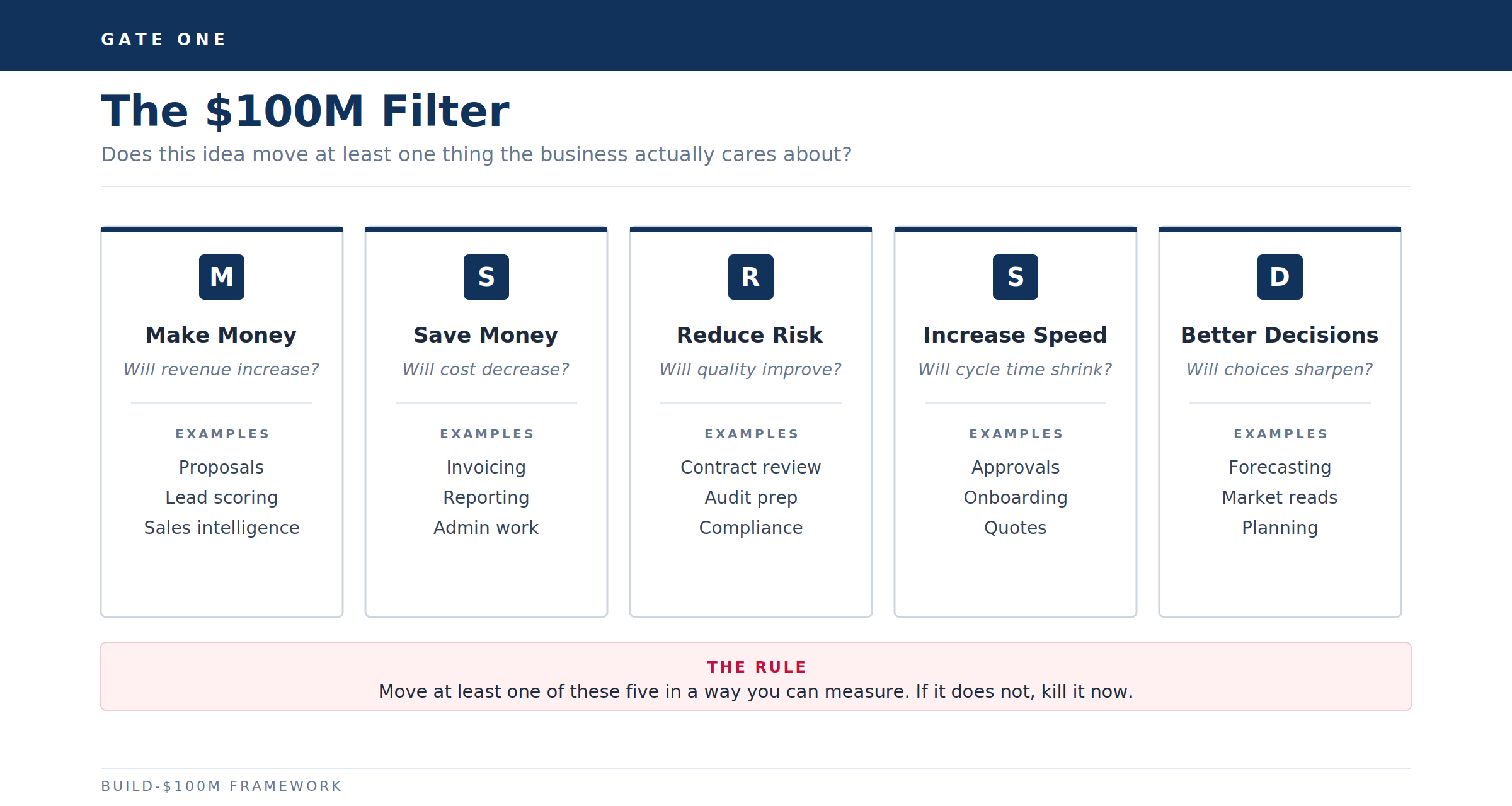
Does it move something the business actually cares about? The $100M Filter forces every idea to justify why it deserves to exist, and it measures that across five kinds of value.
Does the idea make money by lifting revenue through something like proposal generation, lead qualification, or sales intelligence?
Does it save money by stripping cost out of reporting, invoicing, or the manual admin work that quietly eats payroll?
Does it reduce risk by tightening compliance and quality in areas such as contract review and audit prep?
Does it increase speed by collapsing a cycle time the customer actually feels, like approvals, onboarding, or quote turnaround?
Or does it improve decisions by making forecasting and market intelligence genuinely sharper?
Notice that this is not just my opinion. It is almost word for word how Gartner now tells companies to choose. Their analyst said it plainly: real value comes from applying AI where it drives measurable improvements in cost, speed, quality, or scalability.
The rule at this gate is brutal on purpose. If an idea does not move at least one of those five in a way you can measure, it does not pass. You kill it before it costs you anything more than the meeting you are sitting in.
Gate 2: The BUILD Score
Surviving the first gate only proves an idea is worth wanting.
It does not prove you can pull it off.
This is where most ideas quietly fall apart. The value is real, but the path to capturing it runs straight through messy data, a nervous team, and a workflow nobody actually owns. So the second gate stops asking “should we” and starts asking “can we, realistically.”
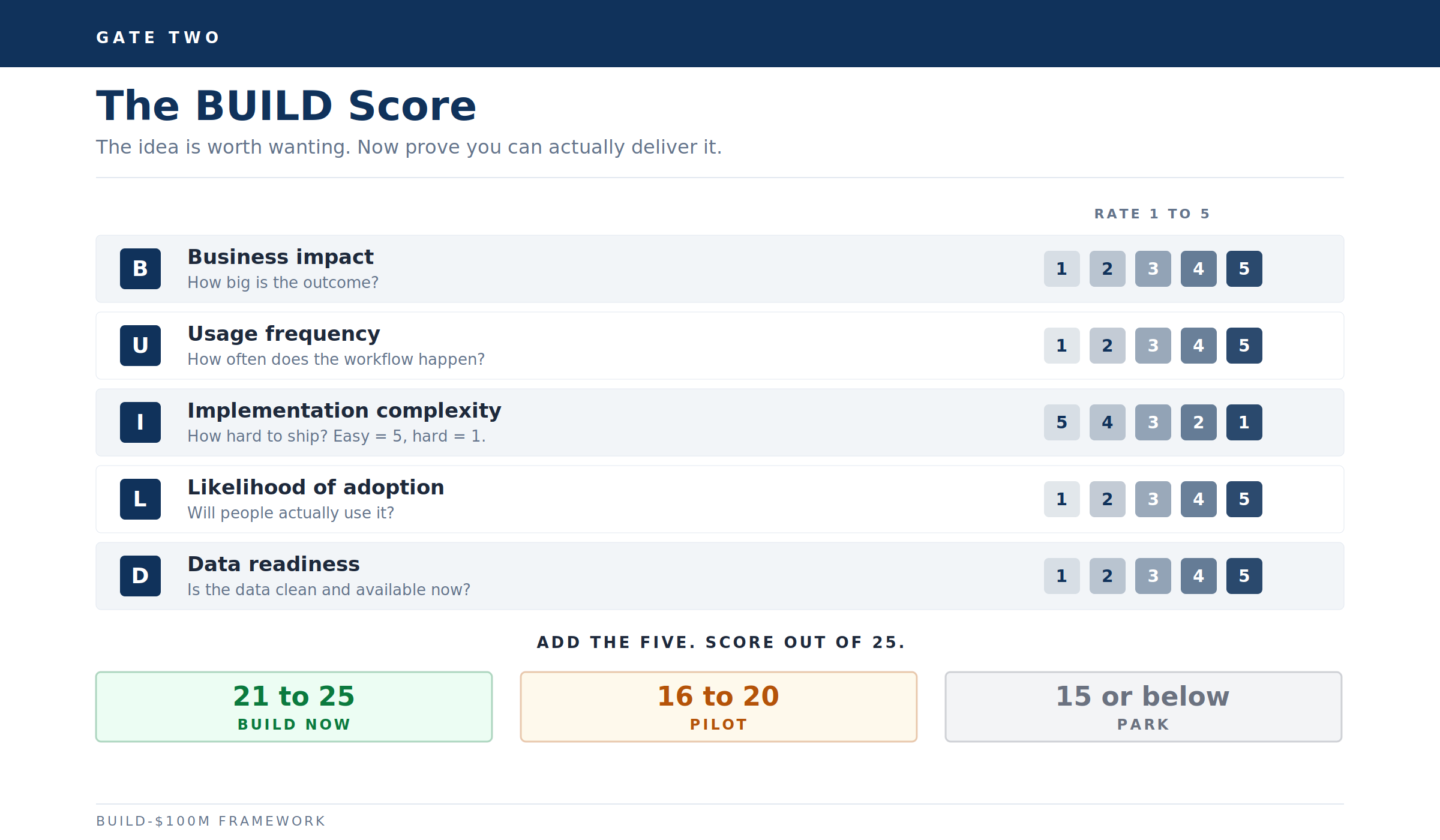
The BUILD Score rates each surviving idea across five dimensions, with one to five points each.
Business impact asks how big the outcome really is.
Usage frequency asks how often the workflow actually happens, because a brilliant tool used twice a year is a hobby, not an investment.
Implementation complexity asks how hard this is to ship, and here is the twist: you score it in reverse, so easy earns a five and painful earns a one.
Likelihood of adoption asks whether your people will genuinely use it once the novelty wears off.
Data readiness asks whether the information the system needs is already sitting there, clean and available, today.
Add the five together, and you get a score out of 25. Anything from 21 to 25 is a build now. Sixteen to 20 earns a pilot, a small controlled test before you commit real money. Fifteen or below gets parked, no matter how much you happen to like it.
Does it matter, and can we deliver? That is the entire engine.
What happened across all 20
So I lined up all twenty ideas and ran them through both gates, in order, no exceptions.
Here is the honest scorecard.
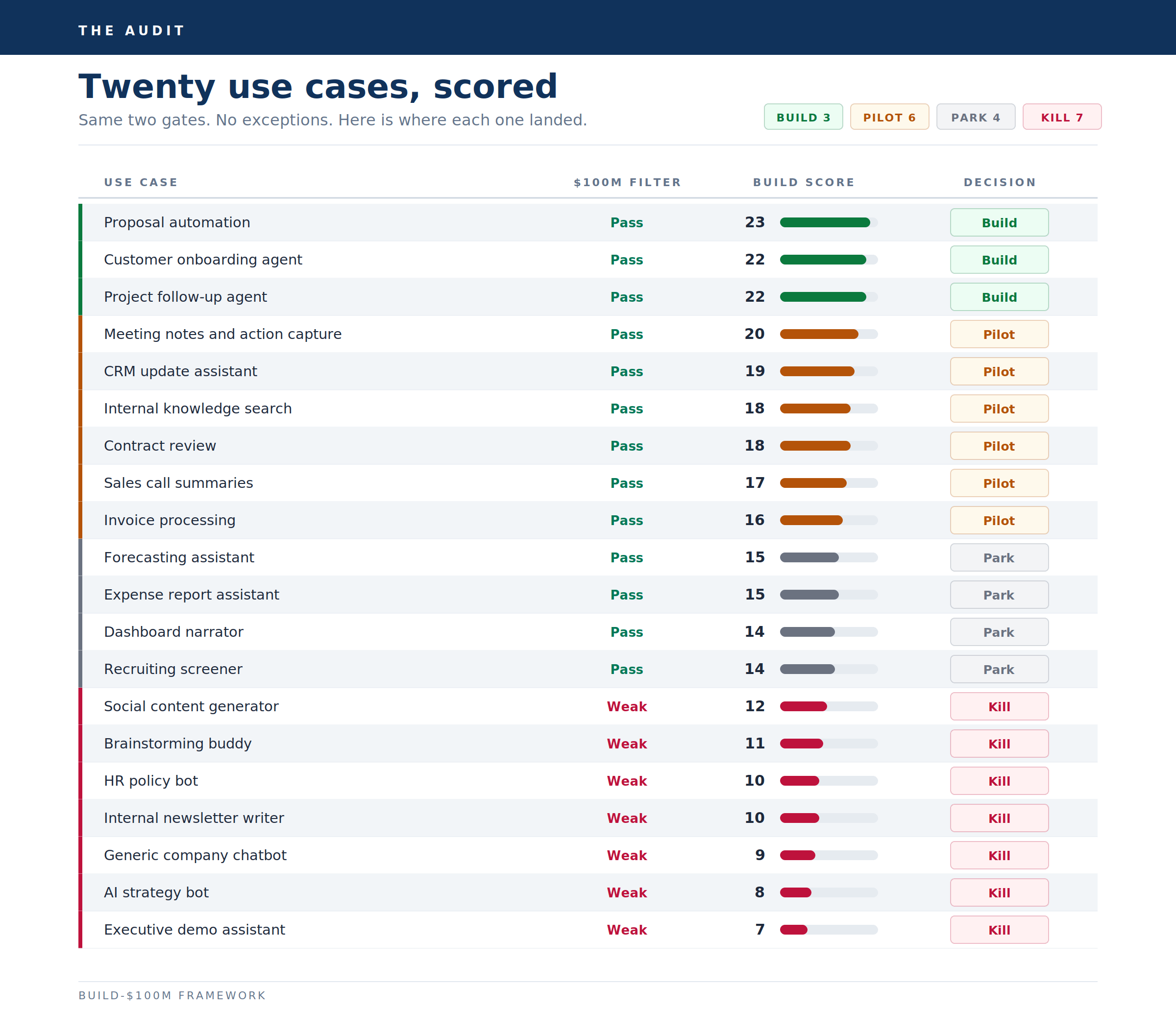
Now look at what that table is really telling you.
The interesting result was not which ideas scored high. Three of them did, and I will get to those in a second. The interesting result was how many scored low the moment I stopped grading them on vibes and started grading them on value and feasibility.
Generic chatbots. An “AI strategy” assistant. An HR policy bot. A social content generator. On a slide, every one of them looks like progress. Run them through the gates, and they fall apart, because they either fail to move a number anyone cares about, or they have no real shot at adoption once the demo is over.
That is the whole point of a framework. It is allowed to disagree with the room.
The three winners
Three ideas cleared both gates with room to spare. They are worth studying closely because they share a pattern you can copy onto your own list.
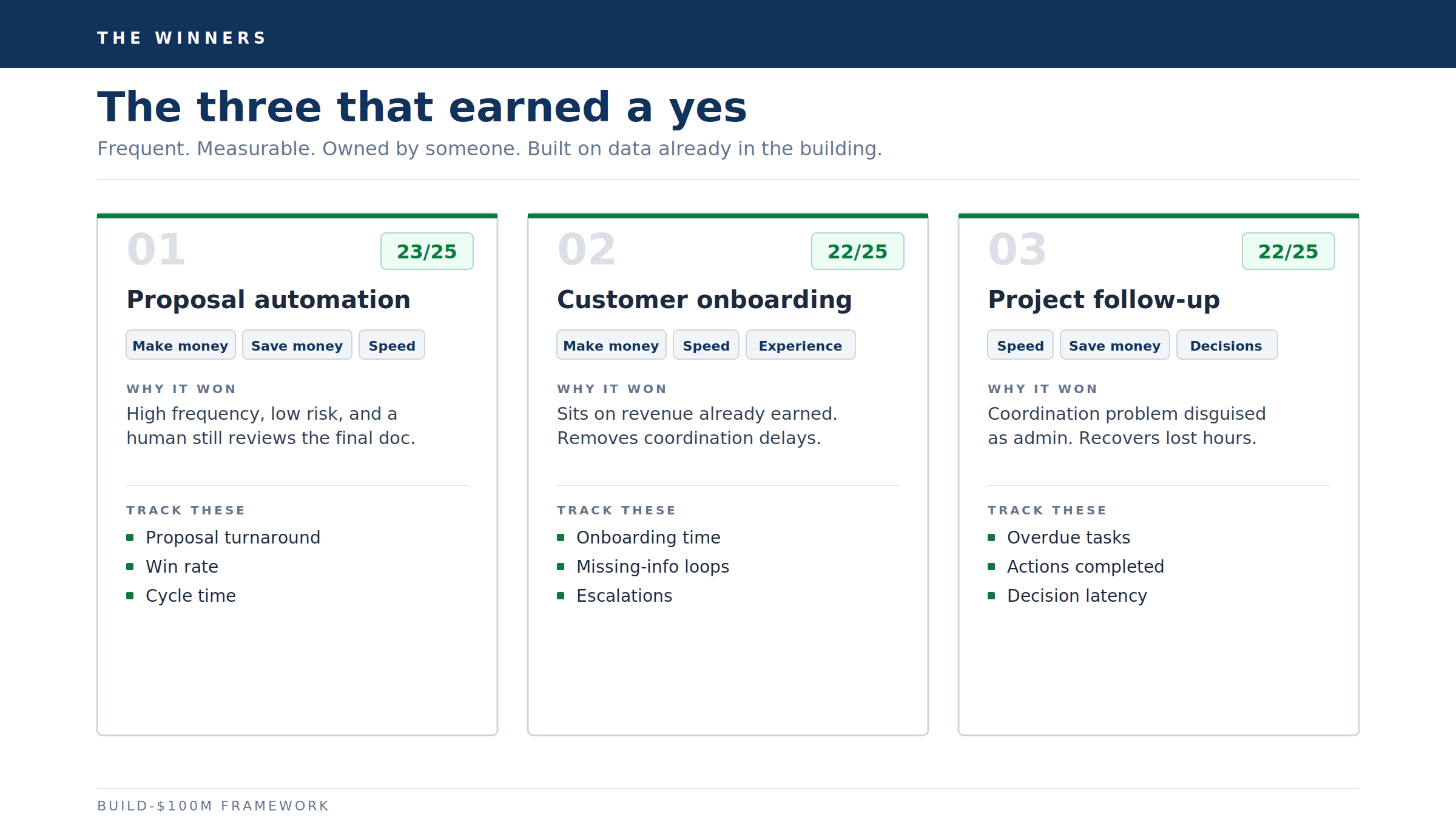
The first was proposal automation, and it scored the highest of everything on the list. It is easy to see why, because it hits three kinds of value at once.
It makes money by lifting win rates, it saves money by killing hours of manual drafting, and it increases speed by shrinking turnaround from days to minutes.
The workflow happens constantly, the risk is low, and a human still reviews the final document before it ever reaches a client. You measure it with proposal turnaround time, win rate, and cycle time, and the needle moves fast enough that people believe in it.
The second was a customer onboarding agent. This one wins because it sits directly on top of revenue you have already earned but not yet realized. Every day a new customer waits is a day of value leaking out and a quiet chance for them to wonder if they made a mistake choosing you.
The agent removes the coordination delays, chases the missing information, and keeps the handoffs from falling through the cracks. Track onboarding time, the number of missing information loops, and escalations, and you will watch it earn its keep.
The third one surprised a few people in the room. A project follow-up agent. On the surface, it looks like boring admin. Underneath, it is solving a coordination problem that quietly bleeds every company alive.
Think about it for a second.
How many decisions get made in a meeting and then simply evaporate?
How many follow-ups get forgotten?
How much of your week disappears into chasing status updates that should have updated themselves?
Measure overdue tasks, the percentage of meeting actions actually completed, how long a decision takes to turn into movement, and how the case makes itself.
Notice the common thread. None of these are flashy. All three are frequent, measurable, owned by someone, and built on data the company already has. That is what a winner actually looks like, and it rarely looks like the thing that gets applause in the demo.
The AI theater trap
Now let me warn you about the most expensive mistake in this entire space.
A lot of AI projects get funded not because they create value, but because they look intelligent.
The slick assistant was built mostly to impress the board. I call this AI theater, and it is seductive precisely because it photographs beautifully. It just does not do anything.
These projects almost always score badly at the second gate. Adoption is low because nobody actually needs them. Ownership is fuzzy because they were never tied to a real workflow. Measurement is impossible because there was never a number they were supposed to move in the first place.
Here is the line I want you to carry out of this article.
The most dangerous AI projects are not the ones that fail loudly. They are the ones that look successful while creating no measurable value at all. They survive review after review, soak up budget and attention, and quietly become the reason your real opportunities never get funded.
What I would do if I were starting today
So picture this. You have Microsoft Copilot, Claude, ChatGPT, and Copilot Studio all sitting in front of you.
What would I do? Honestly, it is almost embarrassingly simple.
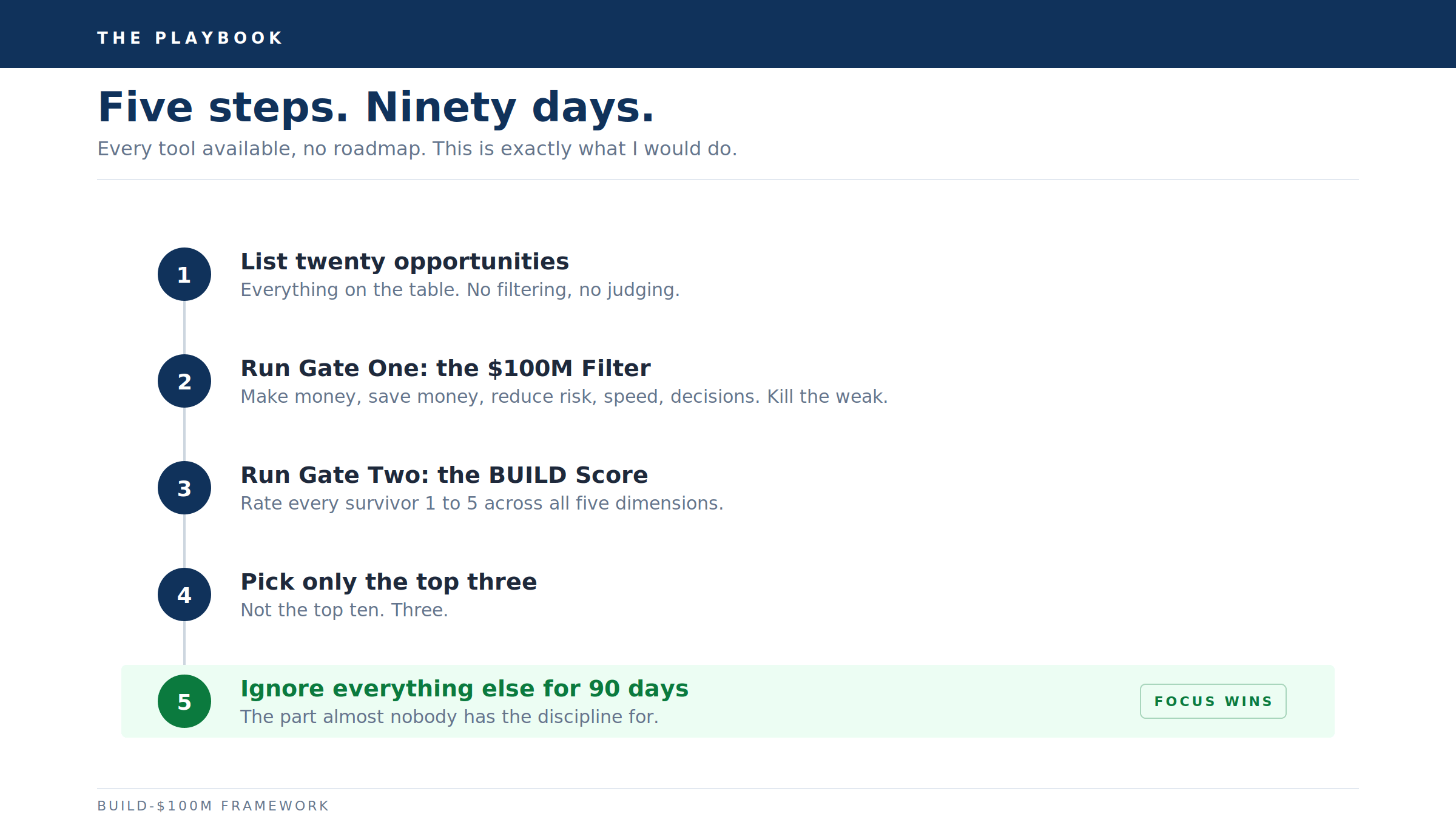
I would start by writing down twenty opportunities. No filtering, no judging, just everything currently on the table. Then I would run all twenty through the $100M Filter and accept that a good chunk of them die right there.
The survivors earn a BUILD Score, one to five across all five dimensions. From whatever is left standing, I pick the top three. That’s It.
And then comes the part almost nobody has the stomach for. I ignore everything else for ninety days.
That last step is the entire secret.
Remember the MIT finding that focused, well-integrated solutions succeeded far more often than effort spread thin across a dozen half-built experiments?
Focus is not the boring choice here. It is the winning one.
The real bottleneck
Most leaders think their problem is AI adoption.
Their problem is AI prioritization.
The companies that win in the next three years will not be the ones running the most pilots or making the most noise on LinkedIn. They will be the ones who found the handful of workflows where AI creates real, measurable value, and then executed on those few with everything they had.
Every idea you consider deserves the same two questions.
Does it matter?
Can you deliver it?
That is the BUILD-$100M framework in a single breath.
I pointed it at twenty opportunities. It handed me three.
Your list is probably no different. The only real question is whether you have the discipline to say “not yet” to the other seventeen.
Talk soon,
Sameer Khan
Creator of Solve with AI.