


Hey Transformation Leader,
This week, I was going to cover the Lens 5: License to Build of the Intelligence Economy series. However, I came across a post the day before yesterday that claimed we only have 800 days left for the intelligence worker.
First, I thought it was a clickbait like many so called AI doom and gloom narratives. Unfortunately, most of them come from popular social media names. But when I started looking behind the facade, it became clear that I had to investigate and write about it because it can have severe implications for humanity and organizations.
The originator of the post is none other than Emad Mostaque, who is the founder of Stability AI, a former macro hedge fund manager, and the author of a new book called The Last Economy.
He has claimed that in the next 800 to 1,000 days, any task that can be done with a keyboard, a video, and a mouse will have its economic value slide toward zero. Cognitive labor, in his framing, is entering a terminal phase. The age of the knowledge worker is ending on a schedule you can count down to.
When I did research, I also found that somehow people are connecting with this number. Not just ordinary people, but company leaders as well.
It’s being cited in board discussions and, in some cases, informing AI investment decisions at companies that should know better.
Now, the issue is not that Emad is wrong. The dangerous part is that he’s only half right. Unfortunately, the half he gets wrong is exactly the half that matters most for organizations whose operations are built on the physical world.
So I want to do something that rarely happens in AI discourse: take a serious argument seriously, give it the credit it deserves, and then show precisely where it breaks down with a competing framework built from the inside of a physical economy operation.
If you are a leader looking to invest in AI, this is the analysis you need before your next planning cycle.
Table of Contents
The Claim That’s Filling Boardrooms
What Emad Is Actually Arguing
What He Gets Right
The Constraint Stack: Where His Model Breaks
The Operating Model Collision
Executive Recommendations
The One Question to Ask Before Your Next Planning Cycle
What Emad Is Actually Arguing
Let me give Emad the fair hearing his actual argument deserves.
His framework is built on what he calls the Intelligence Inversion, which is the fourth great inversion in the history of economic value. He is combining four eras based on the shift of the scarce and valuable asset.
The first was land.
For most of human history, power meant controlling territory or regions (think Age of Empires or colonization). Wealth was measured in acres, floodplains, and the ability to tax what moved across your borders.
Then it was labor.
Industrialization made human labor the primary economic asset because factories needed large numbers of workers to operate. The workers organized, and most of the social contracts created during the twentieth century were built around the assumption that human labor was important and difficult to replace.
The third was capital.
The software economy changed the relationship between physical assets and value. A small team with code and distribution could create something that previously required factories and thousands of employees, so owning the physical assets was apparently no longer the only way to create large amounts of value.
The fourth is intelligence.
This is where the 800 day argument started making more sense to me.
His thesis is that AI is doing to cognitive labor what factories did to craft labor. Intelligence that was previously locked inside the human brain can now be copied, scaled and amplified at a very low extra cost. His exact argument is that the cost of intelligence is moving closer to the cost of electricity and access to the model.
So when he talks about 800 days, his focus is not on technology, but he is making an economic argument about price and what happens when something that was previously scarce begins becoming abundant and much cheaper.
I want to be clear that we should not judge his argument only on whether the technology arrives exactly within 800 days.
He then describes something called the abundance trap.
Our economic system is built on the assumption that human labor and intelligence are scarce and it was designed to allocate both based on that assumption.
So, in theory, if intelligence becomes abundant, the same system may interpret it as less demand for human work even when more intelligence is available.
For executives and leaders, this creates another problem because productivity, utilization and headcount ratios were created during a period when human intelligence was the scarce input.
How?
Well, if the price and availability of that input change, I am not sure those measures will continue telling us what we think they are telling us. What’s fascinating to me is majority of our economy is still operating on the KPIs of the industrial age (headcount, team size).
Then I discovered another contradiction in his argument that captured my attention.
He separates the official economic dashboard from the human dashboard. The official dashboard can show that the economy is operating normally, while the human dashboard shows something completely different:
Lower life satisfaction,
Declining mental health
Younger generations struggling to reach milestones that were normal for previous generations.
His debate is that the gap between these two dashboards may be an early warning that the existing economic framework is beginning to fail.
In my view, this is a strong economic argument and it deserves some serious attention. But most of the attention is still going toward whether the 800 day timeline is exactly right.
Why?
Because it has a fear factor (massive fear of the unknown).
Although I am not sure that is the most important question.
The question I was left with is what happens to an economy built around scarce human intelligence when that intelligence is no longer scarce?
What He Gets Right
I think one mistake executives can make is reading the 800 days thesis as a yes or no prediction.
Either Emad is right, and your organization is already behind or he is wrong and you can ignore the argument.
But, after spending time with his thesis, I found three things he gets right that are worth serious attention from executives even if the 800-day prediction is wrong.
The repricing of cognitive labor is already happening.
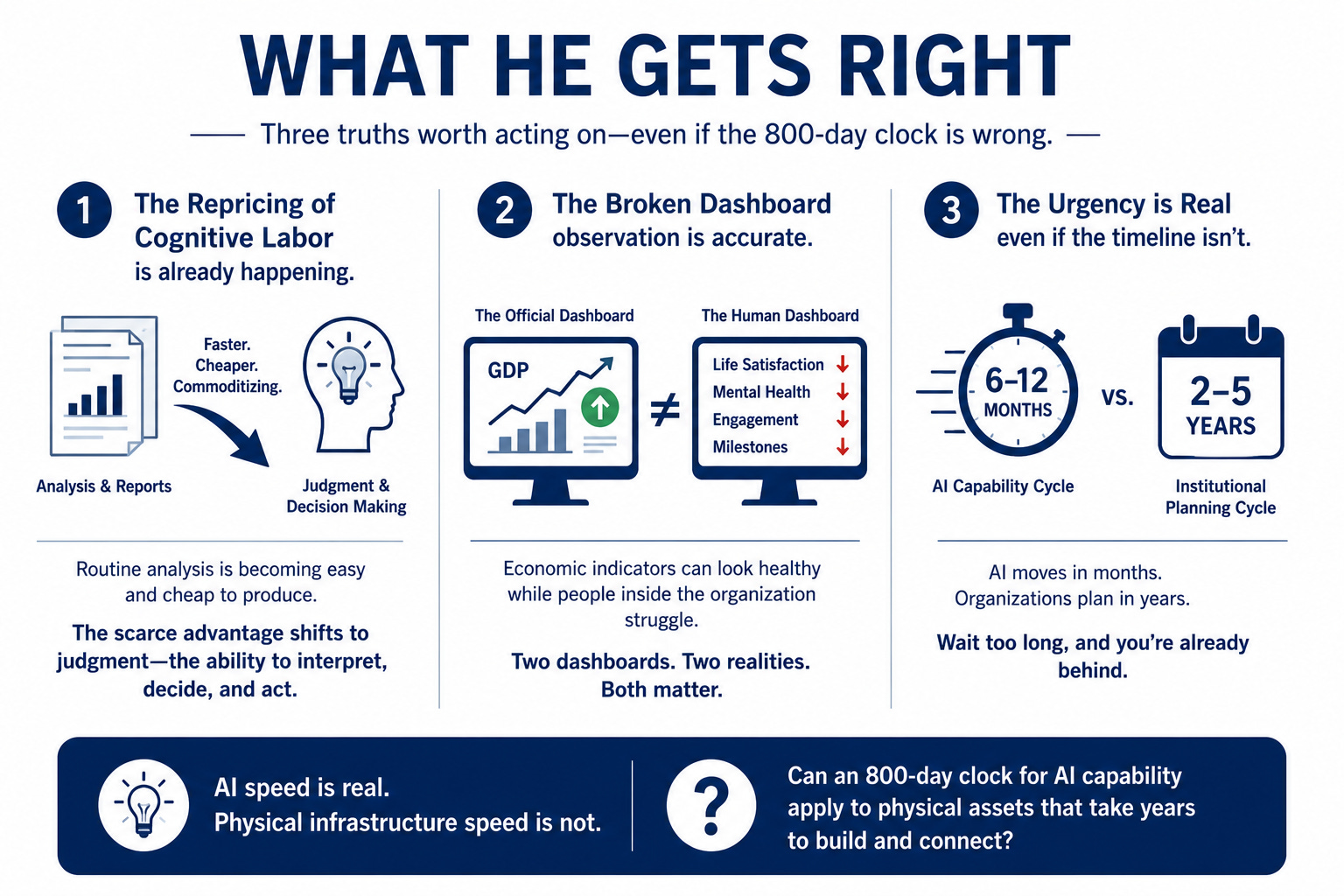
If your organizations competitor advantage is based on having more analysts or statisticians or the mass production of reports, then that advantage is eroding quickly because the same output can be produced significantly faster at a fraction of the cost.
As I thought about this, the part that may remain scarce is the judgment required to understand what the analysis means and what decision should follow from it.
This completely changes where the people inside the organization may create the most value. Some of the analysis they perform today will become easier to produce, while the decisions connected to that analysis will apparently become more important.
Then I went back to his broken dashboard observation.
The broken dashboard observation is accurate.
GDP can continue rising while the actual experience of the people doing the work gets worse. This is not a new criticism of GDP. What I found useful is that Emad does not treat the gap between the official numbers and human experience as only a measurement problem.
An executive may see economic indicators showing that everything is operating normally while the people inside the company are feeling more pressure, becoming less engaged, and struggling to reach the same milestones as the generation before them.
The two dashboards may be describing different realities and I think that is the part of his narrative that is worth your attention.
Finally, there is the urgency.
The urgency is directionally correct even if the timeline is not.
AI capability is moving in six to twelve month cycles, whereas the institutional planning cycles operate between two and five years. When I put those two timelines next to each other, the mismatch cannot be ignored.
A leadership team waiting for the next strategic planning cycle to decide what AI means for the organization may already be moving too slowly.
So far, I am on the same page with Emad.
But, this is also where I begin separating the cognitive economy from the physical economy because AI capability can improve every six months while a data center, power plant, grid connection, or regulatory approval may still take several years.
So the question I am left with is whether an 800 day clock built around AI capability can also be applied to the physical infrastructure required to deliver it.
The Constraint Stack: Where His Model Breaks
This is where my view begins to separate from Emad’s 800 days argument.
I started thinking about what actually controls the timeline inside a physical operating environment and it is rarely one thing.
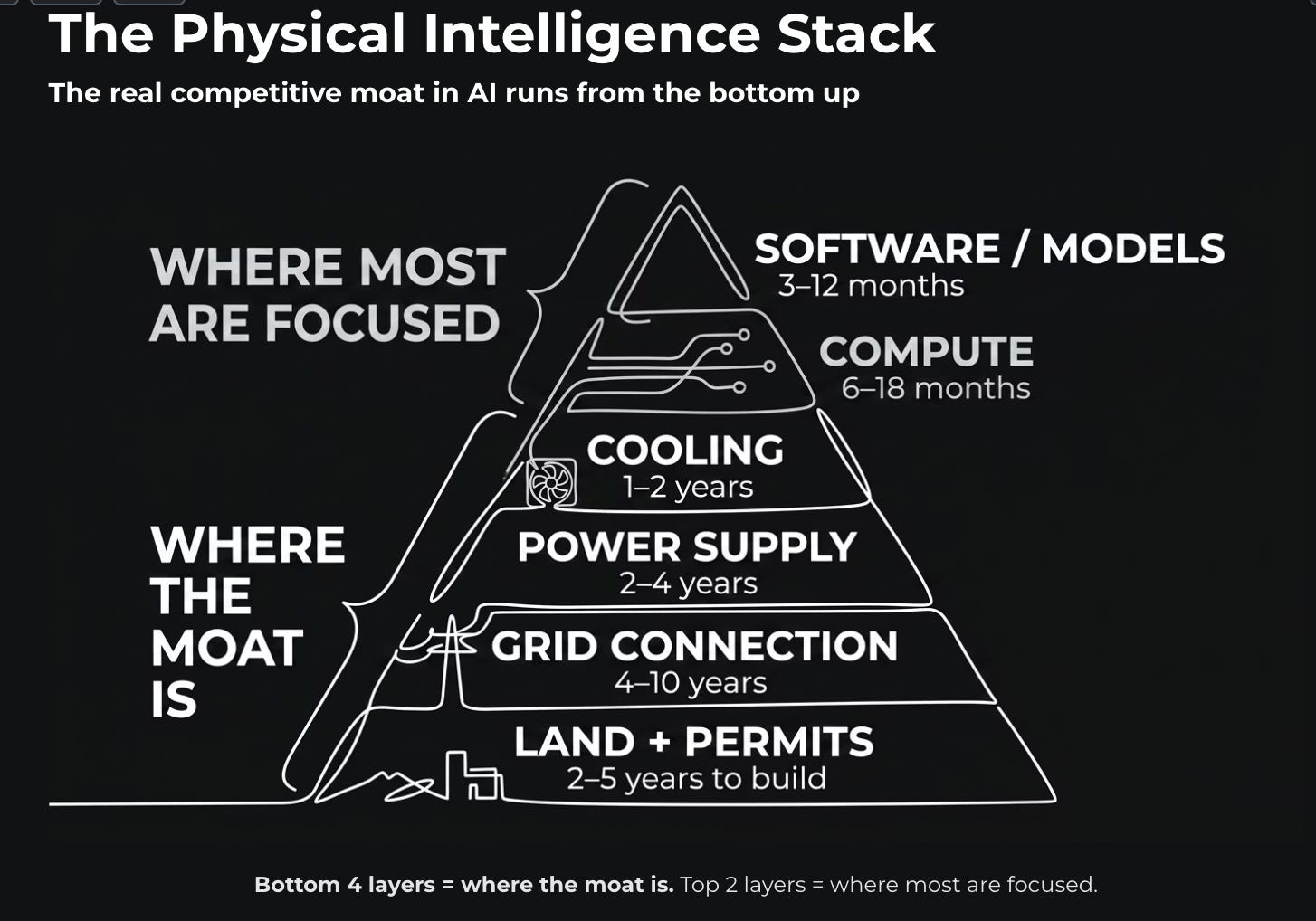
I call this the Constraint Stack.
Every operating environment has a sequence of constraints or roadblocks that determine how fast the system can actually change. What I kept noticing is that after one problem was solved, another problem was already waiting underneath it.
Emad’s narrative assumes that intelligence is the only binding constraint in the economy. So, logically, if intelligence becomes cheaper and more available, then the transformation should follow at approximately the same speed.
If intelligence is actually the bottleneck, his timeline makes sense because that bottleneck is being removed quickly. But, when I apply the same thinking to the physical economy, intelligence is rarely the only thing controlling the timeline and in many cases it may not be the constraint causing the delay at all.
Interestingly, he also says, although only in two pages of his few hundred page book, that the cost of intelligence is collapsing toward the price of electricity and model access.
Ok but if the intelligence requires electricity, where does the electricity come from?
In recent years, projects that actually completed the process of connecting new electricity generation to the U.S. grid spent more than five years and that’s based on the median time range.
It’s not just about how quickly the engineering work can be delivered. A new electric connection may require grid studies, environmental reviews, transmission upgrades and regulatory approval across multiple organizations.
To make that worse, the demand from data centers and new generation projects is also arriving faster than the existing process was designed to handle it.
Then there are the physical components. A new substation can take between two and four years to permit and build. The transformer needed for that substation may have a lead time longer than one year and, in some cases, closer to two years because these are specialized physical objects manufactured by a limited number of facilities.
So, using the top AI model of tomorrow can help design the system or complete parts of the analysis faster, but it cannot make the transformer magically appear when the manufacturing capacity is already full. You can argue it can accelerate the transformer development process or drive efficiency, but you still need a transformer.
We are still far away from having something like Iron Man’s ARC reactor, which is a fictional heart-sized energy source capable of producing enormous amounts of clean power. Even if commercial fusion becomes available during the next few decades, that is very different from putting the same capability inside something small enough to fit inside a person’s chest.

Source: https://marvel-movies.fandom.com/wiki/Arc_Reactor
Until then, intelligence may become cheaper and more available, but the electricity required to run it will continue to depend on power plants, substations, transformers, transmission lines, and permits that take years to build.
Then I extended the same thinking beyond electricity.
To establish a new process inside a chemical plant requires environmental permitting that takes eighteen months to three years. A major energy capital project moves through environmental assessment, community engagement, regulatory review and several levels of approval that are measured in years.
A maintenance turnaround at a refinery may be planned two years in advance because hundreds of contractors need to be coordinated and the physical unit has to be taken offline and returned to operation safely.
AI can help with the planning, analysis and documentation across all of these examples. Drones can help with aerial surveys.
But, it cannot automatically change the regulatory calendar or remove the statutory review period or eliminate the time required to manufacture and install a physical component.
This is where the Constraint Stack became more useful to me.
You can solve the analysis problem, but you may find that the project is awaiting a permit. Once the permit is secured, the project will continue to wait for capital and then finally the vendor lead team for a few years.
So I started questioning how much additional intelligence changes the actual timeline when the project is still waiting for the same permit, committee or physical equipment.
Then I noticed another contradiction inside Emad’s framework. He identifies material capital including energy, infrastructure and ecosystems as the first pillar of his MIND framework. It is the foundation that everything else depends on.
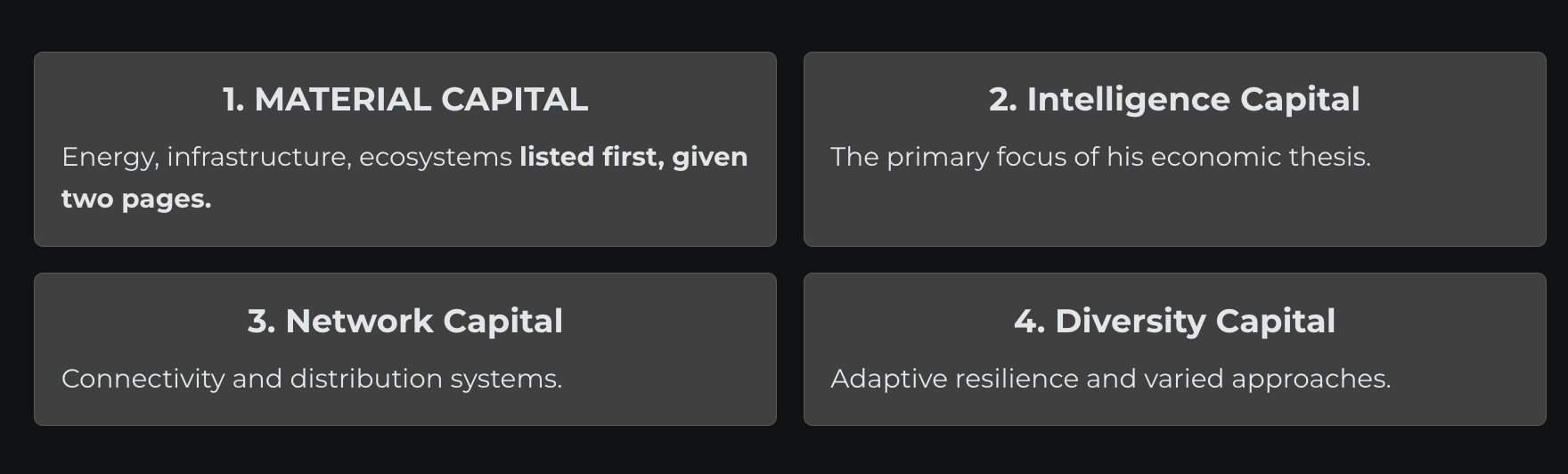
But as I mentioned before, he only spends two pages on material capital before moving toward a dual currency for the digital economy.
For manufacturing companies that deal with physical products or materials, the material capital remains the middle or every key decision, and I am not sure it can be covered in a couple of pages.
After looking at all of these timelines, I am not sure how the same 800 day clock can be applied to both because the intelligence may arrive much earlier than the infrastructure required to use it.
The Operating Model Collision
While working through the Constraint Stack, I kept asking why the same AI capability can move quickly in one environment and then apparently slow down as soon as it enters the physical economy.
This led me back to Lens 03 in my Intelligence series, which I call the Operating Model Collision.
Let me share an example.
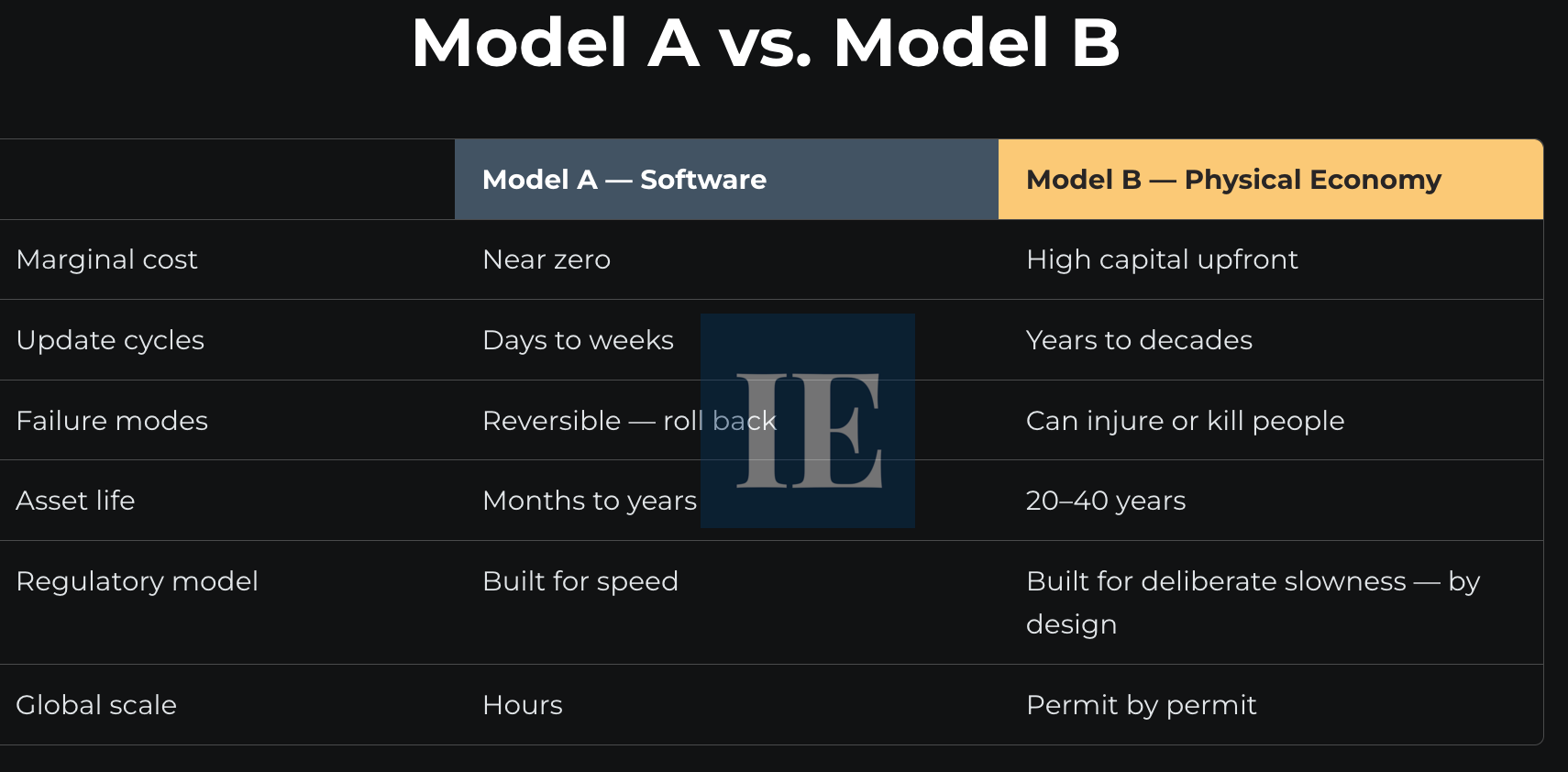
Most AI systems are being developed inside an operating environment built around software. I think of this as Operating Model A.
The additional cost of producing another unit of software output can be close to zero. Updates can happen in days or weeks and in many regular software environments, a bad deployment can be rolled back, the previous version can be restored and the team can try again.
The same software can also be distributed globally within a few hours because there is no physical object that needs to be manufactured and delivered to every location. It’s rinse, repeat and scale model.
The collision started becoming visible when I applied those assumptions inside a physical operating environment.
I think of this as Operating Model B.
The capital is committed earlier and in much larger amounts. The asset may continue operating for twenty to forty years and a compressor station built today may still be operating in 2065. Then there are the consequences when something goes wrong.
A safety incident inside a plant cannot be reversed by “restoring” the previous version. Yes, you can have a digital twin identify potential issues, but the physical object has to be replaced because physical consequences can remain long after the original decision.
You can plan maintenance ahead of time and, in most cases years ahead but the expertise required to operate the asset safely can take a decade to develop. So, a company cannot replace that experience by hiring someone during the next quarter.
AI systems are mostly arriving from Operating Model A. They improve quickly, they are updated frequently and the analysis can sometimes be produced in a few minutes.
Then the recommendation enters Operating Model B.
So the analysis can be correct with useful recommendations but before you make any changes, you will need regulatory clearance and a procurement process, along with a maintenance window that was already planned years ahead. I started noticing that AI can finish its part of the work in minutes and the recommendation may then spend several months waiting for the physical organization to use it.
At first this can look like a regular change management problem. But, some of these timelines exist because the regulation requires them, the asset is physical and the people operating it need experience that develops over several years.
So the takeaway from this is that producing the answer faster does not mean the physical decision can move at the same speed.
This changed how I started thinking about AI value inside a physical economy organization.
The value may first appear through the quality of the analysis and the decision rather than how quickly the entire operating environment changes.
This is also where the Intelligence Supply Chain becomes more useful to me because it has to deliver intelligence when the physical decision can actually use it, and not only produce intelligence as quickly as possible.
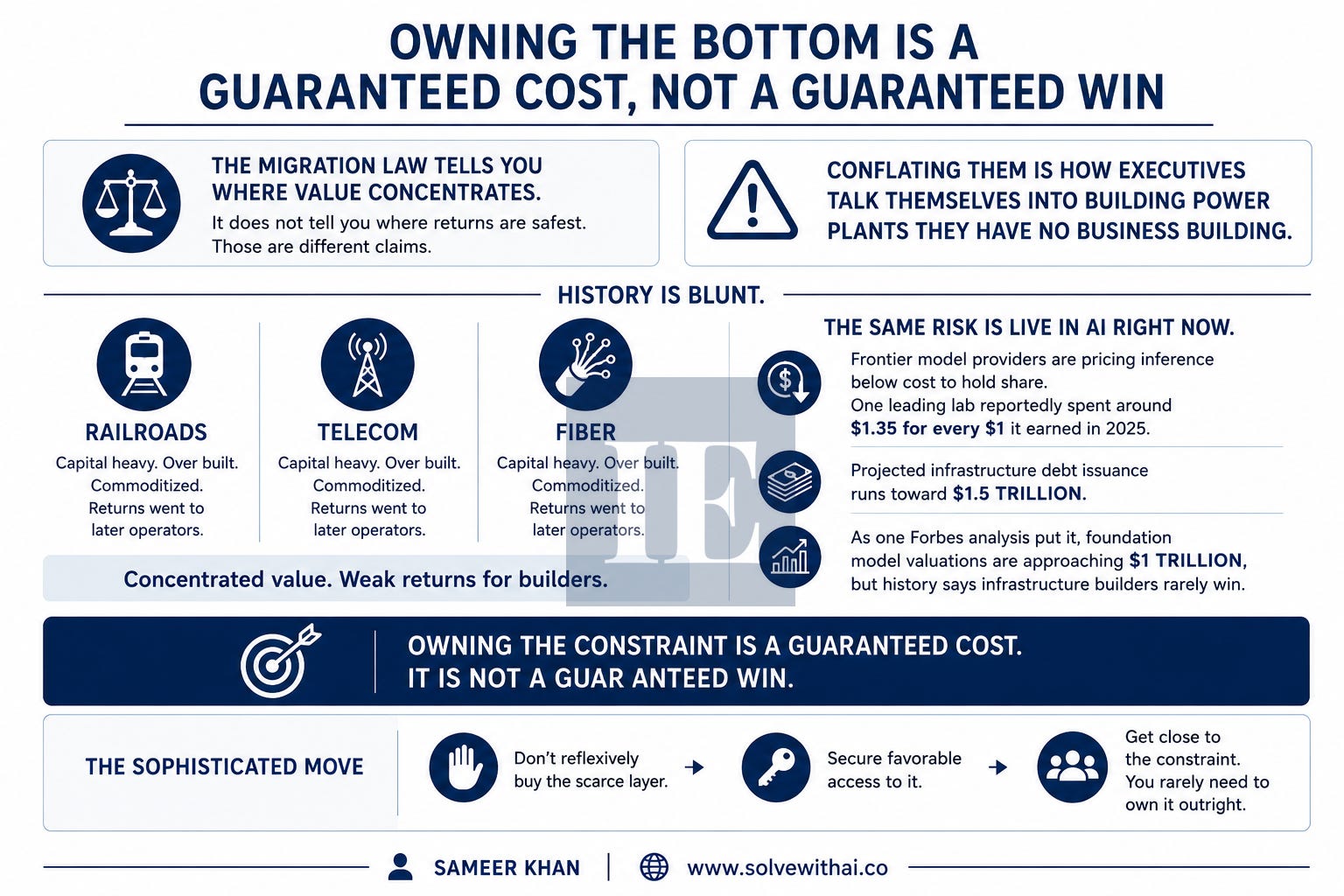
I think this may explain why an AI pilot can look fast while almost nothing around it appears to be moving at the same speed.
Executive Recommendations
After working through the Constraint Stack and the Operating Model Collision, I started thinking about what executives should actually do with the 800 days argument.
The risk I see is adopting a transformation timeline based on how quickly the model is improving while the constraints inside the organization are moving at a very different speed. I think the answer is slightly different for mid-market and enterprise organizations.
For Mid-Market Organizations in the Physical Economy
Before making a significant AI investment, I would start with a constraint audit.
I would not begin by asking what can AI do?
I would ask what is actually slowing the process we are trying to improve and how long does it take for that constraint to move?
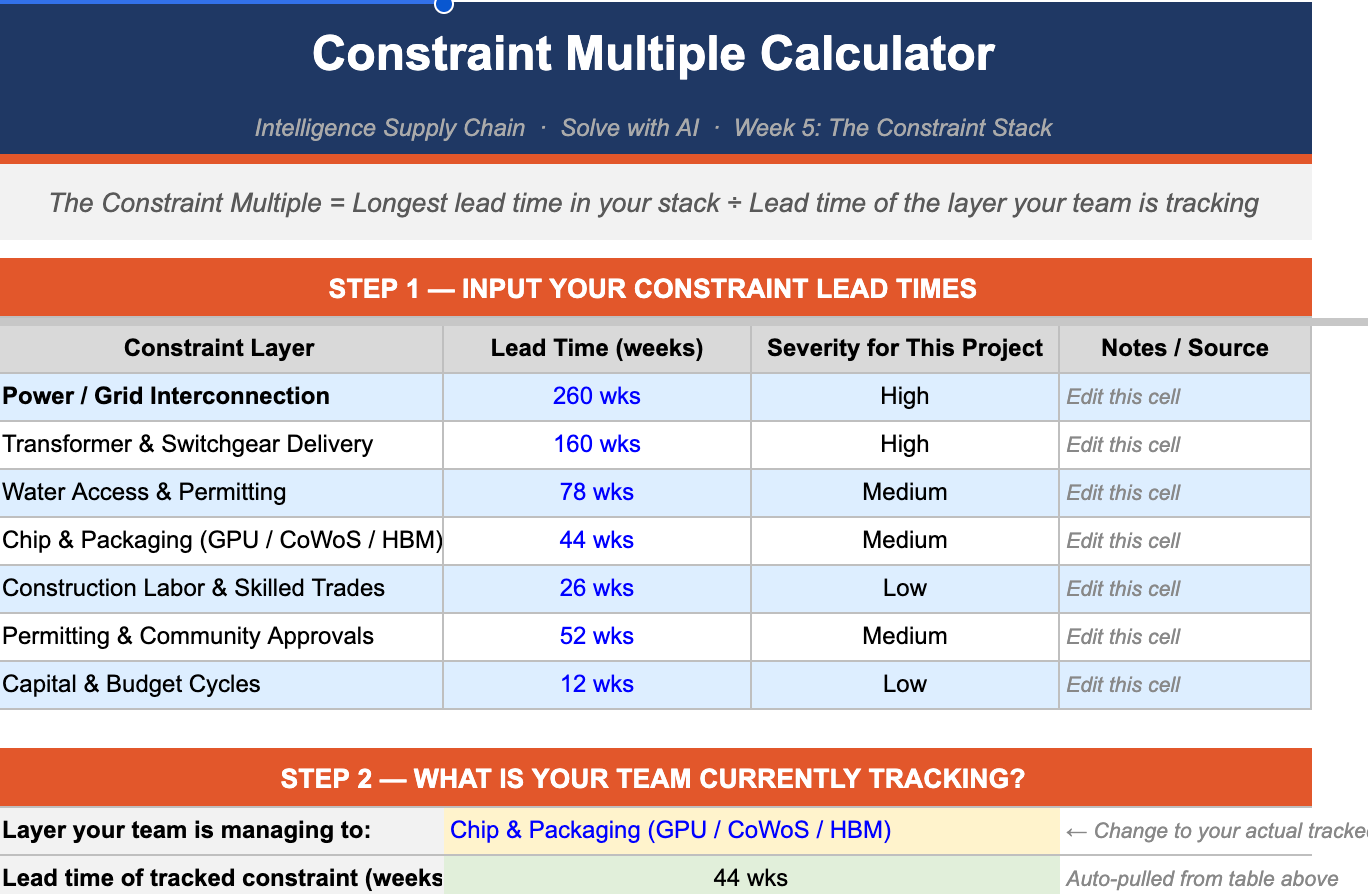
If the process is waiting on a regulatory approval that takes several years, the AI may produce better analysis much faster but apparently the analysis will still wait for the same approval.
This will impact your business case because the value may come from improving the quality of the decision instead of completing the entire process faster.
I would also separate the Model A and Model B processes inside the organization because most physical economy companies have both.
Finance, HR and marketing may operate closer to Model A timelines, where changes can be tested and adjusted quickly. Operations, capital projects and regulatory compliance operate through Model B timelines where the cost of failure is higher and many decisions cannot be easily reversed.
Applying the same investment assumptions to both is where I think the problem begins.
For example, a capital allocation model that includes better predictive maintenance information can still be valuable even if the capital cycle takes eighteen months. A safety assessment using real-time sensor information can also improve the decision even if the regulatory review it supports continues for another two years.
The timeline may not move, but the quality of what moves through it can.
For Enterprise Organizations in the Physical Economy
At enterprise scale I kept coming back to the benchmark.
If the board is comparing the AI transformation of an energy, manufacturing or infrastructure company with the deployment timeline of a software company, then the organization is being measured against an operating model it does not have.
I would establish a physical economy transformation baseline based on the company’s actual Constraint Stack. For every major operating area, map the sequence a decision has to move through before anything physically changes.
Where does it wait for engineering?
Where does it wait for regulatory review, capital approval, procurement, equipment or the next operating window?
This begins showing where intelligence can actually change the decision and where producing more analysis may only create another report that waits inside the organization.
It also becomes part of the Intelligence Supply Chain because now we can see where intelligence needs to enter the process, who needs it and at what point the physical decision can actually use it.
Then there is the workforce constraint.
Some of the most valuable knowledge inside a physical economy organization still sits with people who have spent years understanding equipment behavior, supply chain issues and the patterns of a specific site.
A large part of this knowledge may not exist in a dataset or even an operating manual.
AI may help capture and extend it, but the model can improve every few months while the people carrying this knowledge are retiring and the workforce learning from them still requires years of experience.
What I am not sure most organizations have planned for is what happens when the model advances faster than the transfer of operational knowledge that still exists only inside experienced people.
The Gap Is the Strategy
After going through Emad’s argument, I kept coming back to the gap between how quickly AI is improving and how quickly a physical economy organization can actually use it.
To be clear, I think he is right that we are in the early stages of an Intelligence Inversion. Cognitive labor is being repriced and the urgency is real because most planning cycles are not moving at the same speed as the technology.
But, the physical layer is not moving at that speed.
There is a Constraint Stack sitting beneath the intelligence layer in any organization operating with physical assets. There is also the Operating Model Collision between how quickly AI can produce intelligence and how quickly the physical economy can absorb it and act on it.
I do not think this gap means the AI adoption has failed or that it can be removed with better implementation. A large part of the gap comes from the physical, regulatory and structural reality these organizations have been operating within for decades.
This is where I think executives have to be careful.
Ignoring Emad’s argument because the physical economy moves slowly would be a mistake. The disruption is real and the repricing of cognitive labor is already happening.
But, using the 800-day timeline as the planning assumption on its face value can also create a different problem because now capital is being committed based on a transformation speed the physical operation may not be able to deliver.
The answer is somewhere inside that gap.
Leaders need to understand the actual Constraint Stack inside their operating environment and then design the AI investment based on what is really limiting the process. The Intelligence Supply Chain also has to produce value at the speed the physical decision can actually use it and not only at the speed the model can generate it.
While writing this section, there was one thought that continued to stay with me.
The gap is the strategy.
The gap between AI speed and physical economy speed is not something executives can simply plan around after making the investment. It is where the investment has to be designed.
So the question I would take into the next leadership meeting is:
In your current AI initiatives, what is the non-AI constraint the AI output feeds into and how long does that constraint take to move?
That answer is your real planning assumption.
Next week we will go inside the Intelligence Supply Chain where it breaks, why it breaks in physical economy organizations, and how to design one that is built for the constraint stack rather than the software model.*
Talk soon,
Sameer Khan