

You Are Wasting 70% of Your AI Budget
The model is not your problem. Your architecture is.

Hey Productivity Explorer,
In the summer of 1942, the United States government gathered the most brilliant minds in physics under one roof in Los Alamos, New Mexico.
The mission was to build something that had never existed before, and at the center of it all stood J. Robert Oppenheimer, a man who understood, perhaps better than anyone alive, that raw genius deployed everywhere at once is not a strategy. It is a waste.
Oppenheimer did not personally wire every circuit, run every calculation, or supervise every lab bench.
He was the mind behind the mind.
The man the rest of the team escalated to when the problem got hard enough, actually to need him. Every other decision, every routine step, every mechanical execution that happened without him. Because of that structure, one of the most complex scientific projects in human history got done.
Now think about how you are probably deploying AI right now.
Every task, every workflow step, every token, running through the most capable model you have access to.
You never stopped to ask whether they do. That is the quiet inefficiency that is burning through your AI budget right now. The truth is that the majority of the AI product leaders have no idea how much it is actually costing them.
On April 9, 2026, Anthropic published something that changes this completely. They called it the Advisor Strategy. It is an architectural shift in how intelligence gets allocated inside an AI system, and it is the most important design pattern you have not implemented yet.
The core idea is almost embarrassingly simple once you see it.
A cheaper model runs most of the workflow, including tools, iteration, and output
When it hits a hard decision, it escalates to a stronger model for guidance (400–700 tokens)
It resumes execution immediately, applying high-end reasoning only where needed
The way Oppenheimer would have done it.
The benchmark results Anthropic published are not marginal. Sonnet paired with an Opus advisor improved performance on SWE-bench Multilingual by 2.7 percentage points while cutting cost per task by 11.9%.
Haiku with an Opus advisor more than doubled its score on BrowseComp, jumping from 19.7% to 41.2%, at 85% lower cost than running Sonnet solo. You are not trading quality for savings. You are getting both at the same time, because you are finally spending intelligence where it actually matters.
What follows is exactly how it works, why the economics are so compelling, and what you need to do to test it inside your own workflows this week.
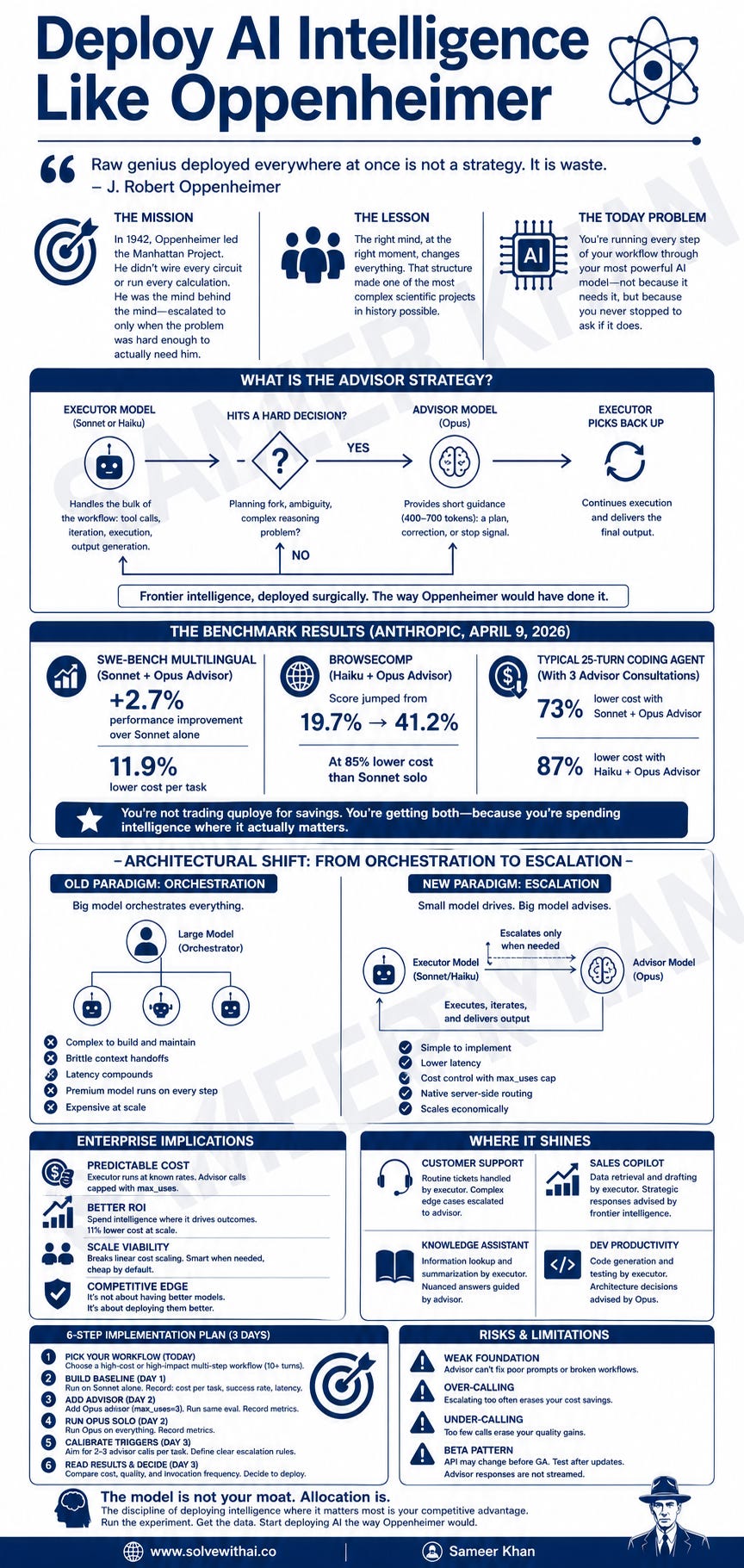
Table of Content
The Problem: Why You Are Overpaying for AI Right Now
What Is the Advisor Strategy
Why the Economics Actually Work
The Architectural Shift: From Orchestration to Escalation
What This Means for Your Business
How to Test It This Week: A 3-Day Implementation Plan
Risks and Limitations
The Only Question That Actually Matters
The Problem: Why Current AI Architectures Are Inefficient
There are two ways you are probably building AI agents right now, and both of them have a cost problem hiding inside them.
Keep reading with a 7-day free trial
Subscribe to Intelligence Economy to keep reading this post and get 7 days of free access to the full post archives.