

AI Leaders Playbook: How Elite Leaders Automate Judgment Transforming Tasks to Intelligent Rules
The system I use to convert recurring work into self-operating decisions

Hey AI Leader,
Although I look at my meeting calendar multiple times a day, when I opened it this morning, it finally hit me that we’re almost at the end of 2025!
And you know what?
Most of us are still fighting the same battle we were in at the start of the year.
Time.
Let’s be honest for a second. You say you want more time.
But if I looked at your calendar today, would I actually see that?
Probably not.
Your week looks just like last week, back-to-back meetings, endless follow-ups, and that nagging feeling that if you stop watching, everything will fall apart. You delegate something, check back a few days later, and end up fixing it yourself. Not because your team isn’t capable, but because no one quite thinks like you.
That’s the real problem with how most people delegate.
They hand off tasks instead of teaching others or systems how to think.
Human delegation scales linearly. You give an instruction, someone executes, and both of you lose time explaining, reviewing, and correcting.
I personally feel delegation is one of the hardest parts of work, vs getting it done yourself.
In fact, studies show that task switching and coordination costs can eat up 20–40% of productive time, as the brain expends more effort managing and explaining than executing. In fact, Harvard Business Review’s classic piece “Who’s Got the Monkey?” shows that many managers spend more time re-checking delegated work than completing it solo, proving that delegation isn’t just a time issue; it’s a cognitive one.
What’s interesting, though, in all of this is the fact that AI delegation compounds. Once the system understands your logic, it doesn’t just follow orders, but it starts predicting what you’d do next. The shift is happening right now among elite leaders
They’re building systems that think for them.
Systems that don’t just save time, but expand it.
Because the future of leadership is designing decision systems that replicate your intelligence.
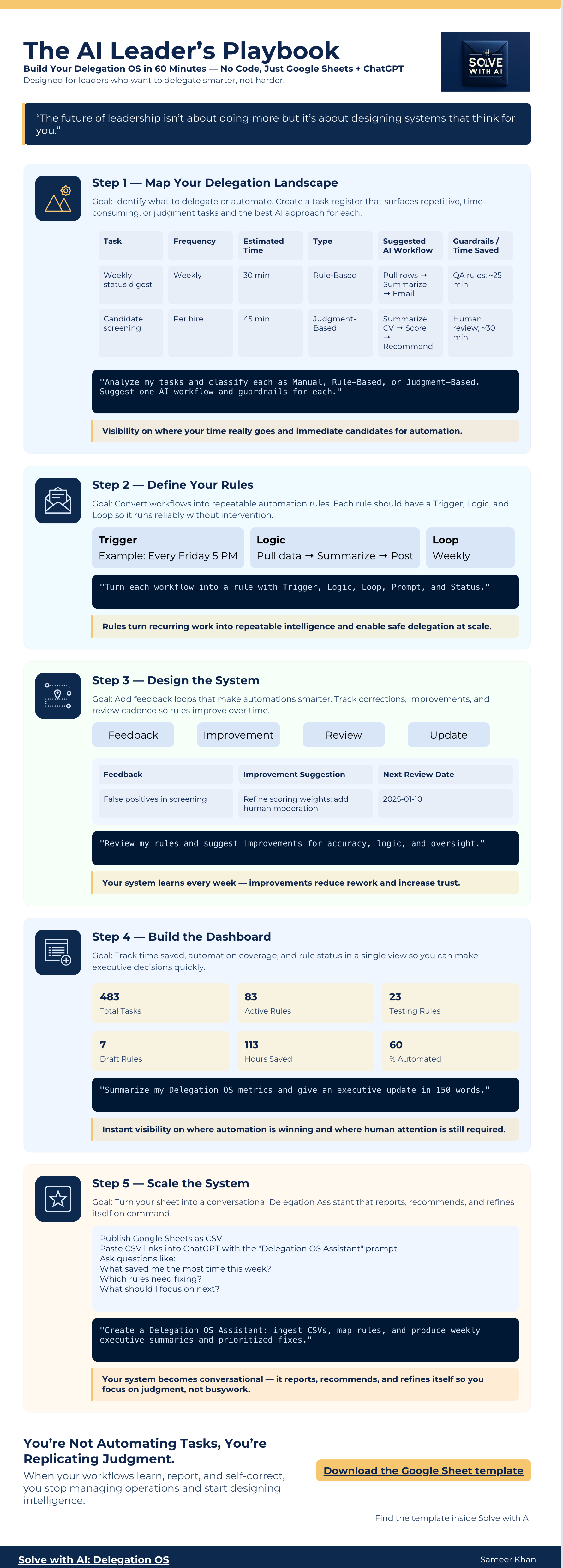
That’s what I call a Delegation OS, your personal network of intelligent workflows that act before you ask.
Imagine this for a second. It’s Monday morning, and your weekly reports are summarized. Key insights are highlighted, and follow-up tasks are drafted and ready to go. You didn’t touch a thing because the system ran overnight, and in addition to doing the work, it mirrored your judgment.
That’s the difference between being busy and being built for scale.
And that’s what we’re going to do here.
By the end of this post, you’ll know how to install your own Delegation OS, one that gives you back 5 to 10 hours a week without ever losing control.
Table of Contents
The Paradigm Shift: From Time Management to Intelligence Replication
The Delegation Trap: Why Most Leaders Fail at Letting Go
The Mental Shift: From Human Delegation → Systemic Delegation
The Quantum AI Delegation Framework (Your New Operating Model)
The System Blueprint: Building Your Delegation OS in 3 Layers
Real-World Case: The 3-Hour → 10-Minute Reporting Shift
The Operator’s Mind: Why Letting Go Feels Hard (and How to Rewire It)
Metrics That Matter: Measuring Your Delegation Leverage
The Prompt Playbook: Delegation Readiness Analyzer (2025 Prompting Techniques)
The Transformation: From Busy to Built for Scale
Implementing the Delegation OS (Prompts + Google Sheets)
The Delegation Trap: Why Most Leaders Fail at Letting Go
Let’s talk about the trap almost every high-performing leader falls into.
You finally delegate a few tasks, thinking you’re buying back time.
But within a week, that “freedom” starts to feel like another job.
You’re checking in, following up, cleaning up, and suddenly you’re managing the same work you were supposed to escape from.
That’s what I call Delegation Drag, which is the hidden tax on your productivity that slowly pulls you back into the weeds.
Keep reading with a 7-day free trial
Subscribe to Intelligence Economy to keep reading this post and get 7 days of free access to the full post archives.