

Boredom Is Wisdom
Why the Intelligence Economy needs fewer inputs and more space for judgment

Hey Productivity Explorer,
This week, I thought I would share a philosophical perspective on the Intelligence Economy vs. the regular intelligence frameworks. The reason is that it’s a bit urgent. Although the thought process originated from my personal experience, I can sense it may apply to you as well.
I spent the vast majority of my time in front of devices. My morning begins with planning my day using Sameer OS around 6 am, reviewing my work calendar, and then attending meetings starting at 7 am also in front of a device.
Then driving to work, and apparently most cars now come with screens, so you are technically never offline, as we are always using some type of device.
Once I am back home, besides small time spent with family, I do the workout and still have something on my device so I can listen to when working out. Finally watching something on Netflix before going to bed.
All of my daily reading is also on devices as I crunch through the output produced by my AI agents to keep me up to date in the digital/AI world.
I review the information, develop ideas of key topics for the week, resolve any problems, and quickly move from one topic to another.
The AI tools are valuable, and I will be the first to tell you it has significantly made me more productive than before 2023. I am learning more and faster than ever before. I feel very confident knowing what I know now, and I am making data-backed decisions.
But I have been paying attention to a contradiction. The more information I consume, the less room I have to hear my strategic mind.
How did I find this?
The day before yesterday, I was driving without any radio or podcast, using my phone or any device. I also dimmed my car screen to eliminate any distraction.
In that apparently unproductive space, ideas began connecting, and I intentionally didn't capture anything on a device. I let the ideas flow, and at the end of my drive, there was this thought that captured my attention.
Boredom is wisdom!
Before you object, I want to clarify that boredom itself is not wisdom in its literal meaning.
The reason I coined that phrase is that it captures something important: When external inputs stop, internal synthesis can begin.
You may be better informed than at any previous point in your career, while having less uninterrupted space to think.
That is the paradox that carries the article.
Table of Contents
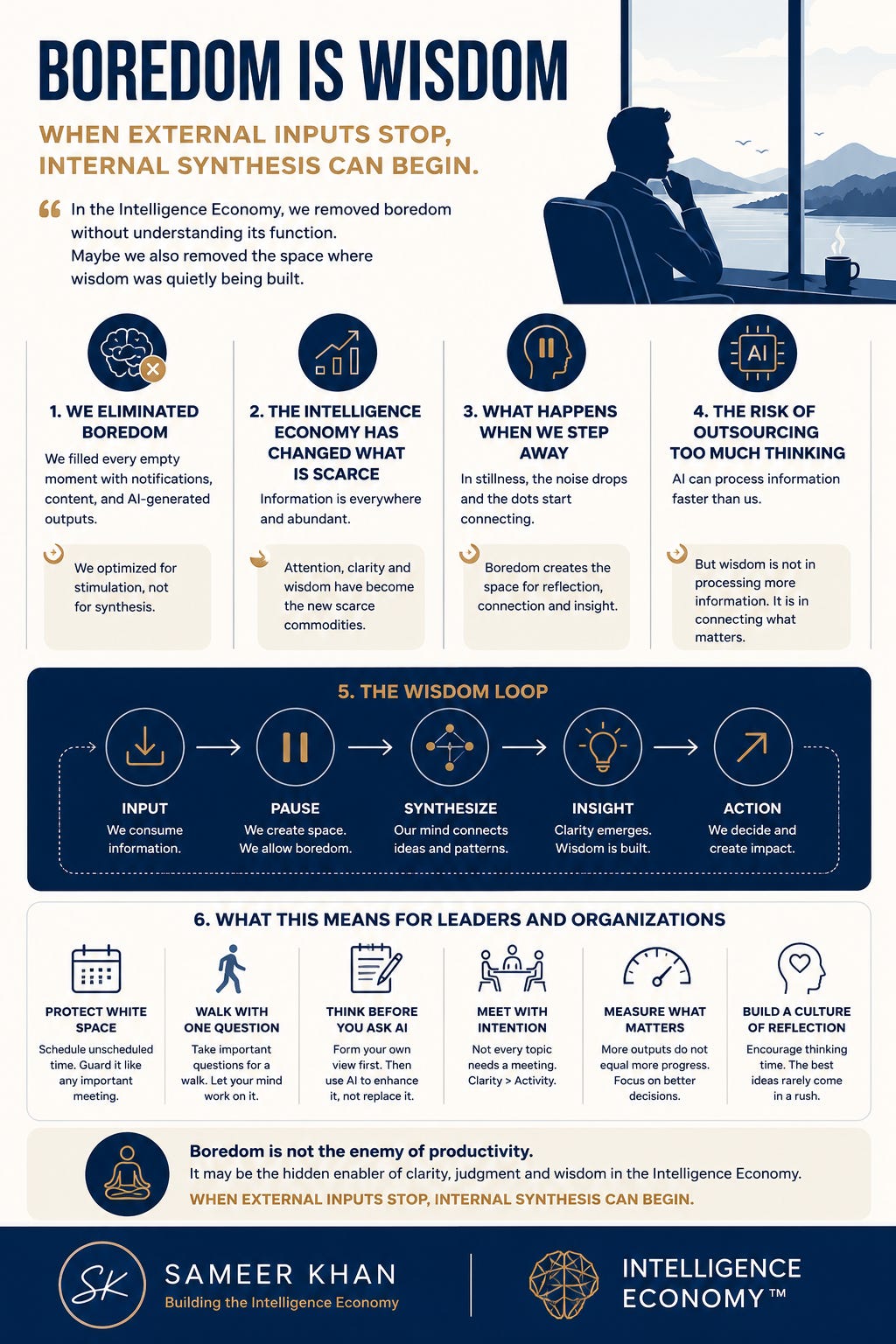
Boredom Is Wisdom
We Eliminated Boredom Without Understanding Its Function
The Intelligence Economy Has Changed What Is Scarce
What Happens When We Step Away
The Risk of Outsourcing Too Much Thinking
The Wisdom Loop (Exact Steps to Take Now)
What This Means for Leaders and Organizations
Conclusion: Creating Space for Wisdom
We Eliminated Boredom Without Understanding Its Function
After paying attention to my own routine, I started noticing that we have designed almost every empty moment out of our daily life.
Think about it for a second. The elevator ride, waiting at a doctor's office, or taking a lunch break. All of that time is filled with something on a device.
You're always going to be distracted by email, LinkedIn, useless videos, or, worst of all, the news. We have reached a point where even a few minutes of your time cannot go by without “wasting” it. Our phone gave us access to unlimited information but at the same time removed the natural pause that existed between one task and another.
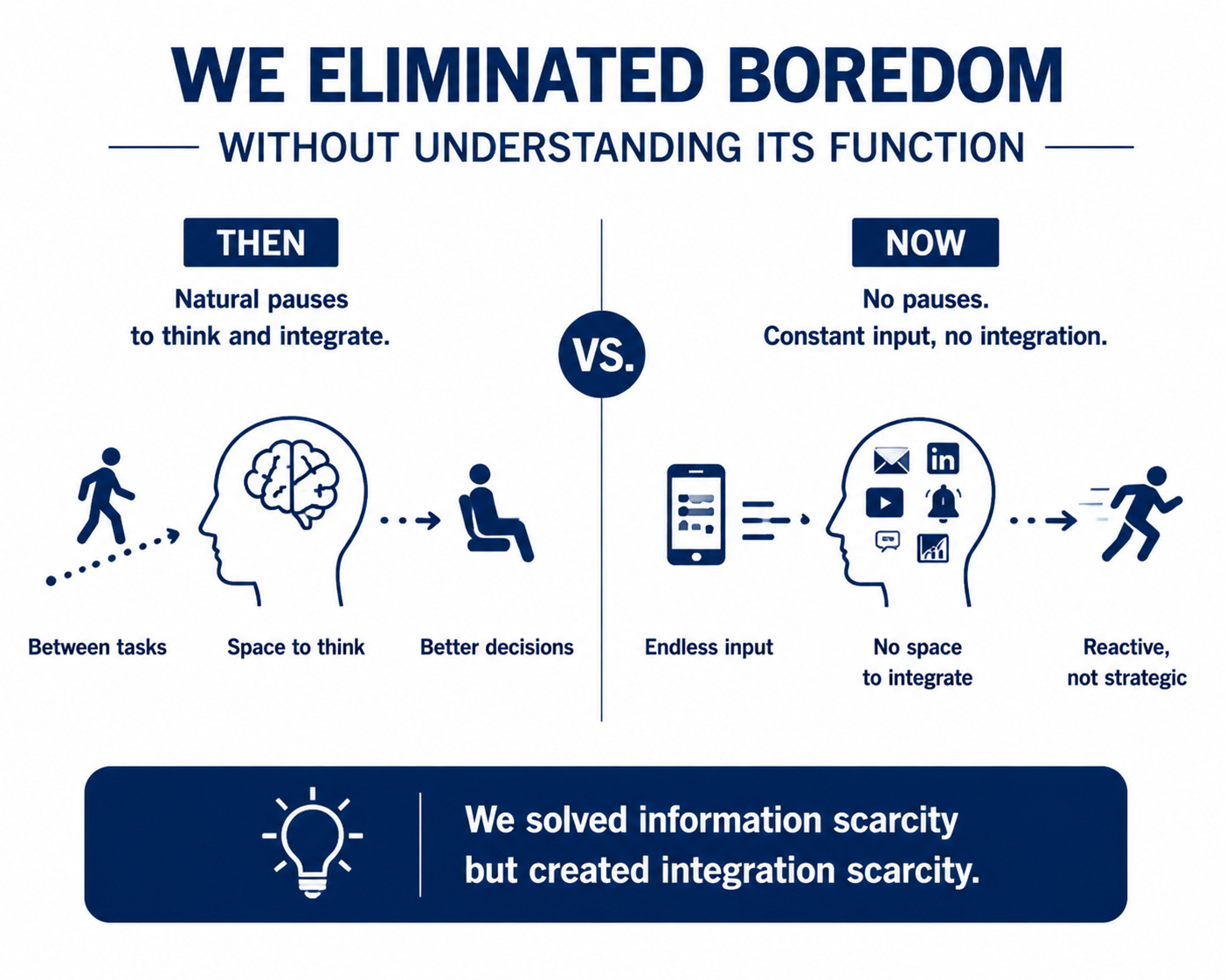
Before 2008 (launch of iPhone), I used to walk from one office building to another without checking anything. I used to drive without listening to a podcast, and it’s funny, but waiting for someone was the only thing to do.
Today, the stream of information never ends. I don’t think this is only a customer behavior problem where people are spending too much time on social media and videos.
Executives and office staff suffer from the same problem, but the environment is different, and the screens are replaced by larger screens.
Instead of social media, you now have constant meetings, a barrage of unwanted emails within which actual useful emails are hidden in plain sight, teams/slack/zoom messages, alerts from your dashboards, and, to top that AI generated summaries.
Don’t forget we also have AI research assistants and agents that technically never stop working, producing reports overnight, monitoring the market, summarizing industry news or trends.
I am personally using these capabilities every day, so I am not saying it’s wrong.
But, the result is that there is almost never a natural stopping point anymore. One meeting leads to another one, one email leads to another, and so on.
So the problem is not necessarily that we don’t have enough information.
The problem may be that we have too much information moving through our mind without enough space in between.
Research on attention residue also shows that when we move from one task to another, part of our attention can remain attached to the previous task, which may impact how effectively we focus on the next one. ScienceDirect
I think this is what many executives may be experiencing without necessarily calling it that.
You may leave one meeting but still be thinking about something that happened there while already joining the next meeting. Although sometimes it can help connect the dots, it is not always making us more strategic or productive.
By the end of the day, you may have consumed a significant amount of intelligence, but your mind never really received the opportunity to fully process any of it.
But, at the same time, you may also be cognitively saturated.
This is the contradiction that is worth talking about. We solved information scarcity by creating integration scarcity.
The Intelligence Economy Has Changed What Is Scarce
In the previous economy (aka industrial or semi digital), access to information itself was a major advantage since the launch of the internet. If you had the original idea, then using industry research, leveraging experts, accessing analytics and data allowed you to make decisions that others could not make easily.
Information was not readily available, or at least not cheap. That’s no longer the case.
Right now, I can ask AI a question and get more of a summary of the entire industry or compare different companies and identify trends in the market. I can even challenge existing business models or poke holes in a scenario.
The information may not always be 100% accurate, and it still needs to be validated, but the amount of intelligence available to us has increased significantly.
That’s just the tip of the iceberg.
As AI agents become more capable, they will analyze internal data (inference), constantly monitor markets, identify any risks, and generate recommendations without any human intervention. I mean 0% touch from anyone.
The competitive advantage is no longer only about having access to intelligence because everyone has access to it as intelligence gets cheaper and compute is accessible even more.
The real question becomes: what do you do with all of that intelligence?
Because AI can provide you many options, but it cannot automatically tell you which one matters most. For example: it can summarize data from the latest research, but the data may be telling a different story. Someone needs to understand the context, risk, and impact after the decision in real life scenario.
This is where human judgment becomes more important, not less important.
I think we sometimes assume that as AI becomes more intelligent, there will be less need for human thinking because the technology will eventually provide the answers, recommendations, and probably tell us what decision we should make.
I don’t think that is what is going to happen.
The amount of intelligence available to us will continue increasing, but that may actually make the decision more difficult because now there will be more information, more options, and probably several different directions that all look reasonable.
AI can help me identify those options, compare them, and probably show me something I may have missed.
But someone still needs to decide what is important in that specific situation, what can be ignored and what the organization should actually do.
This is where I think judgment becomes more important.
Because judgment is not only based on the amount of information you have but also based on your experience, context, people involved, what happened before, and hidden bottlenecks that the data is not showing.
Two leaders can have access to the same information, AI tools, and analytical capabilities and still make completely different decisions. So the difference may not be what they know but how they understand what they know and what decisions they make after that.
This is also where Boredom is wisdom connects with the Intelligence Economy.
I am not saying that we should stop using AI or reduce the amount of intelligence available to us. I will continue using AI aggressively because it has significantly improved how I work, learn, and make decisions.
But I also need some space between receiving all of that information and deciding what I personally think about that situation or use case.
Otherwise, I may continue consuming more intelligence, but my own point of view may simply become a combination of the last report or my last meeting or the last AI generated response.
To me, that is the real risk. The Intelligence Economy is making intelligence more available and probably much less expensive than before, but our attention is still limited and judgment is not something that automatically increases because more information is available.
This is why I don’t see Boredom is wisdom as something outside of the Intelligence Economy. It may actually be part of the human side of it.
AI can continue producing the intelligence, but leaders still need some time where they are not consuming anything new so they can understand what all of that intelligence means for the decision in front of them.
What Happens When We Step Away
After the drive, I started thinking about what exactly was happening during the time when I was not consuming anything, because obviously my mind was not doing nothing. Right?
I was driving and paying attention to the road, but at the same time different ideas were coming into my mind without me intentionally thinking about any specific topic. One thought connected with another one, and eventually there was this phrase: Boredom is wisdom.
Honestly, I did not start the drive with the intention to develop a topic for this newsletter, nor was I trying to solve any particular problem. The only thing I did differently was that I stopped the information coming in deliberately.
This made me think about the number of times I was trying to solve something while sitting in front of my computer or discussing it during a meeting, and the answer did not come at that time. Then later I am driving, walking or doing something completely different, and suddenly the solution appears.
How did that happen?
The information was probably already in my mind, but for some reason it did not connect when I was directly trying to find the answer using AI.
I later found that researchers sometimes call this incubation. You spend time thinking about a problem, and when you step away from it, the mind may continue processing it without you intentionally focusing on it. I think something similar happened during my drive.
The thoughts were not 100% new because they were probably coming from my own experience with devices, AI, information overload, and everything else I have been thinking about as part of the Intelligence Economy.
But, frankly, I had not connected them in this way before.
Normally, when an idea comes to my mind, I immediately try to capture it. I will open my phone, send myself a message, put something in Sameer OS, or ask ChatGPT or Claude to help me develop it further.
This time I intentionally did not capture anything because I thought if I took out the phone, I would probably see another notification or something and get distracted.
So I just continued driving and let the thoughts go wherever they were going. This is also where I realized that taking a break from work is not always a break from information.
If I finish my work and start watching Netflix or browsing LinkedIn, I may be taking a break from work, but I am still consuming something.
So I was taking the required breaks from work, but almost no breaks from information.
I am not saying every time we stop using the devices an important idea will appear. There may be times when nothing useful happens, or the mind goes into completely random directions.
But if there is always something coming in, then there is probably less opportunity for the mind to do anything with what is already there.
That is what I was missing. Maybe it also needs some time where I am not asking it to process anything new.
The Risk of Outsourcing Too Much Thinking
As I was thinking about all of this, another thought came to my mind which was probably more uncomfortable.
How much of my own thinking am I giving to AI without realizing it?
Many times something happens during a meeting, or I have a topic in my mind, and before I have fully thought about it, I have already opened ChatGPT or Claude. I ask it to provide me with research or maybe a different perspective or identify what I may be missing, i.e., blind spots.
The response is normally very good, and then I continue from there. I ask another question, challenge something in the response, ask it to provide another point of view, or tell me what may be the best direction.
Within a few minutes, I have more information than I may have collected in several hours before generative AI. As I mentioned before, I find this extremely valuable, and I use it almost every day.
But, recently I started asking myself what exactly I was thinking before I received the first response.
Once the response appears, I immediately start thinking about what it provided. I may agree with it, disagree with it, or ask another question, but now the response is already part of my thought process vs generated.
So technically I am still thinking and making the final decision, but I don’t know what direction my mind may have taken if I did not receive the response immediately.
This does not mean I think we should stop using AI or first struggle with every problem for several hours before asking for help. That would not make sense and personally I dont want to work that way because that’s going in reverse.
But, I think I may be moving too quickly from having a question to receiving an answer. There is almost no space between the two.
It also matters more when the question is not only about finding information, and there is an actual decision involved.
The AI may provide the research, different options and probably a recommendation, but it does not know everything that may be going through my mind from previous experience, discussions, people involved and many other things that may not be part of the question I asked.
This is where the connection with boredom came back to me.
Maybe the empty space is not only helping different information connect. It may also be allowing me to understand what I think before asking another intelligence to tell me what it thinks.
I am not saying my own initial thought will always be right. No one can claim that for all of their thoughts.
But, at least I will know there was an original thought before the AI response arrived.
Otherwise, I may be asking better questions, receiving better answers and making faster decisions, while slowly becoming less clear about which part of the thinking actually started from me.
The Wisdom Loop
After thinking about this more, I started asking myself how I actually use this?
The issue was that I was constantly consuming it without creating enough time to understand what I personally think about it. So I went back to what happened during the drive and started looking at the process.
I did not plan any of these steps at that time, but apparently there were few things happening.
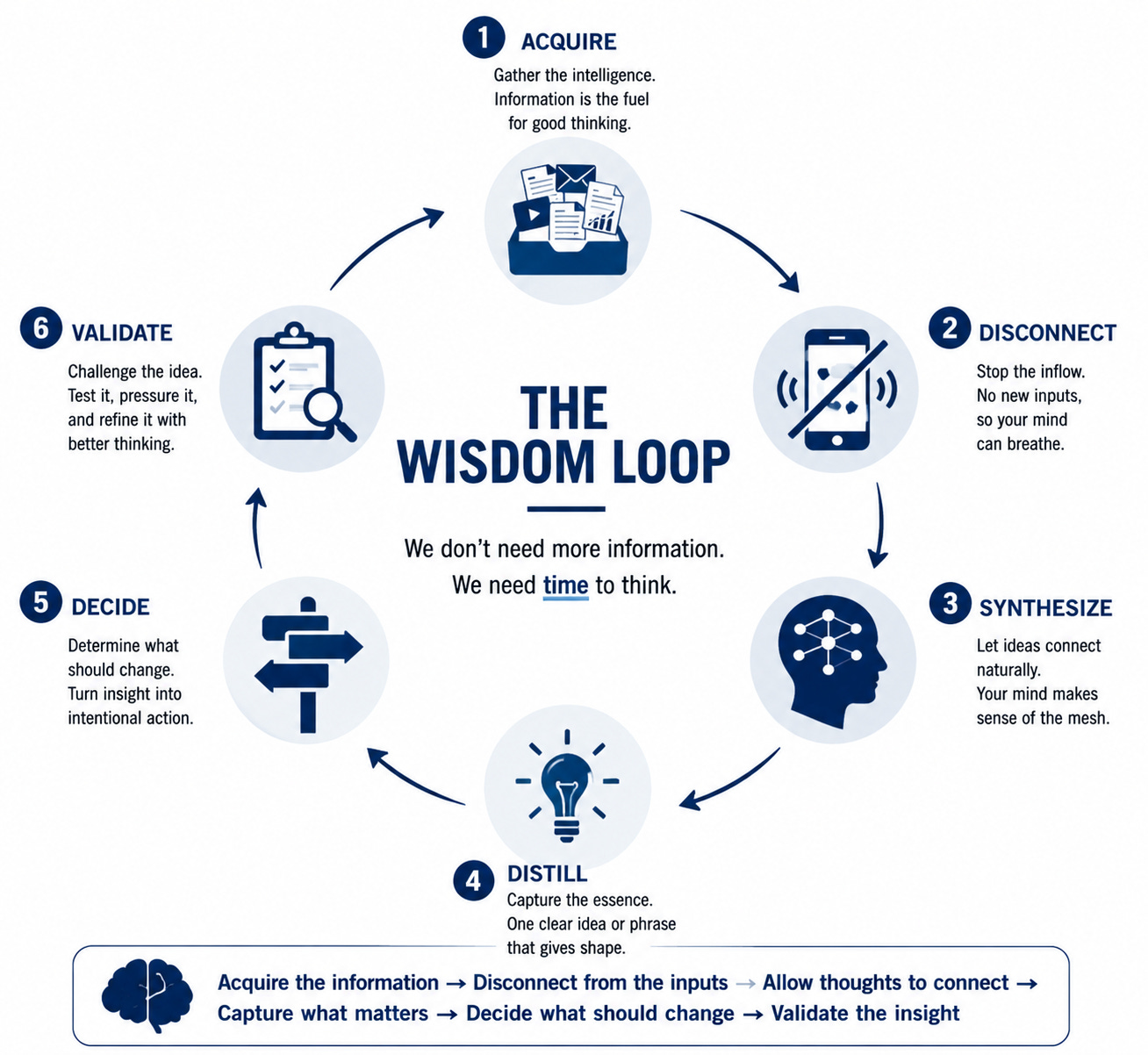
Acquire
Before the drive, I had already consumed a lot of information, i.e., 16/7 device access, AI agents working 24/7, emails, media, and all.
So the information required for the thought was probably already there. This is why I dont think the answer is to stop consuming information. You still need the intelligence before you can do anything with it.
But, I think it helps to know what question you are trying to answer or what problem you are thinking about because otherwise the research can continue forever. Every AI response gives you another five areas you can explore and there is technically no ending point.
Disconnect
At some point, I stopped adding more. There was no podcast, radio, phone call, or AI response coming in during the drive. I was not intentionally following a process. I just decided I did not want anything playing in the background.
Apparently this was the important part because the information will probably never stop by itself. There will always be another report or article or problem I can ask AI.
At some point I have to decide I have enough information for now and stop consuming something new.
Synthesize
After some time, the different ideas started connecting. I was not intentionally trying to connect them, and I don’t remember everything that was going through my mind.
Some of it was probably random. But the devices and AI tools overload, and the feeling that I was not hearing my strategic mind enough were already somewhere in my thinking. During the drive, they started coming together.
This is what I mean by synthesis.
It was my own mind trying to understand what all of the information and experience meant together.
Distill
At some point, there was this phrase that captured my attention.
Boredom is wisdom.
As I mentioned before the phrase is not literally correct, but it helped me capture what I was trying to understand. When external inputs stop, internal synthesis can begin.
Without the phrase I may have continued thinking about several different things and probably forgot most of them by the end of the drive.
The phrase gave the thought some shape.
Decide
Then there was the question about what I should change based on this.
Because having an interesting idea during a drive does not mean much if I return to exactly the same routine the next day.
For me the change is probably very simple and hidden in plain sight.
Not every drive needs a podcast, phone call or music playing in the background. I dont need to use every few minutes between meetings to check another email or review another AI output.
Maybe sometimes the workout can happen without me trying to learn something at the same time. By doing this, I am not doing less work, but I am simply creating a few places in the day where I am not adding more information.
Validate
After the drive I came back and started questioning whether the thought was actually correct. Something coming to my mind during a quiet moment does not automatically make it wisdom.
So I looked at the research, discussed the idea with AI, and started testing whether there was something real behind my personal experience. This is where AI becomes useful again because I can ask it to challenge the thought, identify what may be wrong and provide a different point of view.
So AI is still inside the process. It still helps me gather the intelligence and then later helps me challenge what I concluded.
The difference is that there is some time in the middle where I am not asking it to produce another answer.
I am currently calling this the Wisdom Loop.
Acquire the information, disconnect from the inputs, allow the thoughts to connect, capture what appears important, decide if anything should change and then go back to challenge it.
I am still thinking through the framework, and it may change over time.
But, for now, it helps me understand what happened during that drive and why constantly consuming more intelligence may not automatically create better thinking.
What This May Mean for Leaders and Organizations
Once I started paying attention to this in my own routine, I also noticed the same thing may be happening during the regular workday.
Most of my work is based on consuming information.
I attend a high number of meetings or review presentations, discuss problems, check dashboards, and receive updates from my org. I also have AI generated email summaries, meeting notes, research, and outputs produced by agents while I am probably attending another meeting.
All of this is useful, and I will be the first to tell you it has helped me understand things much faster than before. But the same contradiction is there as before.
At the end of the day I may have attended eight or ten meetings, reviewed several documents, resolved some problems and consumed a significant amount of information.
But, when exactly did I think about all of it?
I think this becomes more important as you move into senior leadership because the amount of information coming to you continues increasing, and at the same time people are waiting for your decision, opinion, or direction.
There is normally no shortage of information, but actually be too much of it coming from different directions and not enough time to understand which part matters the most.
But, if AI saves me thirty minutes and I immediately fill those thirty minutes with another meeting, report, or problem, then I am not sure I created any additional space to think.
I only used the time to consume something else.
I dont think organizations are intentionally creating this problem.
We are simply taking advantage of the additional capacity and apparently using every available minute because there is always more work that can be done. The result is that a leader may be more informed than ever before while also moving too quickly between different issues to develop a clear point of view on any of them.
This is where the few minutes after an important meeting may matter more than I previously thought.
Now I am questioning whether sometimes I should not do anything immediately.
Maybe I need to let the discussion stay in my mind for few minutes and see what part continues coming back.
The same applies when I have a difficult strategic question.
Instead of immediately asking AI for another perspective or listening to something during the drive, I may take only that question with me and see where my own mind goes.
I dont know if every question will produce an important answer. Most likely it will not.
But, I also know that if I continue providing more inputs every few minutes, I am not really giving it a chance. This may look unproductive from the outside because there is no email being answered, document being produced or meeting happening.
Maybe that is why it is difficult to protect inside organizations because organizations vote for visible activity. Visible activity is much easier to recognize than someone apparently doing nothing and thinking.
But, executive work is not only about consuming the information and responding faster.
I think we are spending significant amount of time improving how quickly the intelligence can be produced, but probably not the same amount of time thinking about what happens after it reaches the leader.
Does the additional intelligence reduce the uncertainty or simply create another five questions?
Does the AI summary create clarity or another output that needs to be reviewed?
When every tool is helping us move faster, at what point do we decide that moving faster may not be the only thing required?
I don’t have the complete answer yet. But, I am starting to pay more attention to the small gaps between those activities.
I will continue using AI, devices, and all of the intelligence available to me because I dont want to go back to the way things were before 2023.
But, I am also starting to understand that constantly consuming more information may not automatically help me think better.
Sometimes I may need to stop, allow the thoughts to connect and give my strategic mind enough time to tell me what it already knows. Maybe boredom is not wisdom itself, but apparently it may be the space where wisdom begins.
Talk soon,
Sameer Khan