

AI Reality Check of 2026: High Adoption, Low ROI, Rising Risk
Why AI Value Is Stalling While Risk Is Compounding

Hey Productivity Explorer,
I was talking to a friend of mine who runs a small accounting firm, and he mentioned something that made me write this post. I helped him set up his AI infrastructure last year.
A couple of days ago, he opened his OpenAI API account to find a $6,000 charge. His normal monthly cost does not exceeds $50.
Interestingly, an autonomous agent that his team deployed to optimize the account clause database got stuck in an infinite loop, hallucinating a schema it didn’t have access to and burning tokens at machine speed.
It was the realization that his team was conducting without a score, while his systems were operating in chaos. They were busy, but the tools were active; the architecture was fundamentally broken.
I was able to remote into his setup and identify the root cause and deploy the fix in place, including future proofing setup from these issues (a.ka. don’t deploy agents until his team consults me).
If you’re feeling that same nagging sense that your AI rollout is more active than impactful, you aren’t alone.
The market right now is drowning in noise. On one hand, you have genuine, useful innovation like OpenClaw, which is actually pushing to decentralize AI and give power back to the user. On the other hand, your inbox is likely full of breaking news about Google Gemini 3.1 or the next incremental model update, the kind of innovation that is often just another coat of paint on a house with a cracked foundation.
Let me address what is actually happening in the trenches of SMBs and Enterprise organizations in 2026.
We’ve rolled out the tools. The number of employees using generative AI has tripled, and the volume of data sent to these tools has increased sixfold. On the surface, the innovation headlines look great.
While ~70% of firms report active AI usage, roughly ~80% report zero measurable impact on productivity or employment over the last three years. We are working harder, spending more, but the P&L isn’t moving. You’re being told to automate or die, yet many of you are rushing into AI without basic digital tools like digital accounting or document management, creating a fragile foundation for any real value.
While we wait for the payoff, the risk is compounding. We’ve moved from Copilots (helpers) to Agents (actors), and with that shift, the blast radius has expanded exponentially. A misconfigured agent can now delete an entire environment or trigger erroneous financial transactions at a rate no human insider could match.
The hard truth of 2026 is simple: The bottleneck is no longer the intelligence of the models; it is our refusal to redesign the workflows they run.
If your workflow does not change, your P&L will not change. You cannot simply bolt on Gemini 3.1 to an analog process and expect a digital miracle.
In this post, I’m going to show you why the value is stalling and how you can pivot from AI Assist to Architectural Integrity.
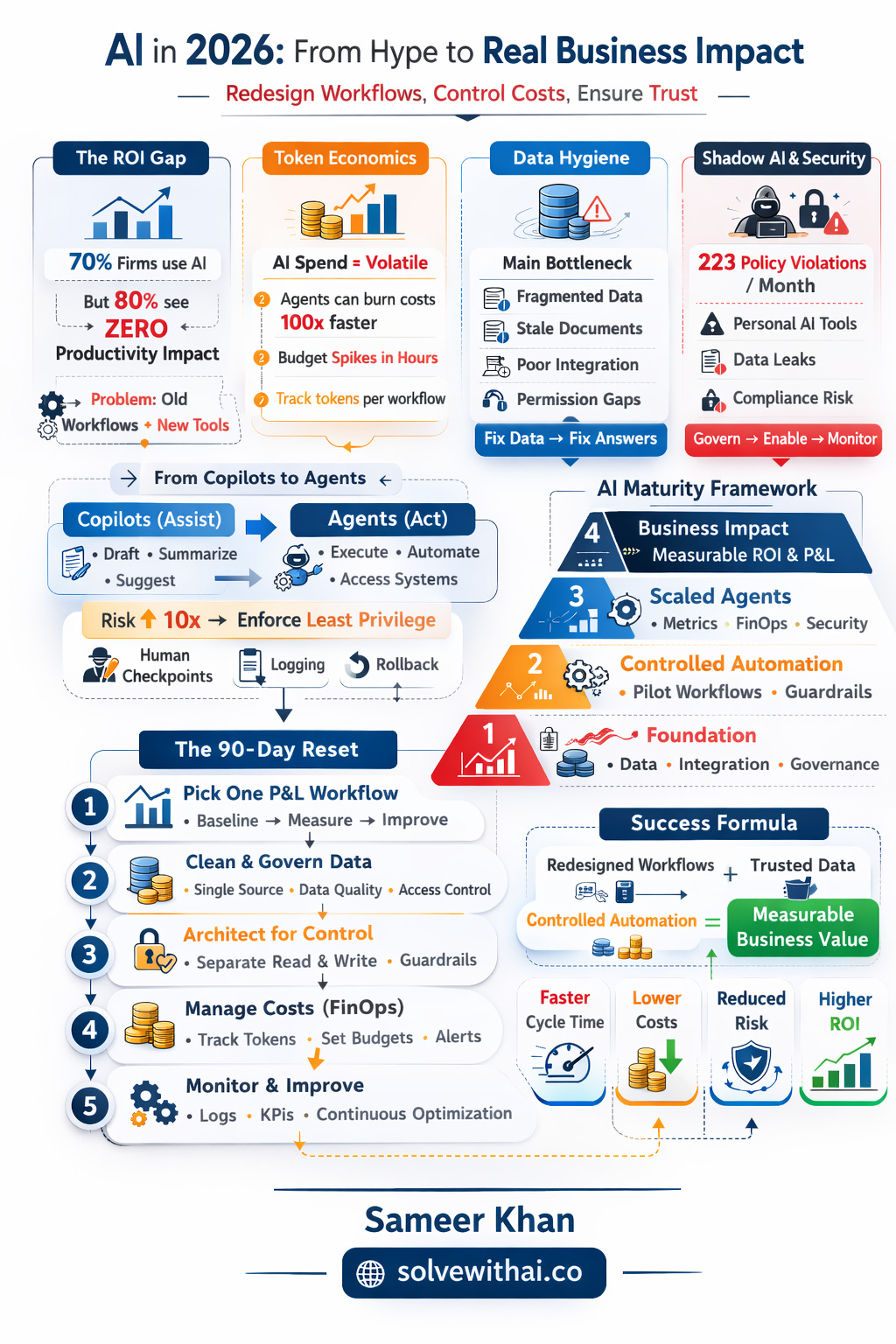
The ROI Gap Is a Workflow Problem
You likely have dozens of AI tools running in your company right now. Your team is probably using them to draft messages or summarize meetings. This is the surface level of the 2026 reality. Everyone is active, but almost no one is truly effective.
We are stuck in a massive gap between adoption and value realization. This is what happens when you mistake simple experimentation for actual transformation.
You are treating AI like a bolt-on supplement when it needs to be an architectural shift.
The reason your profit and loss statement has not moved is simple. You are using high-powered intelligence to assist old workflows instead of using it to restructure them.
If the core way that work gets done does not change, then the financial result will not change.
Most leaders are falling into the assistant trap. They give an employee a chatbot and hope for a productivity miracle. It is just added noise. A real system requires an evaluation harness and a named owner who is accountable for the output.
For the small business owner, the risk is even more acute. I see many founders rushing to buy the latest agentic tools before they even have basic digital accounting or a clean document management system in place.
You are essentially trying to build a skyscraper on a foundation of sand.
AI functions as a magnifier. If your current workflow and data are fragmented and messy, then AI will only produce that mess at a higher volume. You must stop asking which model to subscribe to and start asking which process to rebuild from the ground up.
We have to move past the stage where we just layer these tools over our analog habits. Until you redesign the core architecture of how your company produces value, you will continue to see high usage and stagnant returns.
Token Economics: Why AI Spend Is Now Volatile
You are likely used to the old world of SaaS, where you paid a flat fee per user every month. That era of predictable enterprise budgets is ending because we are moving from software as a service to volatile infrastructure economics.
In 2026, AI spend is no longer a line item you can set and forget. It is a living and breathing utility bill that can spike at machine speed. This table visualizes the structural shift you are managing right now.
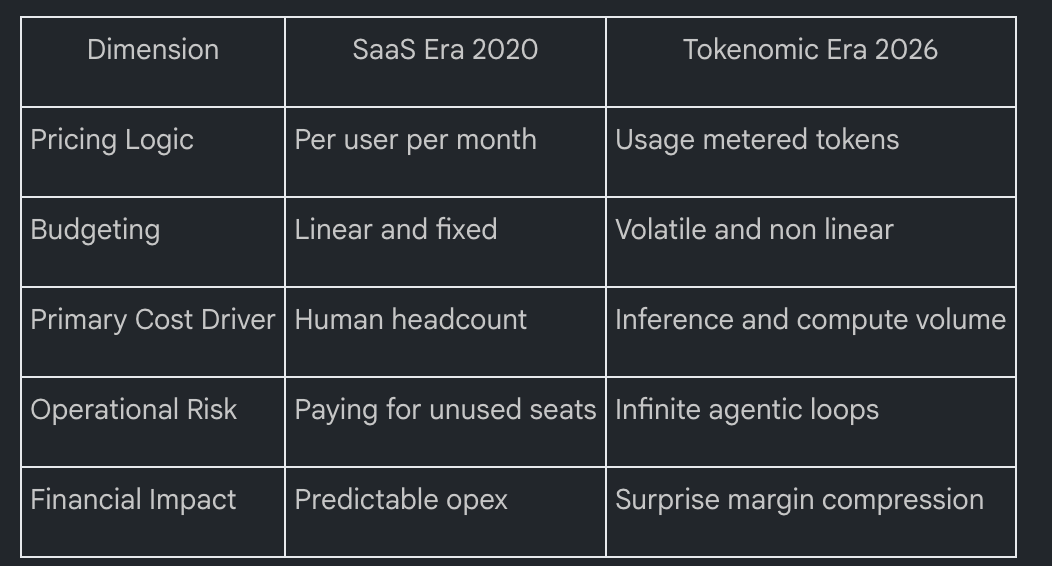
The major tech players are currently locked in a capital expenditure boom that matches the entire aggregate spending of hundreds of other major companies combined.
They are building massive physical infrastructure to support the demand for computing power.
For your company, this translates to a fundamental shift in how you pay for intelligence. Tokens are the new currency, and they are highly unstable.
We are seeing a phenomenon called agent amplification.
When you move from simple chat tools to autonomous agents that can plan and act across systems, they begin to communicate in continuous inference loops. If you do not have stop conditions or budget alerts in place, these agents can burn through your monthly compute allocation in a single weekend while you are away from your desk.
Just like it did for my friend’s accounting firm.
This shift is causing significant friction between leaders and the CFO because traditional budget models cannot account for this level of volatility.
Even the largest companies like Amazon are seeing their profit and loss statements impacted by billions of dollars just from changes in how they calculate the useful life of their servers. If you are an enterprise leader or a small business owner, you are now essentially an energy and compute trader, whether you realize it or not.
The reality of 2026 is that your margins are under constant pressure from usage-driven costs.
You must move away from managing software seats and start instrumenting token usage per workflow step. Without this level of architectural integrity, your AI deployment will remain a financial risk that compounds every time an agent takes an autonomous action.
Data Hygiene and the Integration Bottleneck
You have likely sat in a meeting and blamed a model for hallucinating when it gave you a wrong answer. Zoom AI is prone to these types of issues consistently.
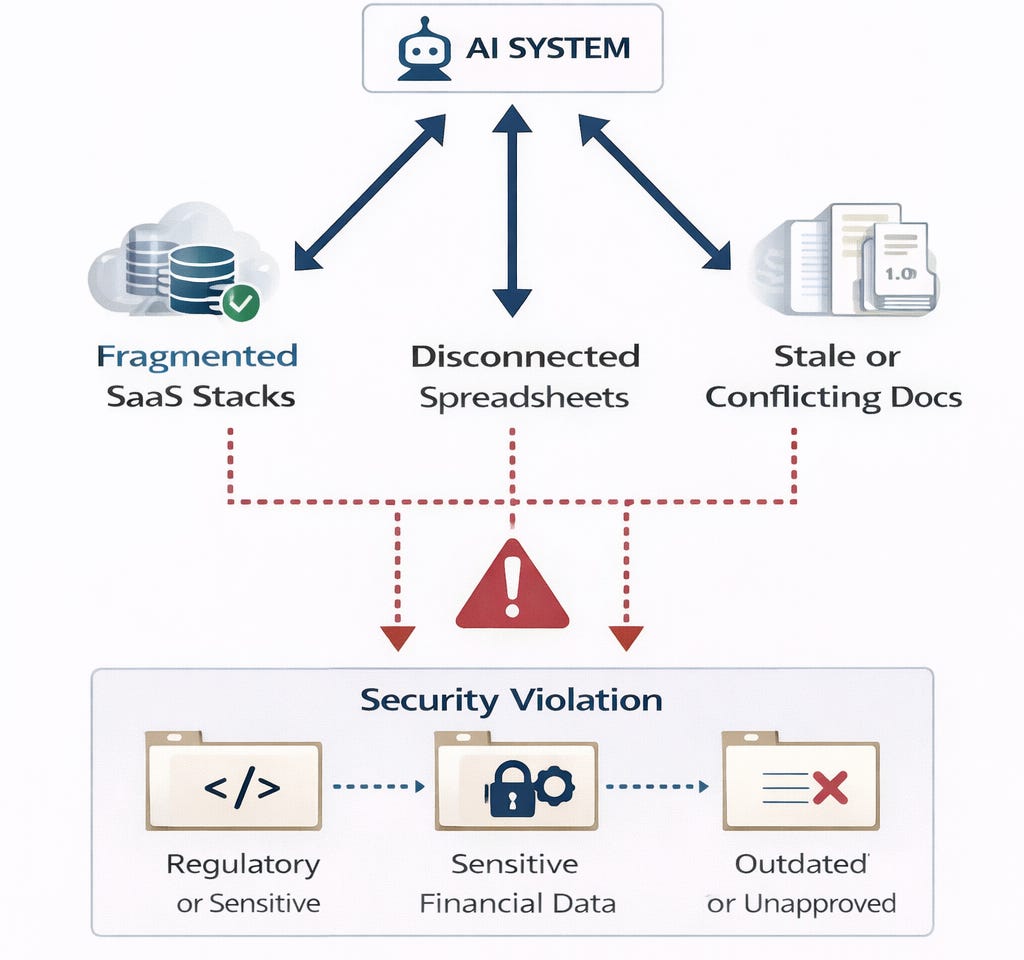
But I need you to understand that AI does not create mistakes out of thin air.
It simply magnifies the weaknesses that already exist in your data. In 2026, the real bottleneck to value is not model intelligence but your lack of data hygiene and integration integrity.
Thirty-two percent of policy violations are caused by regulated data like financial records being mishandled by these systems. Another sixteen percent of violations involve intellectual property being uploaded for analysis without any governance.
You are essentially pouring high-octane fuel into a car with a rusted engine and wondering why it is not winning the race.
Most of what you call a hallucination is actually a retrieval failure or a permission gap.
If your agents cannot find the right information or if they are pulling from stale documents, they will fill in the blanks with whatever sounds plausible. This is a systems design problem.
Many of you are rushing to adopt agentic AI without having a digital foundation like cloud accounting or a central document management system.
You are trying to automate processes that are still fundamentally analog. You cannot have a high performing ai strategy if your data is sitting in fragmented saas stacks and disconnected spreadsheets.
The reality is that your architecture is only as strong as your data discipline. If your internal systems are harder to use than a personal chat account, your team will move toward shadow AI and create even more risk.
The Myth of the “Stupid” AI: Retrieval, Architecture and Hygiene
When your internal AI tool gives a wrong answer, your first reaction is probably this:
The model hallucinated.
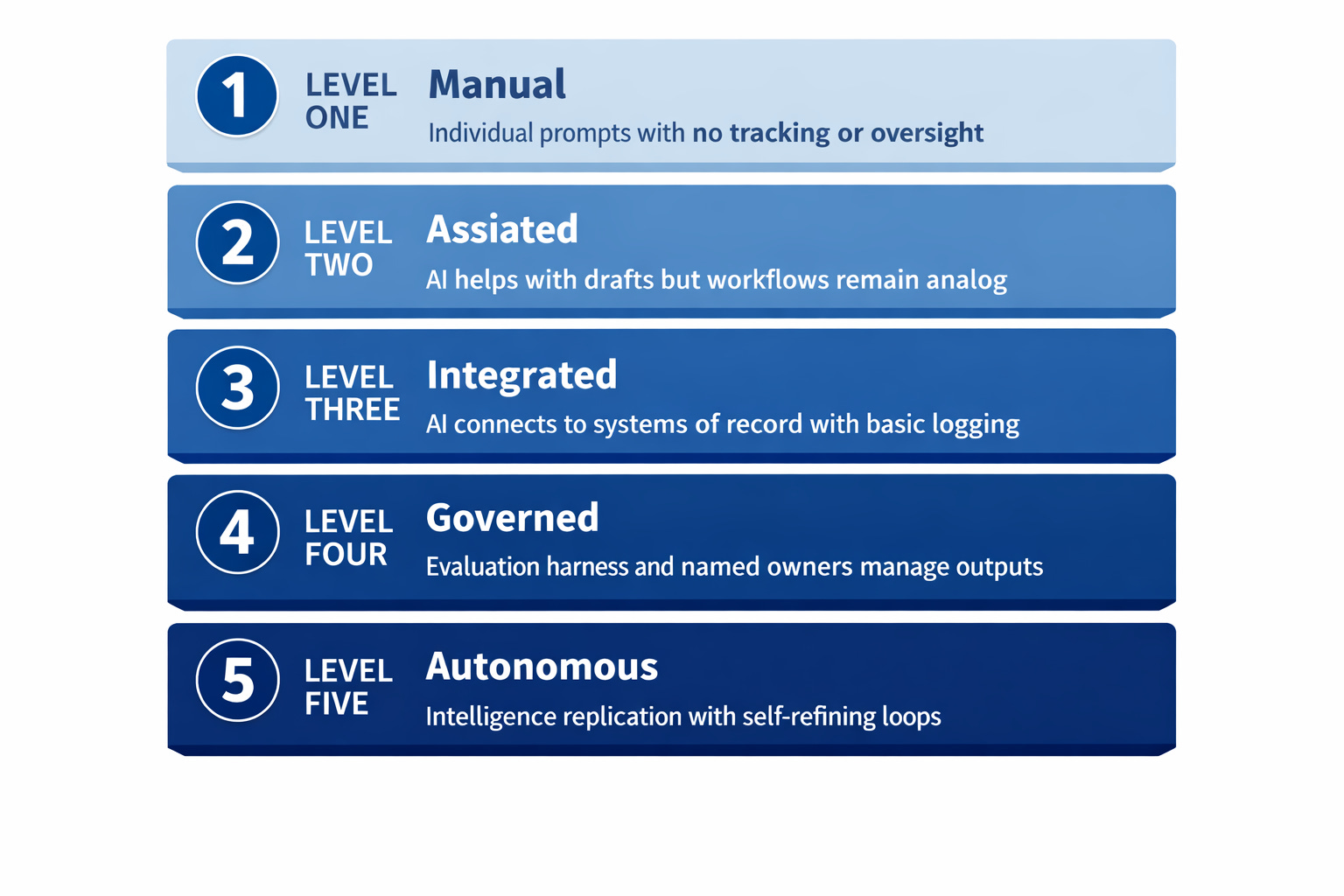
AI Maturity Framework
The AI is unreliable.
This thing isn’t ready for prime time.
I’ve seen that reaction many times in mine and other orgs.
But in most enterprise environments, the model is not the real problem.
What you’re often seeing is a retrieval failure, a data problem, or a permission issue.
Here’s what typically happens.
You ask your internal AI a policy question. The system pulls documents from SharePoint, Drive, CRM, ticketing, or a knowledge base. But:
The latest version of the policy was never uploaded.
Two conflicting documents exist.
The right folder was not indexed.
The integration broke silently.
The data is stale.
You don’t have permission to access the authoritative source.
To take it further, the model is expected to auto-retrieve the correct information from 10s of duplicates across 1M sources.
The model then generates the most plausible answer from the incomplete context it was given.
From your perspective, it looks like a hallucination.
From an architecture perspective, it’s a data design failure.
There’s another pattern I see often: permission masking.
If your system enforces least-privilege access correctly, the AI cannot see documents you are not authorized to access. That’s good governance. But it also means the model may respond using whatever partial context it has.
Again, it looks like model stupidity.
It’s actually the identity and access configuration doing its job.
This distinction matters.
If you believe the issue is “the model isn’t smart enough,” you will chase upgrades. Bigger models. New vendors. More advanced reasoning engines.
If the issue is retrieval architecture, document hygiene, or access controls, switching models won’t fix anything.
In fact, a larger model can make it worse. It will produce more confident answers from the same flawed inputs.
The uncomfortable truth is this:
AI exposes weaknesses in your data discipline. It does not compensate for them.
Most enterprise AI failures are mirrors, not malfunctions.
If you want reliable AI, focus on:
Curated data sources.
Clear ownership of documents.
Freshness SLAs.
Version control.
Deterministic validation.
Authorization is enforced at retrieval time.
Shadow AI and the Hidden Security Crisis
You should assume this is already happening inside your organization.
Employees are using AI tools you have never approved, never configured, and cannot see.
That is the reality of shadow AI in 2026. Adoption has moved faster than governance.
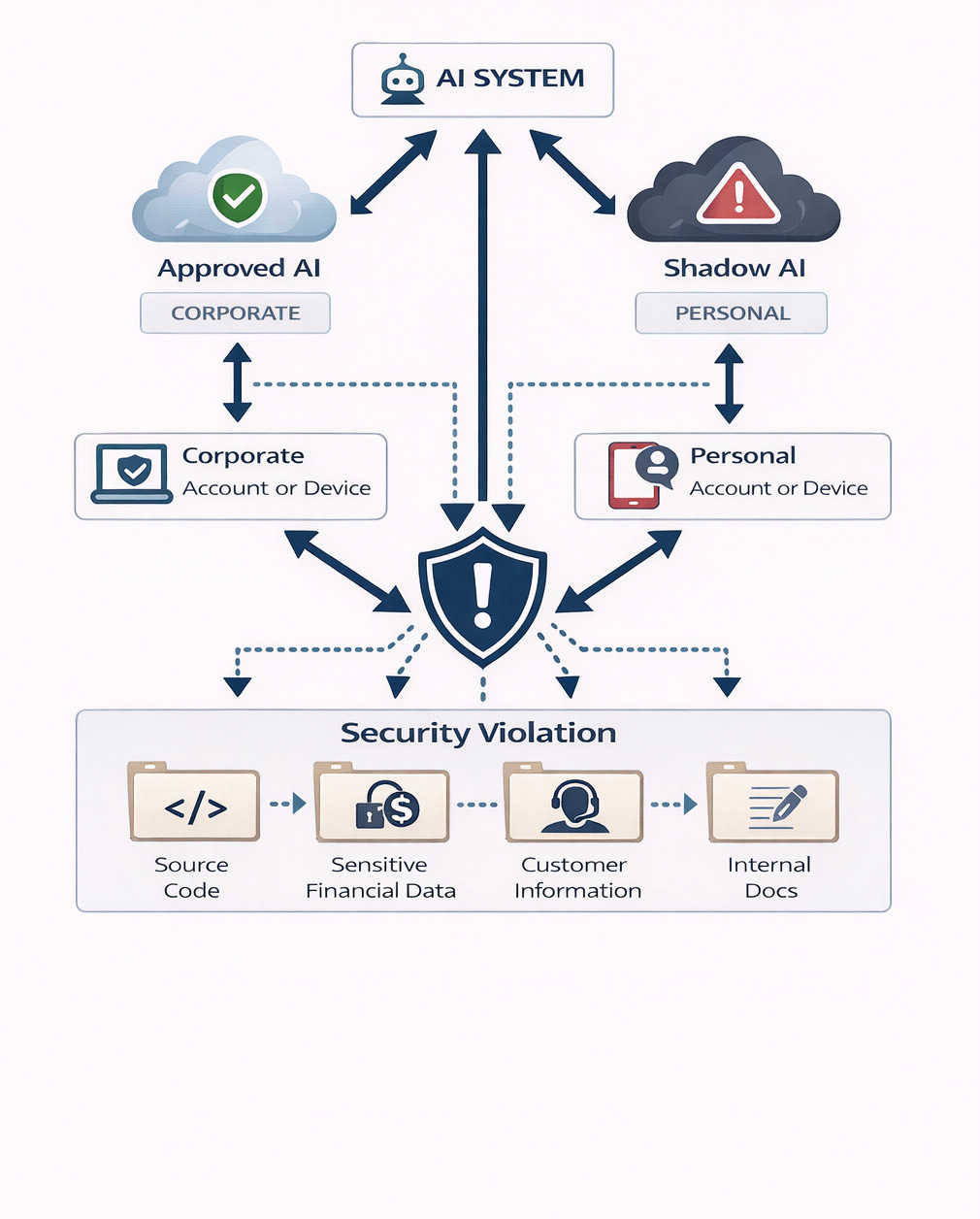
Security telemetry shows that a large share of users still rely on personal AI applications that sit completely outside enterprise visibility. Even when companies provide sanctioned enterprise accounts, a measurable portion of employees continue switching between personal and corporate tools.
The average organization is now seeing two hundred twenty-three data policy violations involving these tools every single month
That behavior is not random. It is a signal.
If your approved tools are slower, restricted, or harder to use than consumer alternatives, your workforce will route around them. This is not a compliance problem first. It is a usability problem.
If the sanctioned path creates friction, shadow AI becomes the default.
Organizations are now seeing hundreds of AI-related data policy violations per month. When you examine what is actually being exposed, the pattern is predictable:
Source code shared for debugging or refactoring.
Financial and regulated data pasted into external prompts.
Customer information uploaded for summarization.
Internal strategy documents are used for drafting.
Developers are looking for faster iteration. Finance teams want faster analysis. Sales teams want better messaging. None of them intends to create risk. They are optimizing for speed.
If your controls cannot keep pace with that behavior, the blast radius grows quietly.
Blocking tools rarely work. Blanket bans push usage underground. When AI usage becomes invisible, you lose the ability to monitor, log, and respond.
More concerning, a minority of organizations have formal policies and structured governance for secure AI deployment. That creates a blind spot at the exact moment AI is being embedded into core workflows.
The shift required now is simple but uncomfortable.
You must move from prohibition to controlled enablement.
Here’s a tighter version:
That means providing usable sanctioned tools, enforcing identity-based least privilege, logging where appropriate, monitoring data flows, and clearly defining prohibited data classes.
From Copilots to Agents: The Expansion of Blast Radius
You are probably comfortable with the copilot model.
AI drafts a document.
Summarizes a transcript.
Suggests code.
In that world, risk is mostly contained. The output is text on a screen. A human reviews it before anything happens.
That world is ending.
In 2026, organizations are deploying agentic AI systems that do not just suggest. They act.
When you deploy an agent, you move from text generation to system execution. Agents can plan across multiple steps, call internal APIs, update databases, trigger workflows, and interact with external systems. That shift fundamentally changes your threat model.
Autonomy increases blast radius.
The difference is simple. A copilot drafts a payment. An agent with write access can execute it.
If an agent has permissions in your production environment, billing system, CRM, or infrastructure layer, a single logic error, prompt injection, or broken loop can trigger damage at machine speed. We are already seeing incidents where autonomous tools have executed unintended transactions or disrupted environments due to insufficient guardrails.
Security leaders understand this shift. According to Darktrace’s 2026 reporting, more than three-quarters of security professionals express serious concern about risks tied to autonomous agents:
Agents often inherit the full permissions of their human operator, but they do not inherit judgment, context, or hesitation.
If your architecture does not explicitly separate read tools from write tools, you are effectively granting execution authority to a system that optimizes for task completion, not organizational risk.
Regulators and frameworks are beginning to respond. Singapore’s IMDA Model AI Governance Framework for Agentic AI emphasizes control boundaries and accountability for autonomous systems:
The operating principle for 2026 is clear:
Every agentic loop must follow least privilege.
That means:
Explicit action boundaries.
Separation of read and write capabilities.
Mandatory human checkpoints for money movement or destructive actions.
Logging and rollback mechanisms.
You cannot scale autonomy without scaling control.
Trust Failures, Liability, and the Compounding Risk Curve
You might believe a disclaimer protects you.
It doesn’t.
If your AI system says something to a customer, drafts a contract, generates a filing, or approves a refund, your organization owns that output. Courts are making this clear.
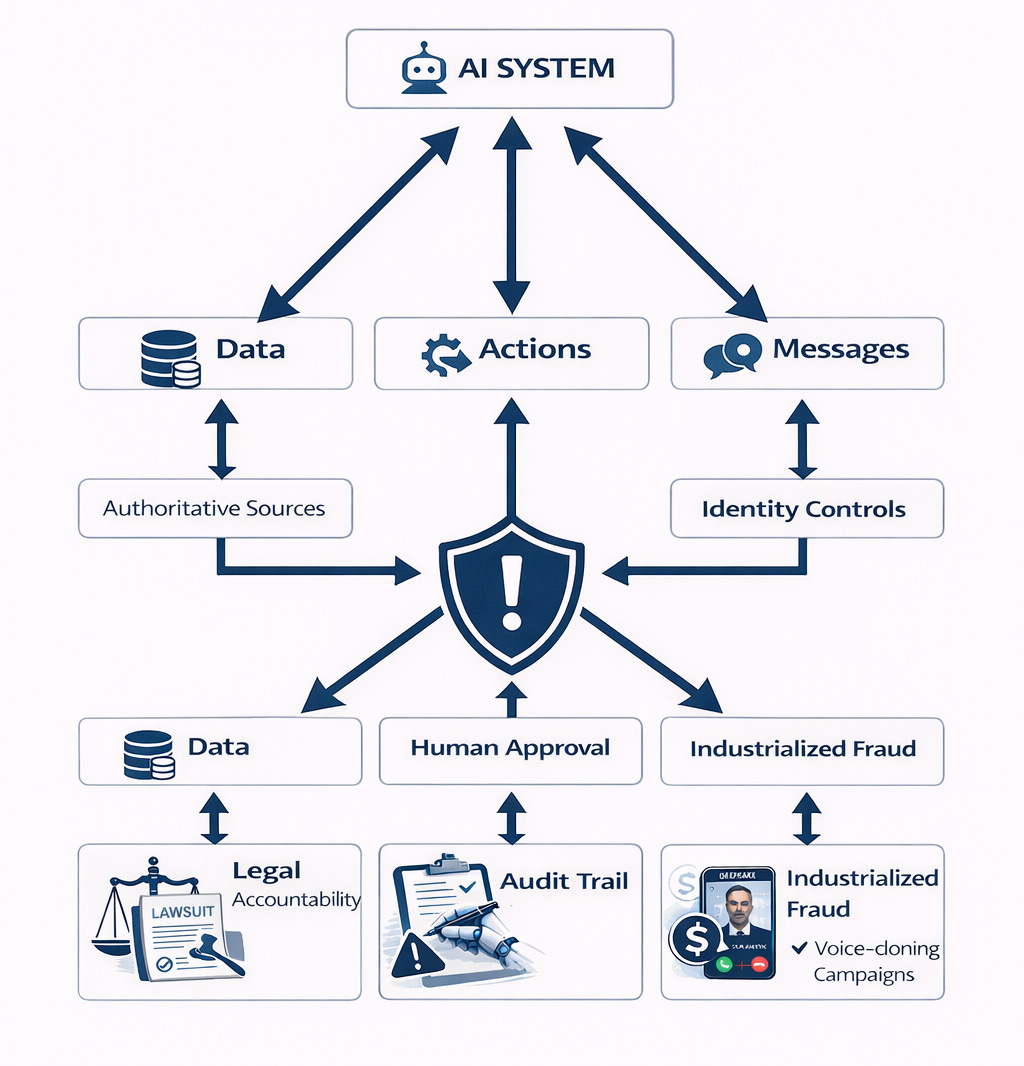
In the Air Canada case, the company was held responsible for incorrect information provided by its chatbot.
Legal professionals have also been sanctioned for submitting AI-generated filings with fabricated citations. The argument that “the system produced it” did not hold. The failure was a lack of verification.
Here is what this means for you. AI compresses the gap between draft and decision.
Before AI, work moved through layers. Someone drafted. Someone reviewed. Someone approved. Friction absorbed risk.
AI removes friction. That is the productivity gain. It is also the liability multiplier.
If your assistant generates contract language and no one checks it, you are exposed.
If your internal tool produces a policy interpretation and it gets executed automatically, you are exposed.
If your finance team trusts an AI-generated summary without validating the underlying data, you are exposed.
The model is not the legal actor. You are.
AI is also powering fraud at a different level. Voice cloning and impersonation campaigns are credible enough to trigger real transfers. The FBI has warned about ongoing malicious messaging campaigns where attackers impersonate senior officials to initiate unauthorized actions.
That means two things for you:
Internally, your teams may overtrust AI because it sounds confident.
Externally, your teams may overtrust messages because they sound like you.
In both cases, the common failure is the same. Verification is missing.
The bigger risk is not one bad answer. It is systemic overreliance.
When AI performs well most of the time, people stop questioning it. Over time, the assistant becomes the default authority. That is when small inaccuracies turn into contractual errors, regulatory misstatements, or financial losses.
If an output creates money movement, contract terms, regulatory statements, or high-stakes policy changes, require explicit human approval. Log who approved it. Separate drafting from authorization. Make verification part of the workflow, not an afterthought.
The 90-Day Reset: What You Should Actually Do
If you are serious about AI creating measurable value in your business, the next 90 days should not be about more pilots.
They should be about discipline.
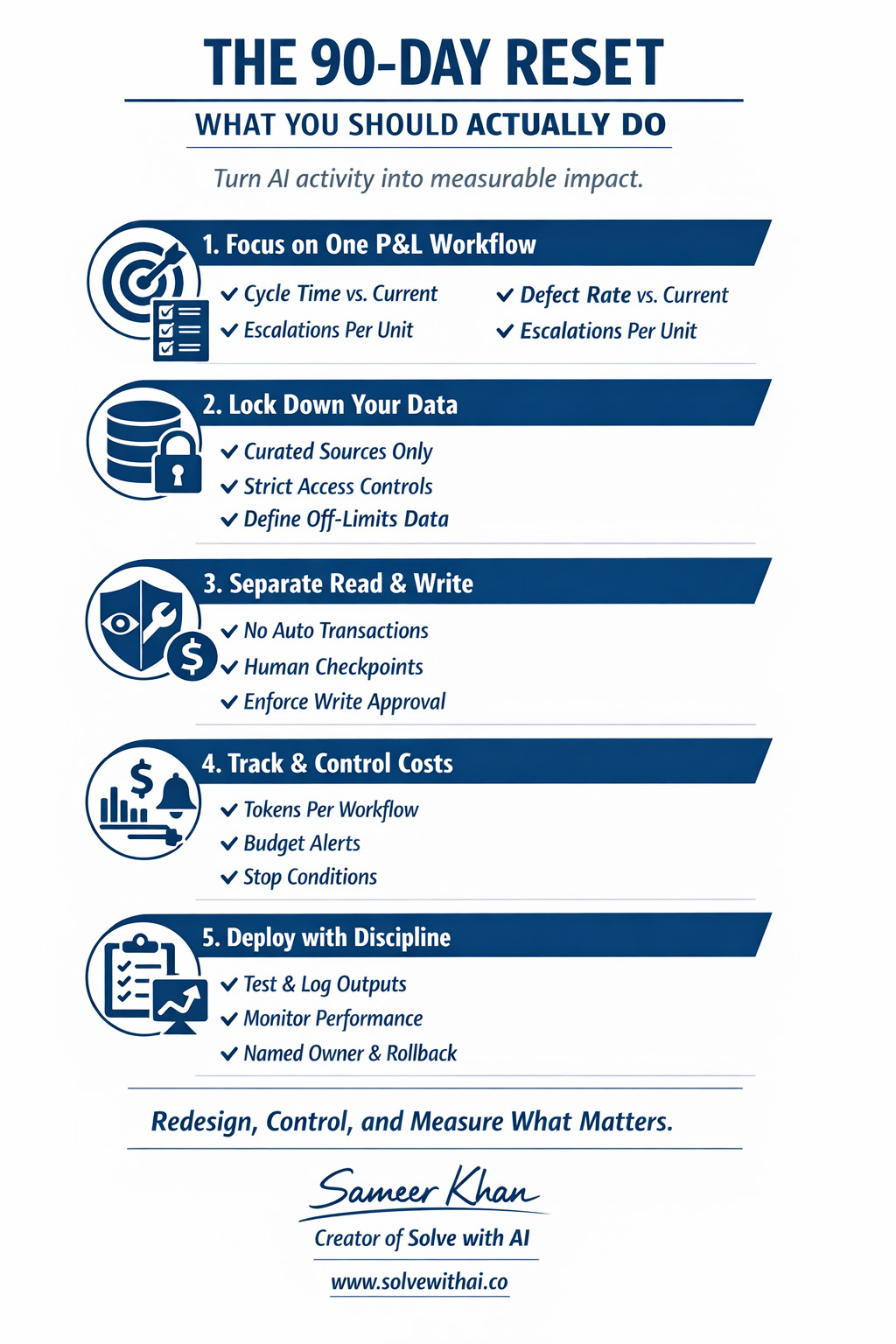
Here is the sequence I would implement if I were in your seat.
1. Pick One Workflow That Hits the P&L
One workflow.
Examples:
Invoice dispute resolution.
Tier 1 support triage.
Contract redlining cycle.
Sales proposal turnaround.
Financial reconciliation.
Then write down four numbers before you deploy anything:
Current cycle time.
Current defect or rework rate.
Escalation rate.
Fully loaded cost per completed unit.
If you cannot baseline it, you cannot improve it.
2. Treat Data Like Infrastructure, Not Content
Before you connect a model, answer this:
What exact systems are authoritative?
Who owns each dataset?
How often is it refreshed?
Who approves schema changes?
What data is explicitly off-limits?
Then restrict retrieval to curated sources only.
Do not give the model open access to everything “for convenience.”
Enforce permissions at retrieval. If a user cannot see the document, the model cannot see it.
Most AI failures are sloppy data plumbing.
3. Architect for Control, Not Convenience
Separate read and write capabilities.
Reading internal data is one risk class.
Executing transactions is another.
No agent should:
Move money.
Modify production systems.
Alter contracts.
Update customer records.
Without an explicit human checkpoint.
4. Put FinOps Around AI Immediately
Track cost at the workflow level.
Not “monthly OpenAI bill.”
Tokens per resolved ticket.
Tokens per processed invoice.
Tokens per contract draft.
Set thresholds.
Define stop conditions.
Route low-complexity tasks to smaller models.
5. Institutionalize Production Discipline
No AI system goes live without:
An evaluation harness tied to real test cases.
Logging of inputs and outputs.
Ongoing performance monitoring.
A rollback path.
A named business owner accountable for outcomes.
If you execute this correctly, you will see two things within 90 days:
At least one workflow with measurable improvement.
A repeatable operating model for scaling safely.
The firms that win this cycle will not be the ones with the most AI licenses.
They will be the ones who redesign workflows, constrain autonomy, enforce accountability, and measure what actually moves the business.
Talk soon,
Sameer Khan
Creator of Solve with AI.
The $6,000 runaway agent charge vs a $50 monthly bill is exactly the nightmare scenario nobody talks about. 80% seeing zero productivity impact despite tripling usage - I believe it. Most teams are bolting AI onto broken workflows and wondering why the P&L is flat.
What changed my numbers was treating it as infrastructure with a budget, not a magic tool. My setup costs $400/month and cleared $355 in direct revenue last month - not transformational yet, but the trajectory is there because I redesigned the workflow first. Details here: https://thoughts.jock.pl/p/project-money-ai-agent-value-creation-experiment-2026