

AI Projects I Would Kill on Day 1 as a Chief AI Officer
Most CAIOs ask what to build. The right question is what to stop.

Hey Productivity Explorer,
Most people step into a Chief AI Officer role and immediately ask, “What should we build?”
I’d ask a different question.
What do we kill?
Because here’s what nobody tells you before you walk through that door. The AI graveyard isn’t somewhere out there in other companies.
It’s unfortunately inside yours.
It’s sitting in your roadmap, consuming your budget, occupying your best engineers, and wearing the costume of progress while delivering absolutely nothing.
80% of AI projects fail to deliver their intended business value. Not because the technology doesn’t work. Not because the team isn’t smart. Because companies keep pouring resources into the wrong things and calling it innovation.
Day one as a CAIO should not be about vision decks and transformation speeches. It’s about triage.
The most valuable thing I could do for any organization is to have the courage to shut down the ones that were never going to work in the first place.
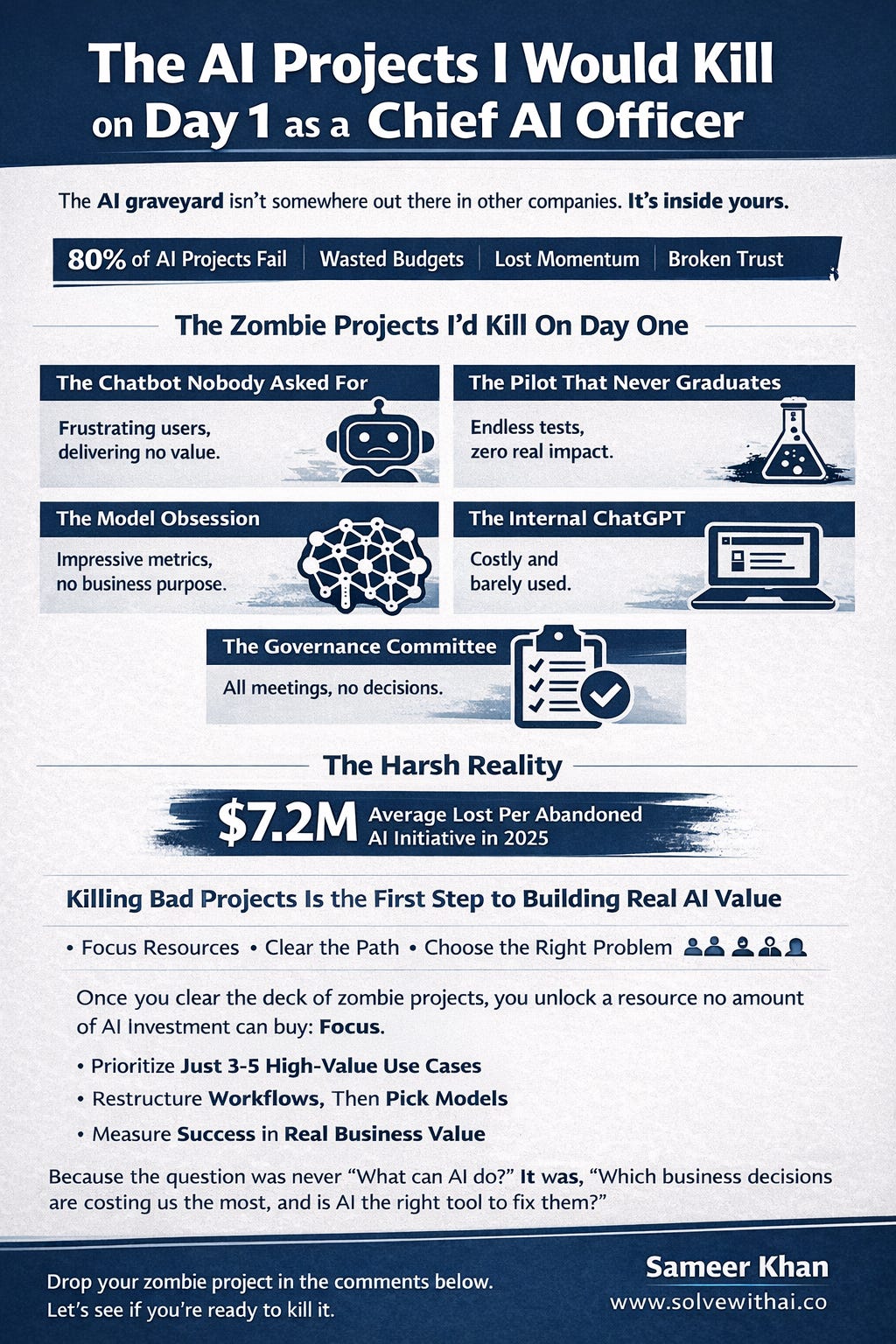
Table of Content
Why the First Question Is Wrong
Kill #1: The Chatbot Nobody Asked For
Kill #2: The Pilot That Never Graduates
Kill #3: The Model Obsession
Kill #4: The Internal ChatGPT Nobody Uses
Kill #5: The Governance Committee That Governs Nothing
This Is Not About Being Destructive
What I Would Build Instead
This Is Not What the Boardroom Wants to Hear
Killing a project is harder than launching one. Launching feels like leadership. It gets applause, budget approvals, and LinkedIn announcements.
Killing something requires you to look at the people who built it, the executives who championed it, and the sunk costs that are already on the books, and say, “This isn’t working, and we need to stop.”
That takes a different kind of courage entirely.
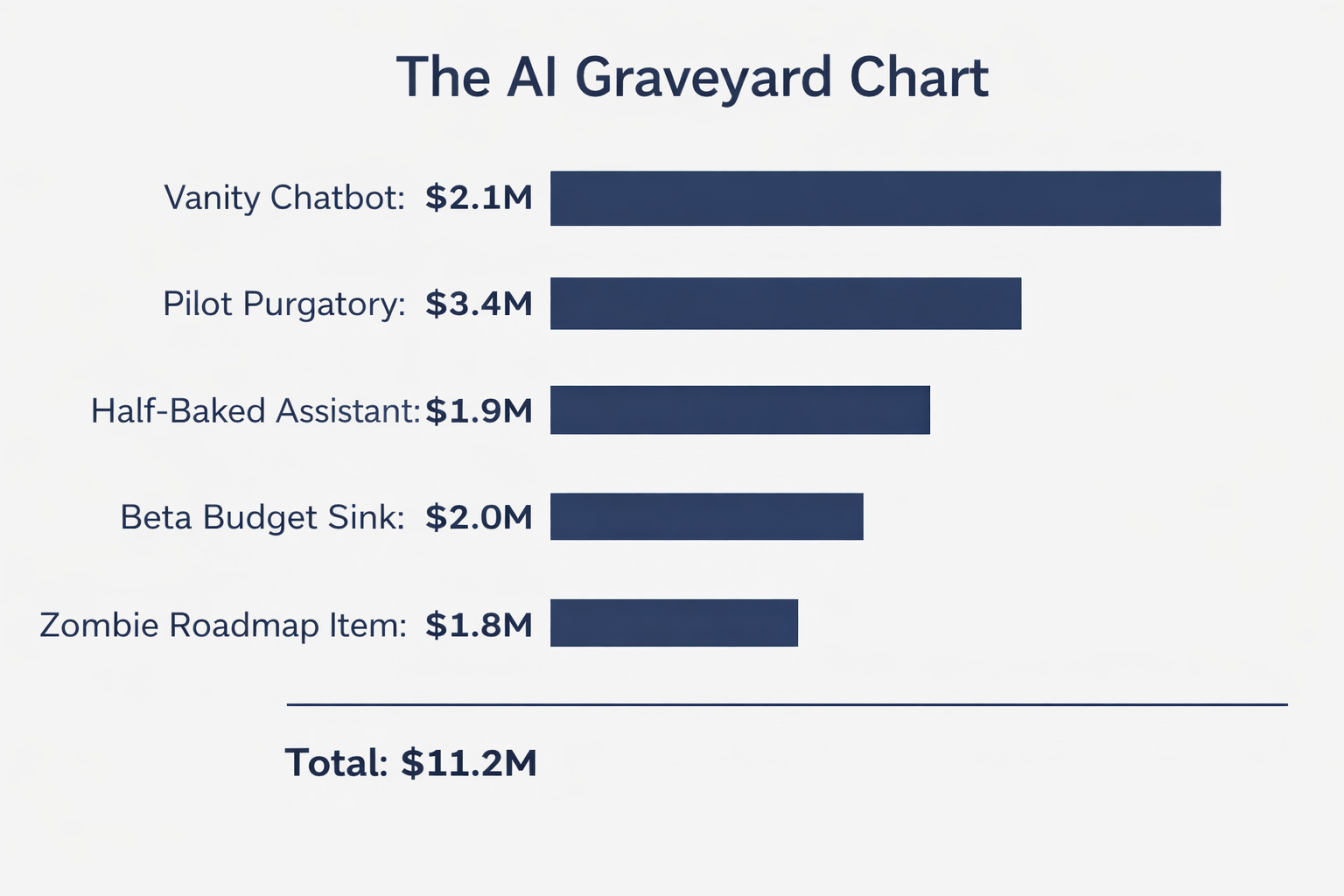
But the math doesn’t care about feelings. The average enterprise lost $7.2 million per abandoned AI initiative in 2025. The ones that waited longest to pull the plug lost the most, not just in money but in something far more expensive. Momentum. Trust. The willingness of the organization to try again.
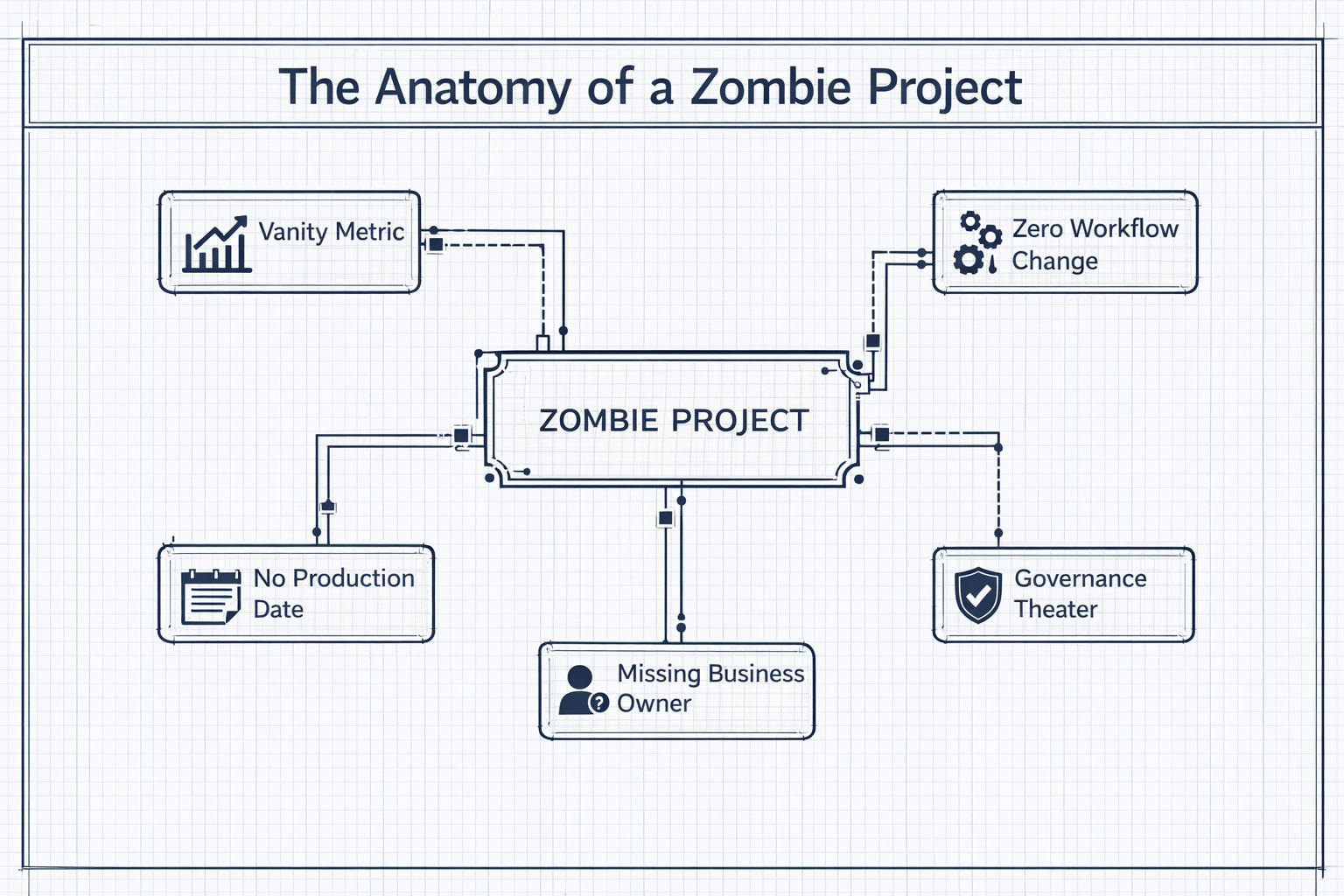
Every zombie AI project that stays alive on life support is quietly taxing the projects that actually deserve a chance.
So before I sketch a single vision, before I hire a single engineer, before I sit in a single strategy session about what AI could do for this company, I need to walk the floor and find out what’s already broken.
Here is exactly what I would shut down on day one.
Kill #1: The Chatbot Nobody Asked For
You’ve seen this one. Every company has one.
It lives on the customer service page. It has a friendly name, maybe even a little avatar. It was announced internally with great excitement about “transforming the customer experience.”
Right now, it is handling about 4% of incoming tickets, frustrating everyone it touches, and quietly destroying customer trust one bad interaction at a time.
Nobody built this because customers asked for it. Nobody built it because the data showed a gap that AI could fill. They built it because a competitor launched one, someone in the C-suite saw it at a conference, and suddenly it became the thing we needed to do to prove we were serious about AI.
I would not call that a strategy. That is fear dressed up as innovation.
Air Canada learned this the hard way when their chatbot gave customers misleading information and ended up in court over it.
That is what happens when you deploy AI for optics instead of outcomes.
Vanity AI is the most expensive kind because it burns two things at once. Budget and trust. When your employees and customers have a bad AI experience early, you spend twice as much convincing them to give the next thing a chance.
On day one, this one is gone.
Kill #2: The Pilot That Never Graduates
You know this project too.
It has been “in testing” for fourteen months. There is a dedicated Slack channel. There are weekly update emails with color-coded status reports. Someone gave it a codename that people say with genuine affection. And if you ask anyone when it goes live, they smile and say, “We’re getting close.”
Close to what, exactly?
This is what I call Pilot Purgatory.
The proof of concept that works beautifully in a sandbox impresses everyone in the demo room, and somehow never makes it into the real world.
Not because the technology failed, but because nobody defined what graduation looked like before the project started.
If there was no clear path to production written into the original brief, there never will be. What exists instead is an expensive science experiment that makes people feel like progress is happening without any of the accountability that real progress demands.
The average organization scrapped 46% of AI proof of concepts before they ever reached production in 2025. Nearly half gone before they ever touched a real user, a real workflow, or a real business outcome.
I have sat in rooms where a pilot has consumed two engineers, a product manager, and 12 months of runway, and the team is still describing it as “early stage.” That is not an early stage. That is a project without a destination.
On day one, if it cannot tell me its production date, it cannot tell me anything useful at all.
Kill #3: The Model Obsession
This one is sneaky because it looks like real work.
The team is heads down. The engineers are brilliant. The Notion docs are immaculate, and if you ask them how the project is going, they will pull up a dashboard and show you accuracy metrics, F1 scores, precision, and recall numbers that would make any data scientist nod with genuine respect.
Then you ask the one question that matters.
What business problem does this solve?
…And the room gets quiet in a very specific way.
This is the model obsession trap. A team so focused on making the AI technically impressive that they forgot to stay connected to the reason it was built in the first place.
No business stakeholder owns the outcome. No success metric tied to revenue, retention, or cost. Just a model getting incrementally smarter in a vacuum while the rest of the organization waits for something useful to arrive.
Engineering teams spending quarters optimizing model performance while integration work sits untouched in the backlog is one of the most consistent patterns separating AI projects that ship from AI projects that die quietly in a shared drive folder.
The brutal truth is that a model with 94% accuracy that nobody uses is worth less than a simple rule based system that solves the actual problem every single day.
I am not paying for impressive. I am paying for impact.
On day one, if the success metric lives inside the model and not inside the business, the project does not survive the morning.
Kill #4: The Internal ChatGPT Nobody Uses
This one has the biggest gap between how it sounds in the boardroom and what it actually does in the real world.
The pitch is always compelling: We need our own secure internal AI assistant.
We cannot trust third party tools with our data. We will build something custom, something that knows our company, something our people will actually want to use every single day.
Two million dollars later, the system summarizes emails and answers basic questions.
It’s over-engineered, slow, and disconnected from real workflows.
Every query runs through layers of orchestration, retrieval, and approvals, turning a simple task into a prolonged wait.
Not because the models are weak, but because the system was designed without a clear business outcome.
I have seen this project in more organizations than I can count, and it follows the same arc every single time. Months of infrastructure work, a lengthy security review, and a big internal launch with an impressive demo.
Six weeks later, adoption flatlines because it only does what employees could already do with a $20/month tool they were likely using anyway.
The justification is always data security and governance.
I do agree that sometimes that concern is legitimate. But more often, it is a cover story for something less comfortable to admit. The organization wanted to feel like it was building something, not just buying something. There is a pride tax buried inside this project, and the company is paying it every single month.
MIT’s research is unambiguous on this. Companies that force generative AI into existing processes with minimal workflow redesign see no measurable business impact. A private wrapper around a foundation model with no workflow integration is the purest version of that mistake.
On day one, the budget it was consuming goes somewhere that will actually move the needle.
Kill #5: The Governance Committee That Governs Nothing
This is the kill that will make people uncomfortable. That’s the intent.
Because not every zombie project is a technical one. Sometimes, the most dangerous AI initiative in a company is not a model or a chatbot or a pilot stuck in purgatory.
Sometimes it is a 12 person committee that meets on the third Thursday of every month, produces beautifully formatted PDF reports, and has never once made a decision that changed how anything actually works.
I call this Governance Theater.
It exists because someone senior got nervous about AI risk, which is a completely legitimate feeling, and the response was to form a committee, which feels like a solution but is actually just a way of distributing the discomfort across more calendars.
The committee discusses and documents risk.
It creates frameworks for thinking about risk. Meanwhile, the teams doing real AI work either wait months for approvals that mean nothing or quietly route around the committee entirely because they cannot afford to wait.
Real governance is not a meeting. It is not a PDF. It is not a working group with a charter that nobody has read since the kickoff call.
Real governance is embedded directly into the workflow. It is the guardrail that exists inside the system, not the report that describes what the guardrail should probably look like someday.
Traditional governance that locks everything down and documents everything creates the exact opposite of what AI development actually needs. You end up with bureaucracy wearing the costume of responsibility, while the people doing the real work find ways around it just to get anything done.
On day one, the committee is dissolved.
The two people in that room who were actually driving anything useful get seats at the real table. The rest of the meetings get cancelled, and everyone quietly gets three hours of their week back.
This Is Not About Being Destructive
If you have read this far and you think this is the perspective of someone who does not believe in AI, you have missed the point entirely.
That’s not what I am sharing.
Everything I just described killing represents millions of dollars, months of engineering time, and organizational energy that could have been pointed at something real.
That is what this is about. Not cynicism. Surgery.
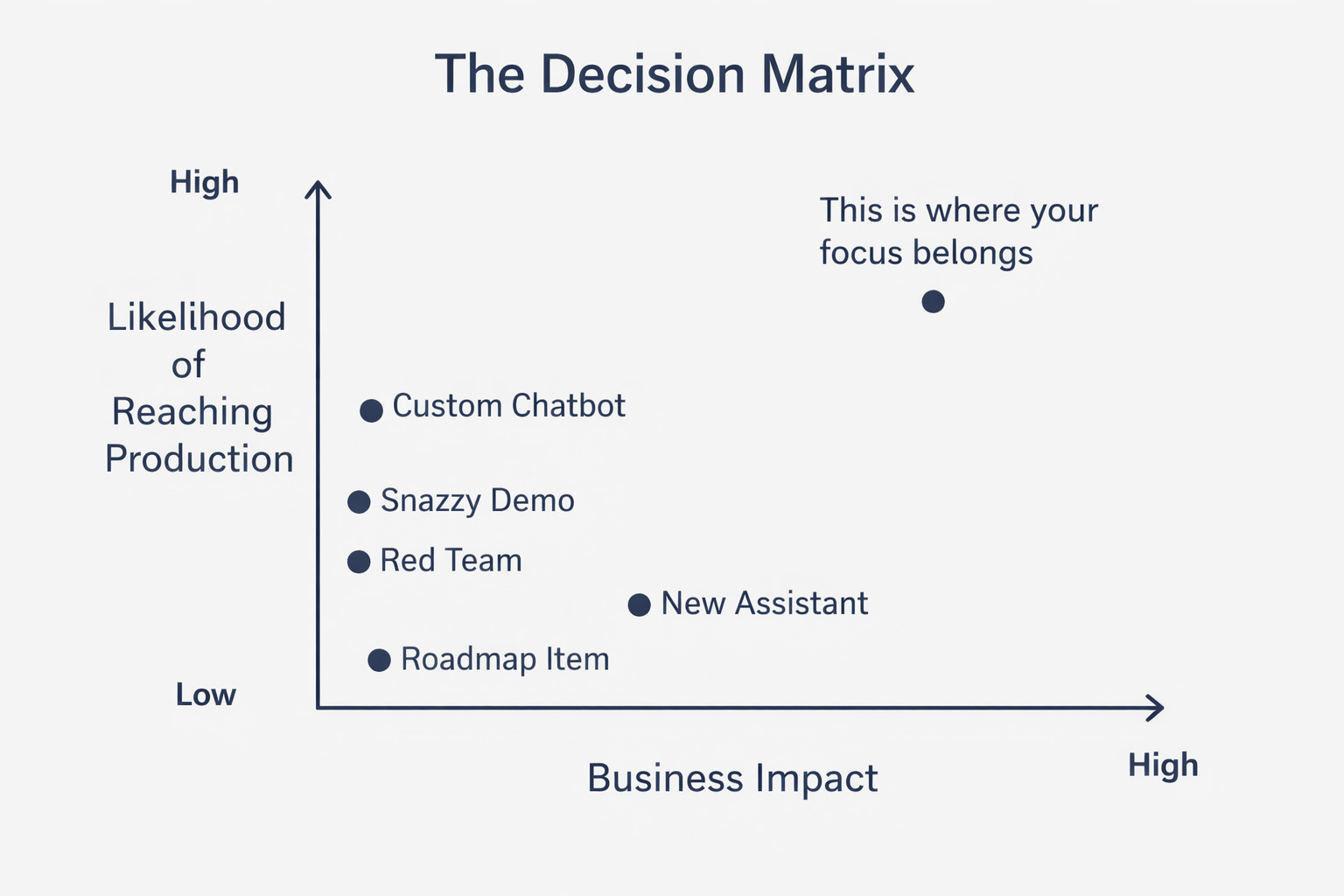
Because here is what I have learned watching companies navigate this. The ones actually winning with AI right now are not the ones who launched the most initiatives.
They are the ones who said no fast, killed ruthlessly, and protected their best people’s attention long enough to go deep on the things that actually mattered.
McKinsey’s research confirms it. Organizations reporting significant financial returns from AI are twice as likely to have redesigned their workflows before they ever selected a model or wrote a single line of code. They started with an unambiguous business problem and worked backwards. Every single time.
That discipline is the whole game.
The companies stuck in the AI graveyard did the opposite. They started with the technology and went looking for a problem to attach it to. They optimized for looking innovative rather than being effective. And they are now sitting on hundreds of millions in sunk costs, with boards asking increasingly uncomfortable questions about where the returns are.
Killing bad projects is not the end of an AI strategy. It is the beginning of one worth having.
The moment you stop protecting things that do not deserve protection, you create space for something that does.
What I Would Build Instead
Once you clear the deck, something interesting happens.
The engineers buried in pilot purgatory are suddenly available. The budget funding a chatbot nobody asked for is back on the table.
The two smart people writing governance PDFs nobody reads are now in the room where real decisions get made. For the first time in a long time, the organization has one resource no amount of AI investment can manufacture.
Focus.
But focus without direction is just a cleaner kind of confusion. And this is where most companies make their next mistake. They kill the bad projects, free up the budget, and then immediately start filling the space with new initiatives before they have done the one thing that actually determines whether any of it works.
Choosing the right problem.
I wrote about this in depth in my last piece.
The companies generating real AI returns are not the ones doing more. BCG found that leaders prioritize an average of 3.5 use cases, compared to 6.1 for everyone else, and generate twice the ROI.
Because they are more disciplined about where AI actually creates business value versus where it just looks impressive in a demo.
If you want a practical framework for finding where that value actually lives inside your business, and how to quantify it before you spend a single dollar, that is exactly what I broke down in how to find $100M in AI value without building more models. Start there before you start building anything.
Because the question was never what AI can do.
It was always about which decisions in your business are broken, what it costs you every day they stay broken, and whether AI is genuinely the right tool to fix them.
That clarity is what separates the 5% that win from the 95% still searching for their first real return.
So here is my question for you.
What is the zombie project sitting inside your organization right now that everyone knows is not working, but nobody has dared to kill yet?
Drop it in the comments. Because I have a feeling you already know exactly which one it is.
Talk soon,
Sameer Khan
Creator of Solve with AI.