

AI Is Not a Software Story Anymore
The Hidden Constraints Shaping the Next Decade

Hey Productivity Explorer,
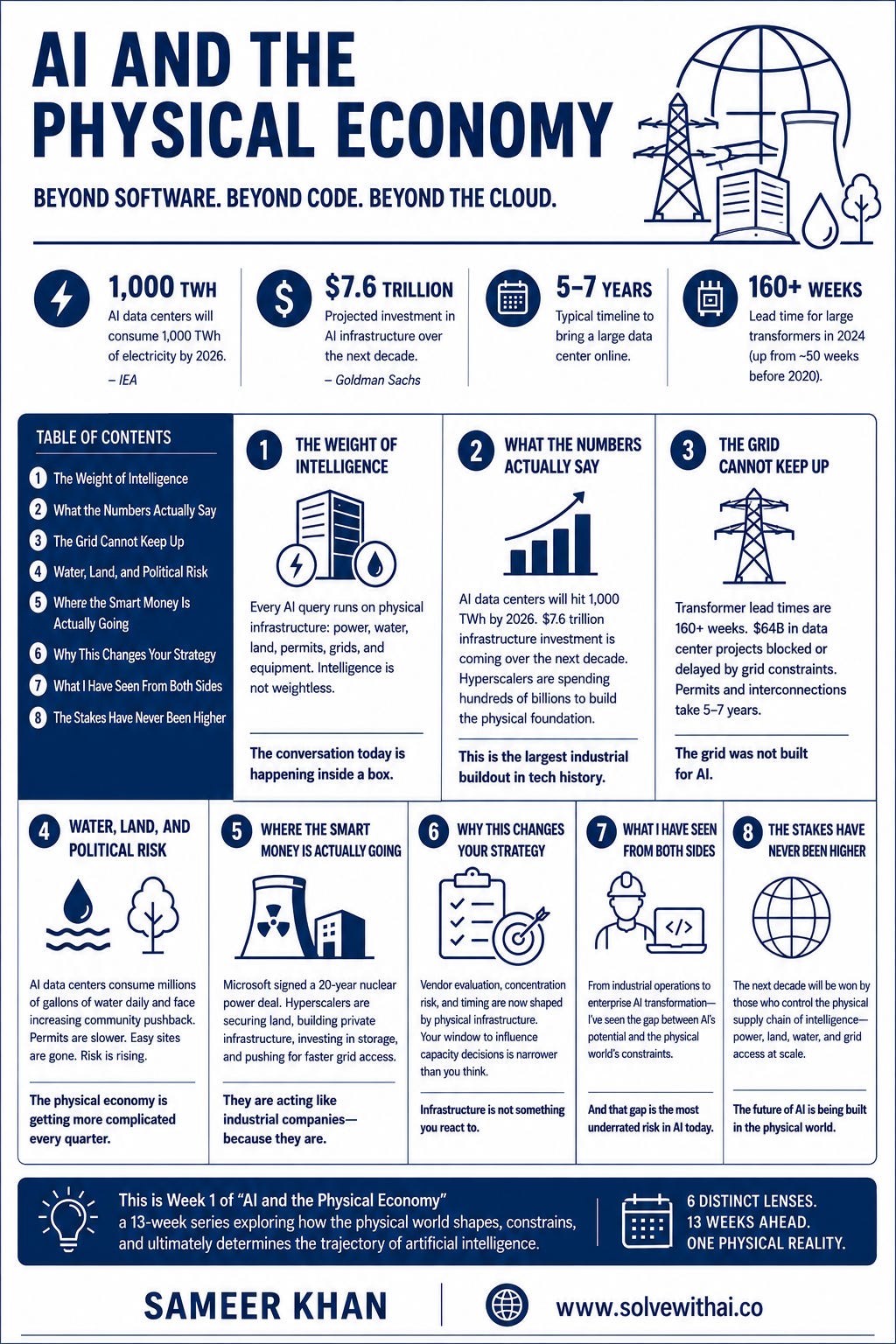
Every conversation about AI for the past 3.5 years has happened at the software layer.
Models. Code. Interfaces. APIs. Compute efficiency. Token costs.
The assumption stated or not was that AI is fundamentally a digital phenomenon. Something that lives in the cloud and is weightless.
That assumption is breaking.
The next decade of AI will be won by whoever controls the physical supply chain of intelligence: the power, the land, the grid connections, and the permits that make any of the software possible in the first place.
We are not in a software race anymore. We are in an infrastructure race, and most of the people still debating AI strategy have not looked up from their laptops long enough to notice.
Table of Contents
1. The Weight of Intelligence
2. What the Numbers Actually Say
3. The Grid Cannot Keep Up
4. Water, Land, and Political Risk
5. Where the Smart Money Is Actually Going
6. Why This Changes Your Strategy
7. What I Have Seen From Both Sides
8. The Stakes Have Never Been Higher
The Weight of Intelligence
There is a version of the AI story that feels almost frictionless. You open your favorite AI app or SaaS with embedded LLM, type a prompt, and get an answer. The intelligence appears instantly, as if conjured from nothing. That experience is so seamless, so immediate, that it is easy to forget what actually powers it.
Behind every query, every generated document, every AI-assisted decision sits a physical machine drawing electricity, consuming water to stay cool, occupying land inside a building that took years to permit and build.
None of that is abstract or weightless. In fact as the demand for AI capability grows, the physical infrastructure required to support it grows with it at a pace that the world’s power grids, water systems, and regulatory timelines were simply not designed to absorb.
I am not making this up as this is a know fact but unfortunately people only focussed on the visible part of AI.
Think about what it takes to run a large language model at scale. I am not talking about training the model because that is a separate, enormous conversation but just to run it, to serve it to users around the world in real time.
You need data centers.
Those data centers need massive, uninterrupted power.
Need cooling, which means water.
Need land, which means permits.
Need grid connections, which means transmission infrastructure.
All of that needs to exist before a single model can answer a single question.
The frictionless experience that users see is built on top of an extraordinarily heavy physical foundation. Once you understand that, the entire AI landscape looks different.
The questions that matter most shift from being purely about model quality and start being about megawatts and permits and water rights and transmission capacity. The conversation today is happening inside a box, and nobody is describing the box.
What the Numbers Actually Say
The International Energy Agency estimated that AI data centers consumed roughly 460 terawatt-hours of electricity globally in 2022.
For context, that is more electricity than many entire countries use in a year. The IEA projects that figure will more than double, reaching 1,000 terawatt-hours by 2026.
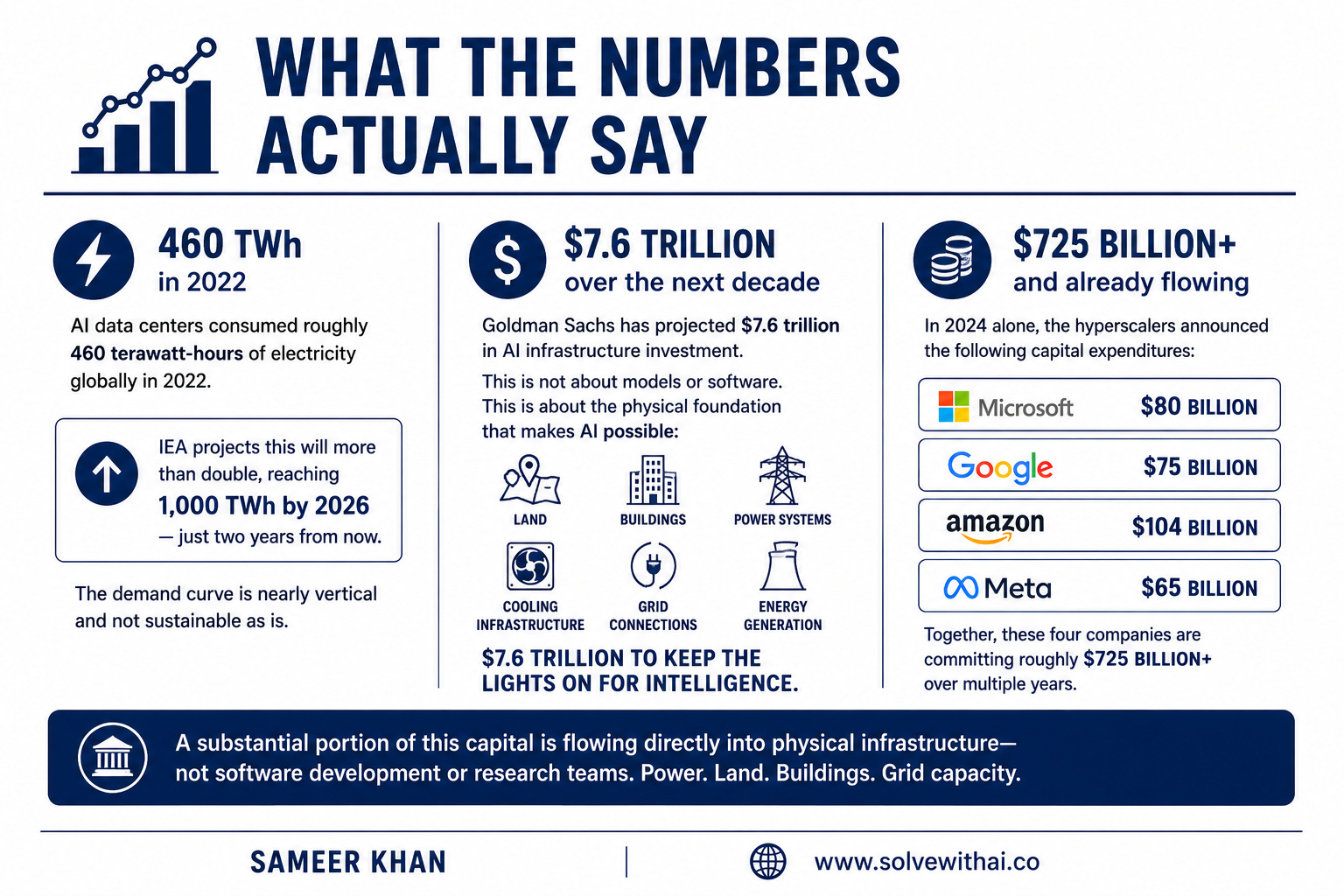
Two years from now. The demand curve is not gradual. It is nearly vertical and not sustainable unless something is done about it.
Goldman Sachs has projected $7.6 trillion in AI infrastructure investment over the next decade. That is not investment in models or software or API access where the Wallstreet usually focusses.
That is investment in the physical substrate that makes AI possible at all such as land, buildings, power systems, cooling infrastructure, grid connections, and the energy generation capacity to feed it. 7.6 trillion dollars to keep the lights on for intelligence.
Consider where the capital is actually flowing right now.
In 2024 alone,
Microsoft announced $80 billion in capital expenditure.
Google committed $75 billion.
Amazon allocated $104 billion.
Meta put forward $65 billion.
Those four companies together are committing something in the range of $725 billion over multiple years, and a substantial portion of that money is flowing directly into physical infrastructure.
Not software development or research teams. Power. Land. Buildings. Grid capacity.
These are the largest capital expenditures in the history of technology. They make the industrial buildouts of the 20th century look measured by comparison. These investments are happening because the people running these companies understand something the broader business conversation has not absorbed: intelligence at scale is a physical problem, and the physical problem is harder than anyone publicly admits.
The Grid Cannot Keep Up
The electrical grid particularly in the United States was not built for this.
It was built for a different era of consumption, with different demand patterns and a different pace of change. Data centers are uniquely demanding in ways that strain grid operators: they want power at high volumes, with minimal interruption and 24/7.
That profile puts enormous pressure on systems that were designed around very different assumptions about who needs power, when they need it, and how much.
Before 2020, the lead time for large electrical transformers the equipment that steps voltage up or down to move power through the grid was around 50 weeks.
By 2024, those lead times had grown to over 160 weeks. That is more than three years just to procure one piece of critical equipment. You cannot accelerate AI deployment faster than you can procure transformers, and right now, you cannot procure transformers on any timeline that matches the speed at which AI companies want to scale.
The consequences are direct and expensive. According to Data Center Watch, by 2024, $64 billion worth of data center projects had been blocked or delayed specifically by grid constraints.
Not by zoning opposition or community resistance.
By the inability to get power to the site. Sixty-four billion dollars in committed capital, stalled because the grid could not keep up. That number will grow.
The permitting and grid interconnection timelines compound everything else. In many US markets, the full process of securing grid interconnection, completing environmental review, navigating local permitting, and getting a large facility online takes five to seven years.
Five to seven years!
Meanwhile, AI model capability is advancing on roughly an annual cycle. The mismatch between those two timelines is not a minor operational detail. It is a structural constraint on how fast AI can actually scale in the real world, and it is one that no amount of model efficiency can close.
Water, Land, and Political Risk
Power is the most visible constraint. It is not the only one.
AI data centers consume water at a scale that is beginning to generate real political friction. Cooling these facilities requires enormous volumes of water i.e. millions of gallons per day at large sites.
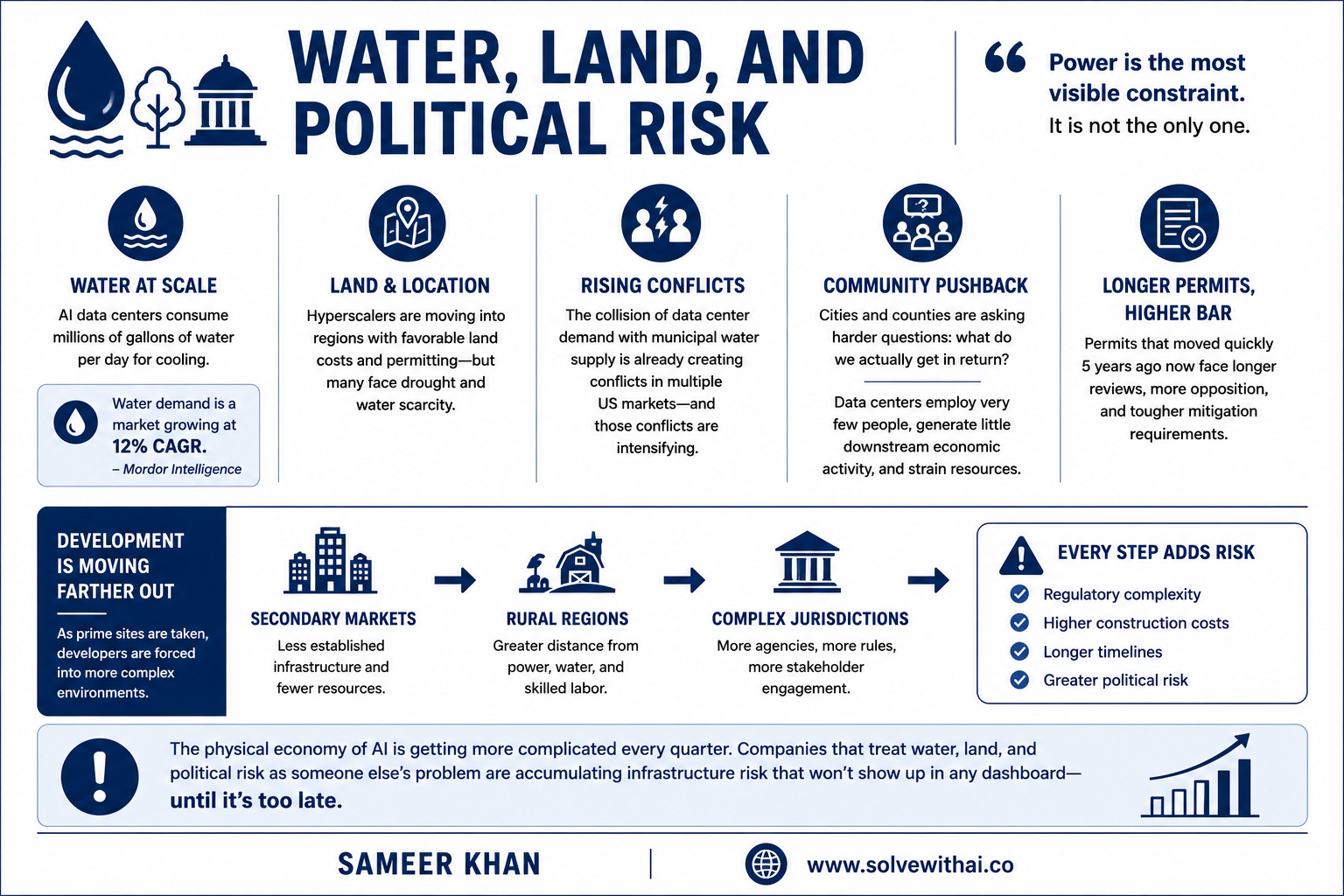
As hyperscalers look for land to build on, they have increasingly moved into regions with favorable land costs and permitting environments. Some of those regions also face drought conditions or water scarcity pressures.
The collision of data center demand with municipal water supply is already producing conflicts in multiple US markets, and those conflicts are intensifying.
Mordor Intelligence tracks data center water consumption as a market growing at 12% CAGR faster than almost any other infrastructure segment.
That growth lands somewhere. It lands in communities that were not planning for it.
Cities and counties that once competed aggressively for data center investment are now asking harder questions.
What do we actually get in return?
Data centers employ very few people relative to their footprint and resource consumption. They do not anchor supply chains or generate downstream economic activity at the scale that traditional industrial development does.
The community calculus is shifting, and permits that might have moved through quickly five years ago are now facing longer review cycles, more organized opposition, and more demanding mitigation requirements.
As the most obvious and well-serviced sites in major markets get taken, development is moving into secondary markets, rural regions, and increasingly complex jurisdictional environments.
Every step away from established infrastructure adds regulatory complexity, construction cost, and timeline risk.
The easy sites are gone.
What is left requires more capital, patience, and local political navigation than anything the industry has had to manage before.
The physical economy of AI is not just complicated, but it is getting more complicated every quarter than you and I can imagine.
The companies that treat this as a background problem, as something their cloud vendor handles are accumulating a kind of infrastructure risk that does not show up in any AI adoption dashboard.
Where the Smart Money Is Actually Going
Watch where the hyperscalers put their money when nobody is framing it as an AI story.
Microsoft signed a 20-year power purchase agreement with Constellation Energy for output from the restarted Three Mile Island nuclear reactor.
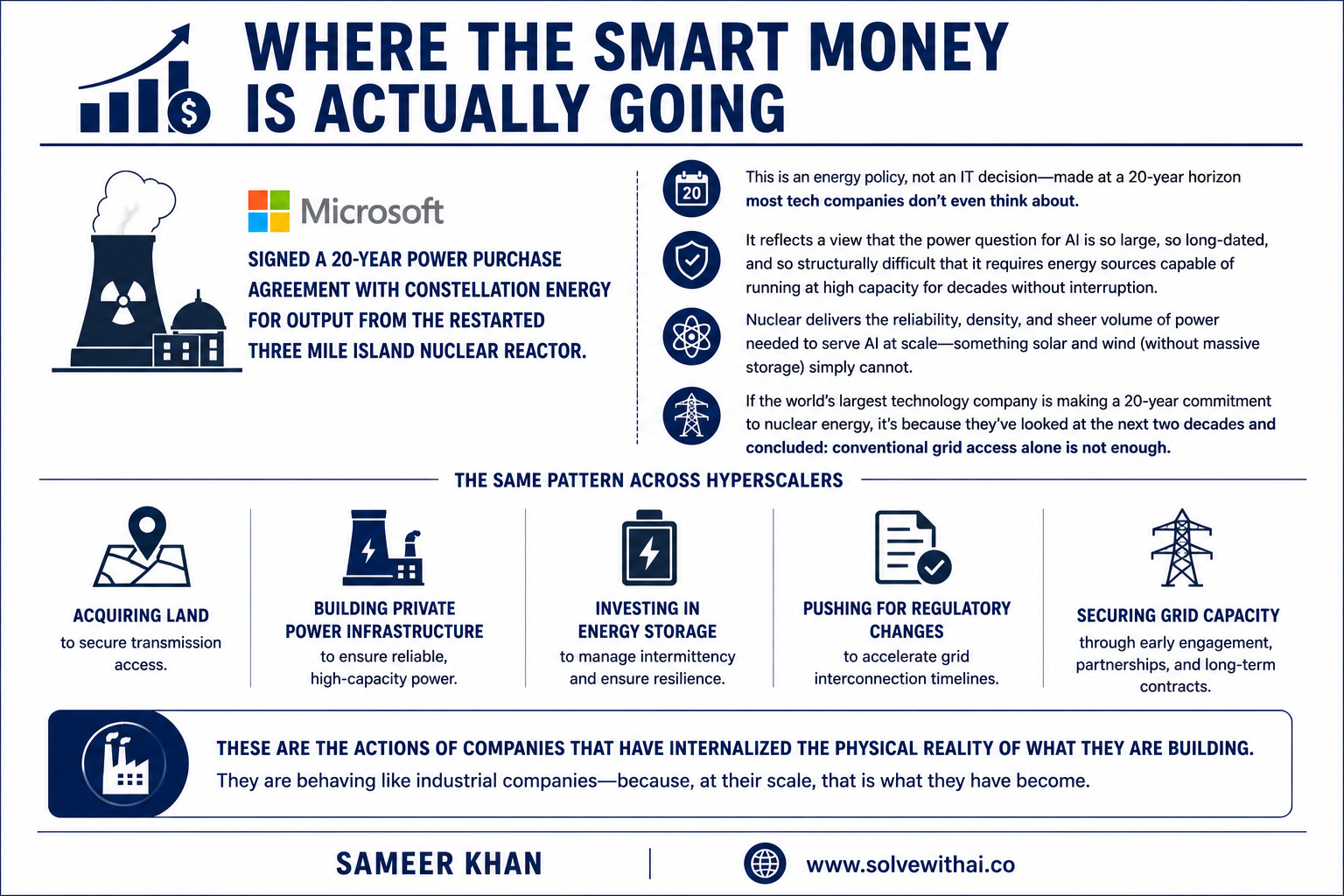
That is an energy policy, not an IT decision made at a horizon that most technology companies do not even think about.
It reflects a view that the power question for AI is so large, so long-dated, and so structurally difficult that it requires energy sources capable of running at high capacity for decades without interruption.
Nuclear fits that description in a way that solar and wind, without massive storage infrastructure, simply cannot.
The bet Microsoft made is not primarily about carbon targets. It is about reliability, density, and the sheer volume of power required to serve AI at scale without depending on grid conditions that change by season and by year.
If you see the world’s largest technology company making a 20-year commitment to nuclear energy, it should tell you something. They have looked at the power landscape for the next two decades and concluded that conventional grid access alone is not enough.
If you look at what the other hyperscalers are doing, you’ll see the same pattern. They are acquiring land to secure transmission access, building private power infrastructure, investing in energy storage, and pushing for regulatory changes that speed up grid connections.
These are the actions of companies that have internalized the physical reality of what they are building.
They are behaving like industrial companies because, at their scale, that is what they have become.
Why This Changes Your Strategy
If you are a business leader thinking about AI strategy right now, this physical reality has direct implications for how you should approach your own position, even if you will never build a data center yourself.
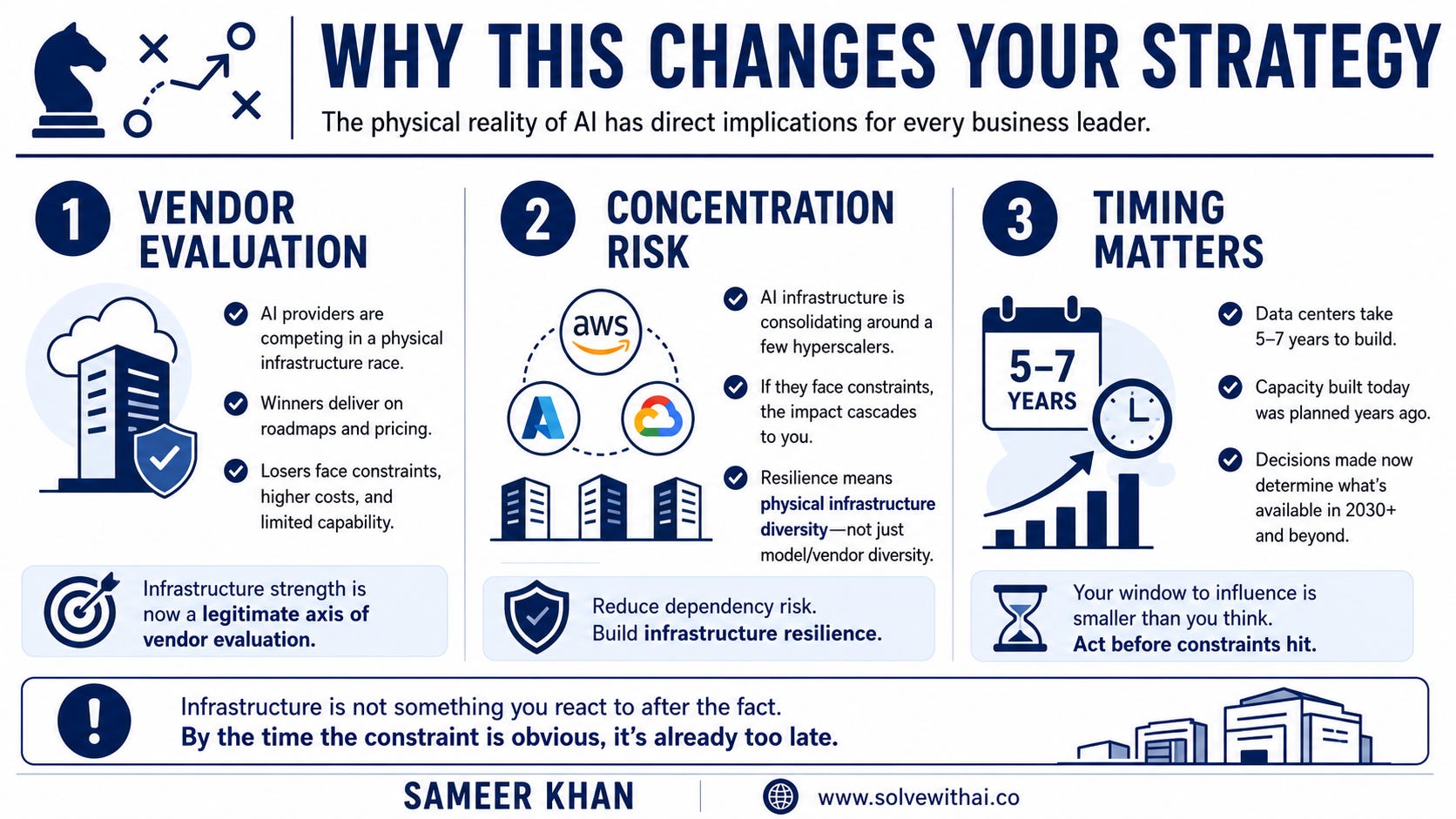
The first implication is about vendors.
The AI providers you depend on, including your model providers, your cloud infrastructure partners are competing in this physical race right now.
The ones who win it will be able to deliver on their product roadmaps and their pricing commitments.
The ones who fall behind will face constraints that slow their development, raise their unit costs, and ultimately limit what they can offer customers. Infrastructure strength is becoming a legitimate axis of vendor evaluation. It was not two years ago.
The second implication is concentration risk.
As the physical supply chain of AI consolidates around a handful of hyperscalers with the capital to build at this scale, the dependency risk for everyone else increases.
If your AI strategy runs through one or two cloud providers, and those providers face infrastructure constraints, that constraint cascades to you.
Resilience in AI increasingly means thinking about physical infrastructure diversity, not just model or vendor diversity.
The third implication is timing.
The 5-7 year timelines for large data center development mean that the capacity being built today was planned years ago.
The capacity decisions being made right now will determine what is available in 2030 and beyond.
Your window to influence those decisions, through vendor partnerships, policy engagement, or early enterprise commitments that help shape where hyperscalers invest, is much smaller than most business leaders realize.
Infrastructure is not something you react to after the fact. By the time the constraint is obvious, it is already too late to address it.
What I Have Seen From Both Sides
I have stood at both ends of this chain, and that experience is the reason this series exists.
I spent years working in physical industrial operations, where power demand is measured in megawatts, equipment lead times determine whether projects stay on schedule, and constraints are things you can actually see and touch, not just numbers on a dashboard.
That world teaches you a particular discipline. You learn to read the physical limits of a system not as inconveniences to be optimized around but as the actual structure of the problem. You learn that software solutions stop at the edge of physical reality, and that edge is harder and more fixed than people who have only worked in software usually believe.
Then I led an enterprise AI transformation inside one of the most physically demanding industries on earth.
I watched the collision happen in real time: the speed at which AI can theoretically move, hitting the reality of operational timelines, regulatory environments, and infrastructure constraints that do not compress regardless of how sophisticated the software gets.
The gap between what AI can do in a demo and what the physical world allows it to do in deployment is the most underappreciated constraint in enterprise technology today. It shows up everywhere.
It almost never gets talked about honestly.
That dual vantage point is what this series is built on.
The conversation most AI strategists are having about models, about workflows, about use cases and ROI is real and worth having. But it is happening inside a box.
This series is about the box.
The Stakes Have Never Been Higher
The AI conversation of the last decade was about software.
Who had the best models, the fastest APIs, the cleverest applications.
That conversation produced enormous value. It will keep producing value. But it is no longer sufficient as a strategic frame, because it describes only the top layer of a system whose real constraints are buried much deeper in the ground, in the grid, in the permit queue, in the transformer backlog.
The AI conversation of the next decade is about infrastructure. About who controls the physical supply chain of intelligence. About who has secured the power, the land, the water, and the grid access to run AI at the scale that actually matters. About who built when the window was open, and who waited until the window closed.
The companies, leaders, and governments that understand this moment will shape what AI looks like for the next generation.
They will set the terms on pricing, on access, on capability, on resilience.
The ones that do not will spend that generation as consumers of infrastructure built by others, on terms they did not negotiate, at prices they did not influence, with resilience determined by someone else’s planning horizon.
That is the physical economy of AI and that is what this series is about.
This is Week 1 of “AI and the Physical Economy” a 13-week series on how the physical world shapes, constrains, and ultimately determines the trajectory of artificial intelligence.
Six distinct lenses are coming across the next several weeks: from energy and grid dynamics to water and land, from supply chains to geopolitics, from enterprise resilience to the long arc of what all of this means for the people and companies trying to win with AI.
Talk soon,
Sameer Khan
Creator of Solve with AI.
If this was useful, you’ll find more like it every week in Intelligence Economy — AI strategy at the infrastructure layer, for leaders making decisions in the physical AI era. Subscribe free at solvewithai.substack.com