

Your AI Roadmap Has a Hidden Constraint. It's Not Your Model.
The six inputs your AI strategy depends on and never accounts for

Hey Transformation Leader,
As I continue my investigation into the future of AI, I came across another interesting insight. There are engineers at Google, Microsoft, and Amazon right now who are not blocked by a lack of GPUs or capital. They have the software teams, the training runs, the roadmaps.
What they don't have is power.
Not enough megawatts or path to grid connection, and no clear timeline for when any of that changes.
That problem, in theory, belongs in a utility conference rather than a boardroom. This is quietly becoming the most important strategic constraint in the AI industry. Last week, we established that AI is no longer a software story. This week, I want to show you what that actually costs.
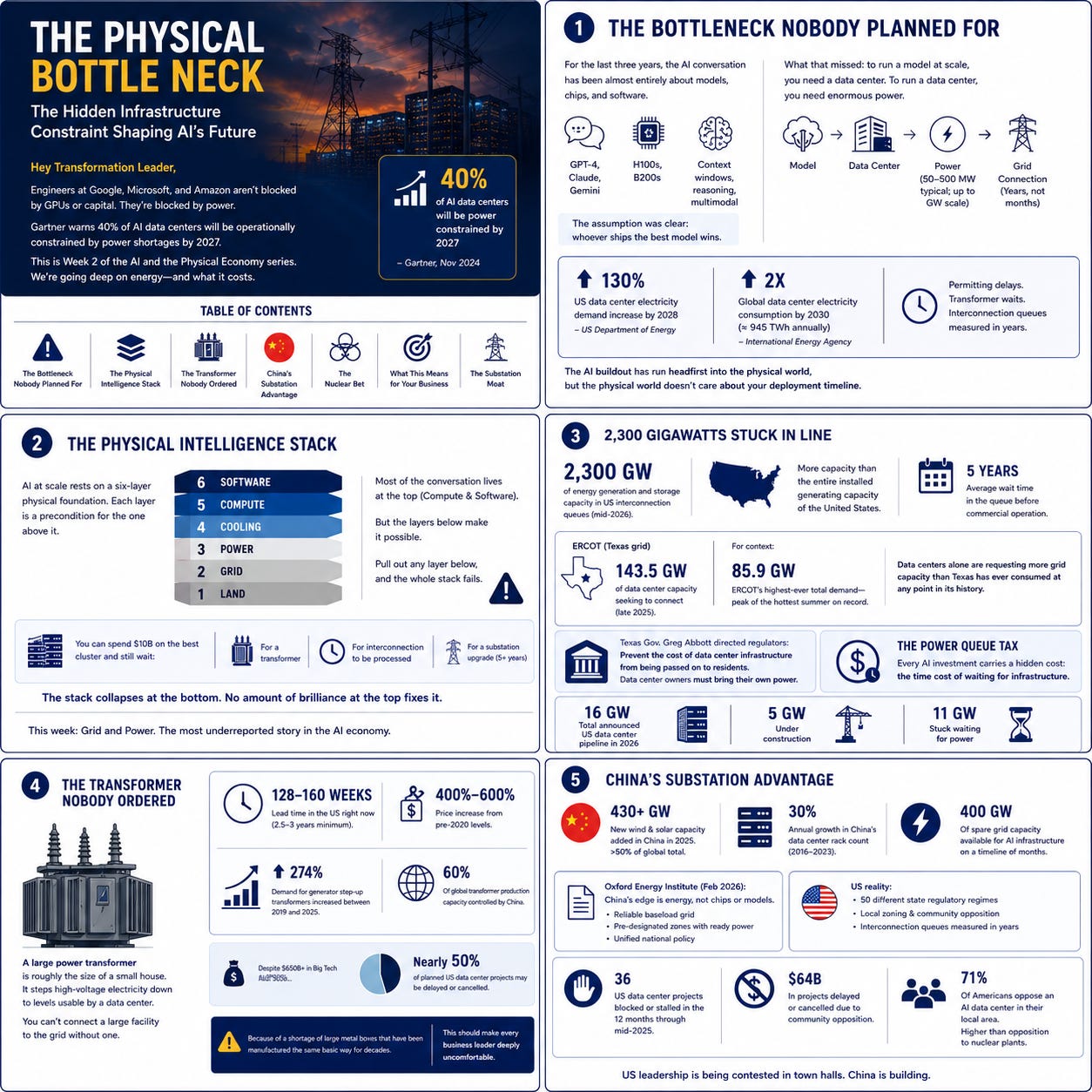
Gartner put a number on it last November: 40% of AI data centers will be operationally constrained by power shortages by 2027.
As in, the servers are sitting there and cannot run at full capacity because the electricity simply is not available.
In this week 2 of the AI and the Physical Economy series, we are going deep on energy today. By the time you finish reading this, you are going to look at your own AI roadmap very differently.
Table of Content
The Bottleneck Nobody Planned For
The Physical Intelligence Stack
The Transformer Nobody Ordered
China’s Substation Advantage
The Nuclear Bet
What This Means for Your Business
The Substation Moat
The Bottleneck Nobody Planned For
For the last three years, the AI conversation has been almost entirely about models, chips, and software.
GPT-4, then Claude, then Gemini. H100s, then B200s.
Context windows, reasoning capabilities, multimodal inputs.
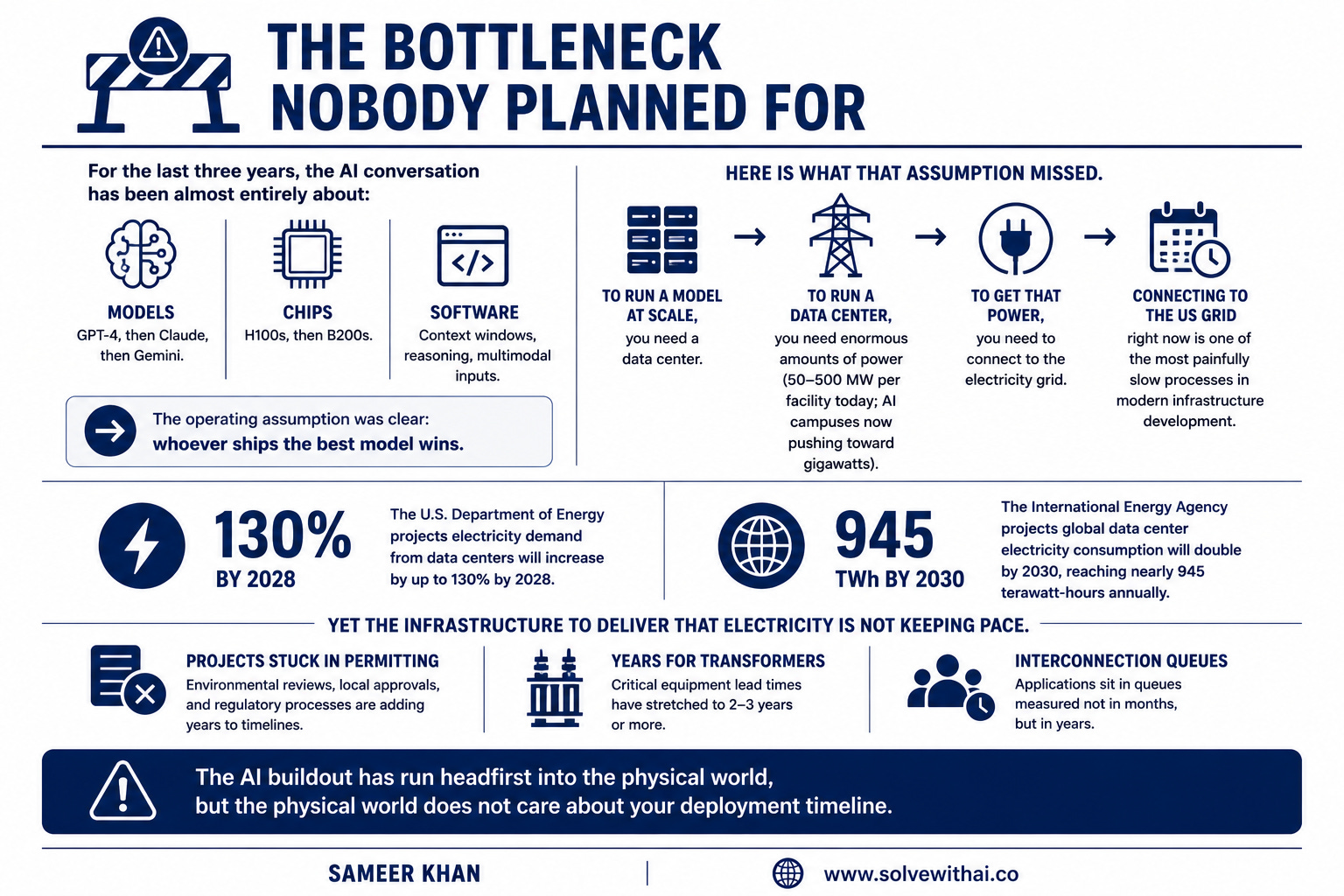
The operating assumption across the industry was clear: whoever ships the best model wins.
Here is what that assumption missed.
To run a model at scale, you need a data center. To run a data center, you need enormous amounts of power, somewhere between 50 and 500 megawatts, depending on size, with hyperscale AI campuses now pushing toward gigawatts.
To get that power, you need to connect to the electricity grid, and connecting to the US electricity grid right now is one of the most painfully slow processes in modern infrastructure development.
The US Department of Energy projects that electricity demand from data centers will increase by up to 130% by 2028. The International Energy Agency projects global data center electricity consumption will double by 2030, reaching nearly 945 terawatt-hours annually.
Yet the infrastructure to deliver that electricity is not keeping pace. Projects are stuck in permitting, and companies are waiting years for transformers. Interconnection applications sit in queues measured not in months but in years.
The AI buildout has run headfirst into the physical world, but the physical world does not care about your deployment timeline.
The Physical Intelligence Stack
I have been mapping what it actually takes to deliver AI at scale. Not just on the software side, but on the physical side.
The inputs that rarely appear in an AI strategy deck but determine whether the strategy survives contact with reality. What I found is a six-layer dependency chain I am calling the Physical Intelligence Stack: Land, Grid, Power, Cooling, Compute, Software. Each layer is a precondition for the one above it. Remove any one of them, and the entire stack fails.
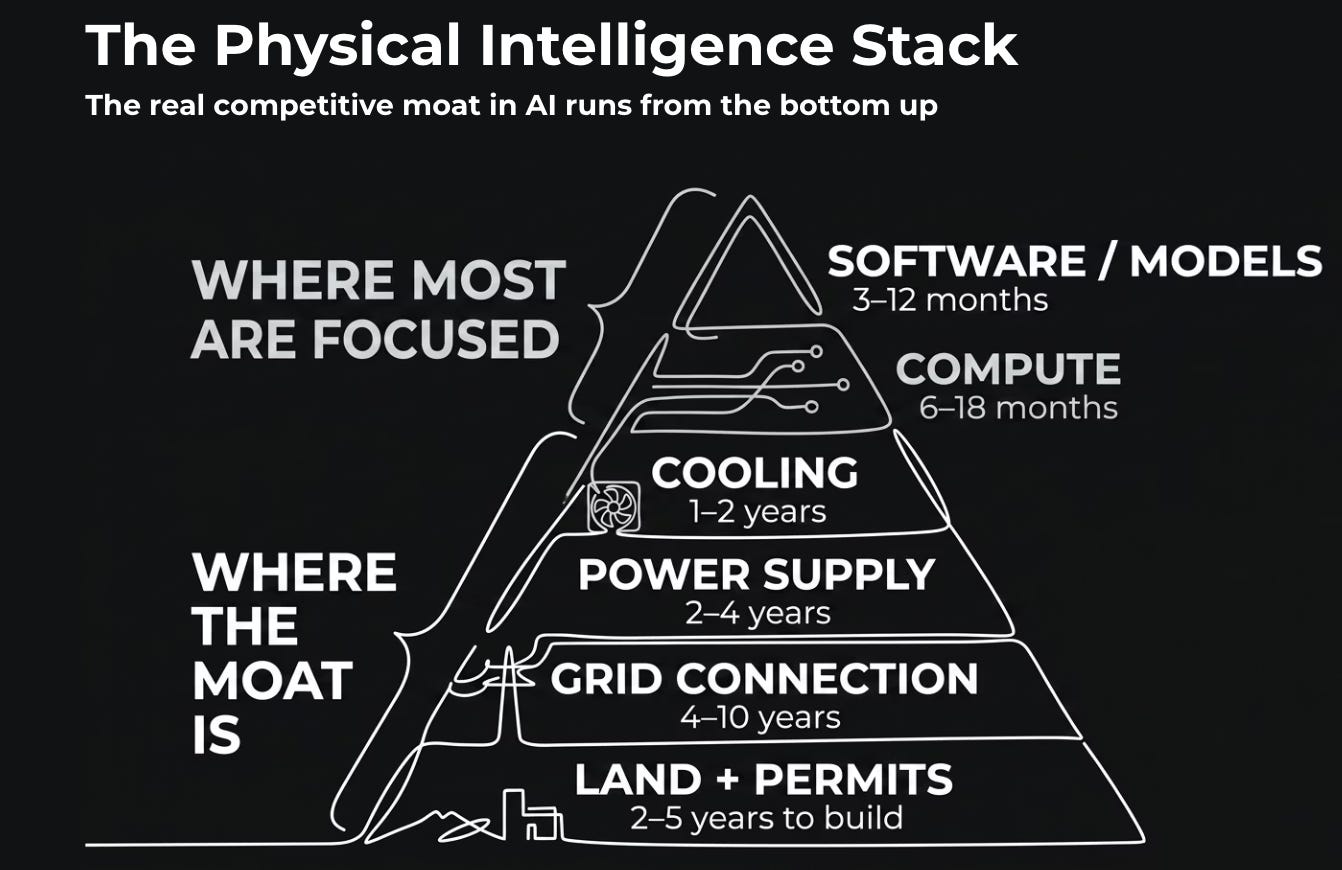
Most of the AI conversation lives in the top two layers, i.e., Compute and Software.
That is where the chips live, where the models run, where the prompts get answered. It is the most visible layer because it is the most digital. But the layers below it are what make everything above it possible.
Pull out any layer below, and the whole stack fails regardless of how sophisticated the layer above it is.
Think of it this way. You can spend $10 billion on the world's most powerful AI cluster. You can hire the best machine learning engineers, train the best models, build the best products on top of them, and then you can wait.
For a transformer to be manufactured
For an interconnection application to be processed
For a substation upgrade that will not happen for five years.
The stack collapses at the bottom, and no amount of brilliance at the top rescues it.
This week, we are focused on layers two and three: Grid and Power. What is happening at those layers right now is the most underreported story in the AI economy.
The companies that understand it early are building advantages that cannot be competed away with a model release. The ones that don't are building roadmaps on assumptions that are already breaking down.
2,300 Gigawatts Stuck in Line
As of mid-2026, approximately 2,300 gigawatts of energy generation and storage capacity are sitting in US interconnection queues.
That is more capacity than the entire installed generating capacity of the United States combined.
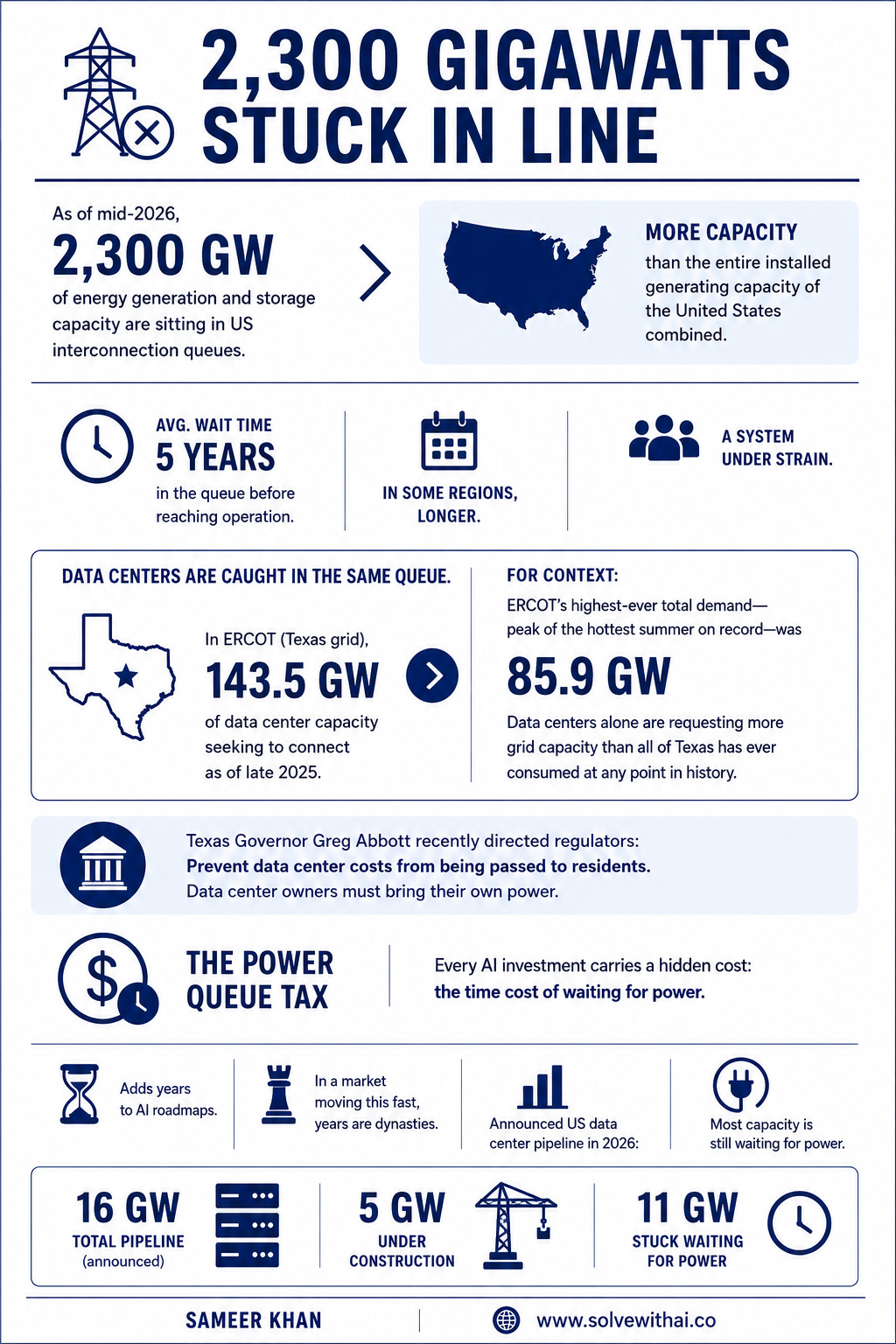
Every single one of those projects, wind farms, solar arrays, battery storage systems, and gas generation, is waiting for permission to connect to the grid. The average wait has more than doubled over the past fifteen years.
Projects now spend an average of five years in the queue before reaching commercial operation. In some regions, it is longer.
Data centers are caught in this same queue. In ERCOT, which manages the Texas grid, 143.5 gigawatts of data center capacity were seeking to connect as of late 2025.
For context, ERCOT's highest-ever total demand, the peak of the hottest summer on record, was 85.9 gigawatts. The data centers alone are requesting more grid capacity than the entire state of Texas has ever consumed at any point in its history.
In fact, earlier this month, Texas Gov. Greg Abbott sent a letter to state energy regulators, saying they must take steps to prevent the cost of data center infrastructure from being passed on to residents. He asks that data center owners must bring their own power.
I call this the Power Queue Tax.
Every AI investment made today carries a hidden cost that does not show up in your capital budget: the time cost of waiting for the physical infrastructure to catch up.
For a company trying to deploy AI at scale, that tax can add years to a roadmap. In an industry moving this fast, years are dynasties. The full announced pipeline for US data centers in 2026 is approximately 16 gigawatts. Only around 5 gigawatts are actually under construction. The rest is stuck waiting for power.
The Transformer Nobody Ordered
There is a physical object at the heart of this problem that almost nobody outside the energy industry has heard of. It is called a large power transformer.
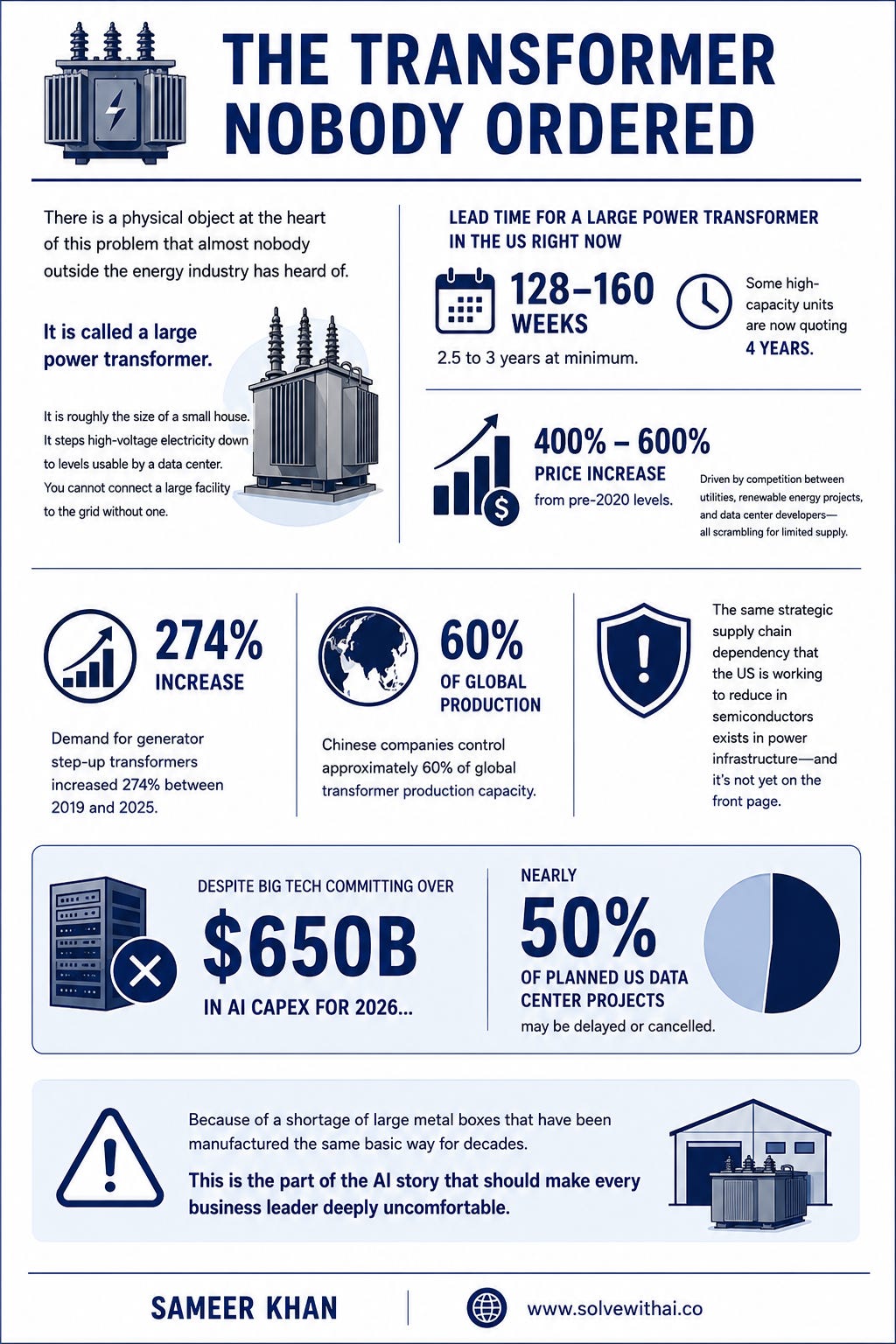
It is roughly the size of a small house. It steps high-voltage electricity down to levels usable by a data center. You cannot connect a large facility to the grid without one.
The lead time for a large power transformer in the United States right now is somewhere between 128 and 160 weeks. That is two and a half to three years at minimum.
Some high-capacity units are now quoting four years. Prices have surged 400 to 600 percent from pre-2020 levels, driven by competition between utilities, renewable energy projects, and data center developers all scrambling for equipment from a manufacturing base that was never designed to handle this scale of demand.
Demand for generator step-up transformers, the specific type needed for large-scale power delivery, increased by 274% between 2019 and 2025.
The United States does not manufacture most of these domestically. Chinese companies control approximately 60% of global transformer production capacity. The same strategic supply chain dependency that the US is working to reduce in semiconductors exists in power infrastructure, and it is not yet on the front page.
Despite Big Tech committing over $650 billion in AI capital expenditure for 2026, nearly half of the planned US data center projects may be delayed or cancelled.
Because of a shortage of large metal boxes that have been manufactured the same basic way for decades. This is the part of the AI story that should make every business leader deeply uncomfortable.
China's Substation Advantage
In May 2026, Al Jazeera ran a headline that should be required reading for every executive thinking seriously about AI strategy: "China's secret weapon in AI race with US? Lots of cheap energy."
While the US grid is clogged with interconnection applications and permitting delays, China operates from a fundamentally different starting position. China added over 430 gigawatts of new wind and solar capacity in 2025 alone, accounting for more than half of all new renewable capacity added globally that year.
Its data center rack count grew at 30% annually from 2016 to 2023. China has approximately 400 gigawatts of spare grid capacity that can be directed toward AI computing infrastructure on a timeline measured in months, not years.
An Oxford Energy Institute paper from February 2026 spelled out the advantage clearly: China's data center edge is not primarily about models or chips. It is about energy.
Chinese operators run on a reliable baseload grid with sufficient capacity. National policy mandates that new AI computing hubs be located inside pre-designated zones with ready power and connectivity.
The US, by contrast, asks developers to navigate 50 different state regulatory regimes, local zoning boards, and an interconnection queue that moves at the speed of federal bureaucracy.
At least 36 data center projects were blocked or stalled in the US in the 12 months through mid-2025. $64 billion worth of projects have been delayed or cancelled due to community opposition.
71% of Americans now oppose the construction of an AI data center in their local area. That figure is higher than the historical opposition to nuclear plants. The physical foundation of US AI leadership is being contested in town planning meetings, while China constructs at a pace that makes US permitting timelines look like geological time.
The Nuclear Bet
The hyperscalers saw this coming, and they responded the only way a company with essentially unlimited capital can respond: by going around the grid entirely.
Microsoft signed an 835-megawatt deal to bring Three Mile Island Unit 1 back online.
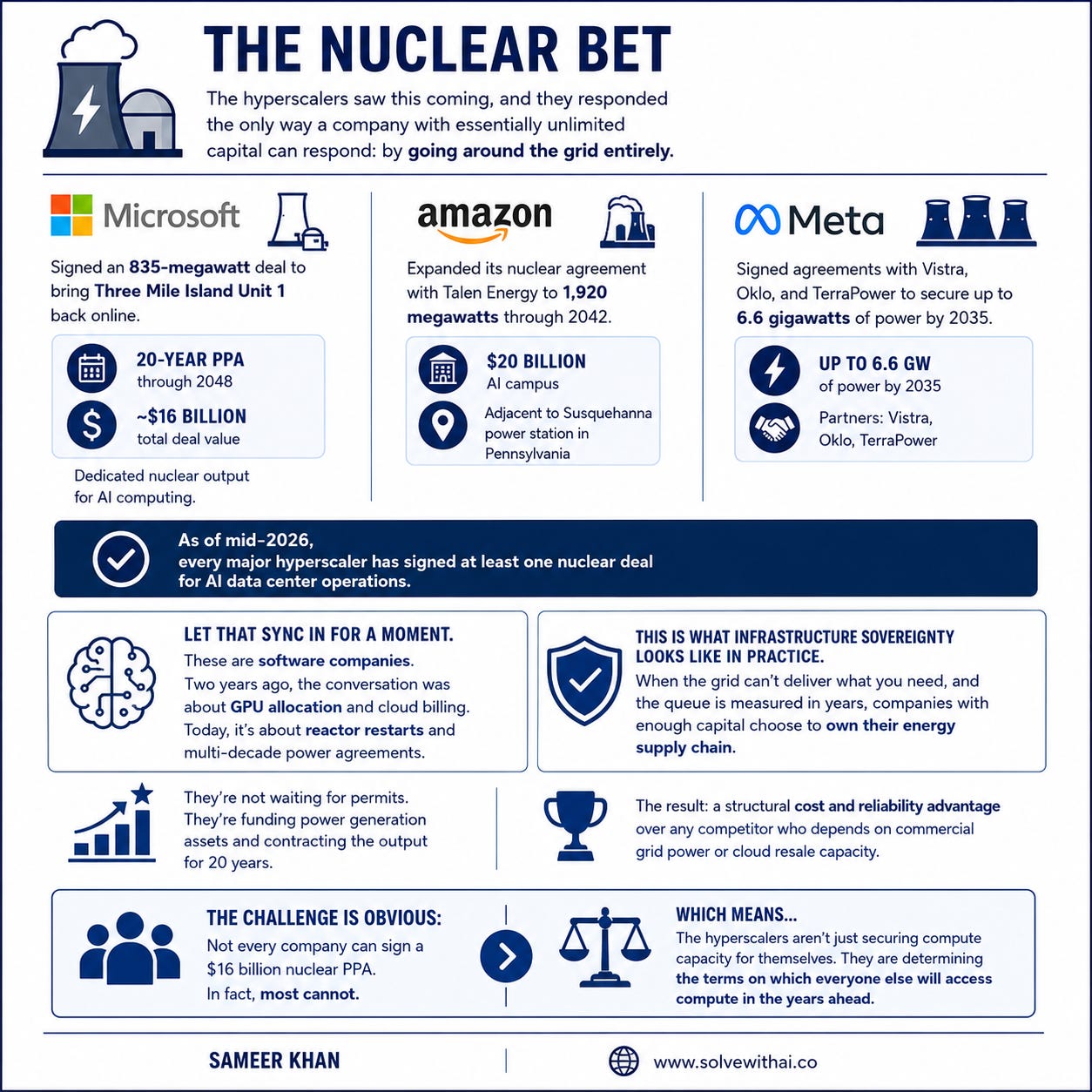
It is a 20-year power purchase agreement worth approximately $16 billion, locking in dedicated nuclear output for AI computing through 2048.
Amazon expanded its nuclear agreement with Talen Energy to 1,920 megawatts through 2042 and is building a $20 billion AI campus adjacent to the Susquehanna power station in Pennsylvania.
Meta went further still, signing agreements with Vistra, Oklo, and TerraPower to secure up to 6.6 gigawatts of power by 2035. As of mid-2026, every major hyperscaler has signed at least one nuclear deal for AI data center operations.
Let that sync in for a moment.
These are software companies. Two years ago, the most pressing infrastructure conversation in Silicon Valley was about GPU allocation and cloud billing rates. Today, it is about reactor restart timelines and multi-decade power purchase agreements.
This is what Infrastructure Sovereignty looks like in practice. When the grid cannot deliver what you need, and the queue is measured in years, companies with enough capital choose to own their energy supply chain directly.
They are not waiting for the permitting process. They are funding the construction of power generation assets and contracting the output for twenty years.
The result is a structural cost and reliability advantage over any competitor who depends on commercial grid power or cloud resale capacity.
The challenge is obvious: not every company can sign a $16 billion nuclear power purchase agreement. In fact, most cannot.
Which means the hyperscalers are not just securing compute capacity for themselves. They are determining the terms on which everyone else will access compute in the years ahead.
What This Means for Your Business
Here is the question you should be asking yourself right now.
If your AI strategy depends on cloud compute, cloud compute depends on data centers, and data centers depend on constrained power infrastructure, what does your AI roadmap actually look like?
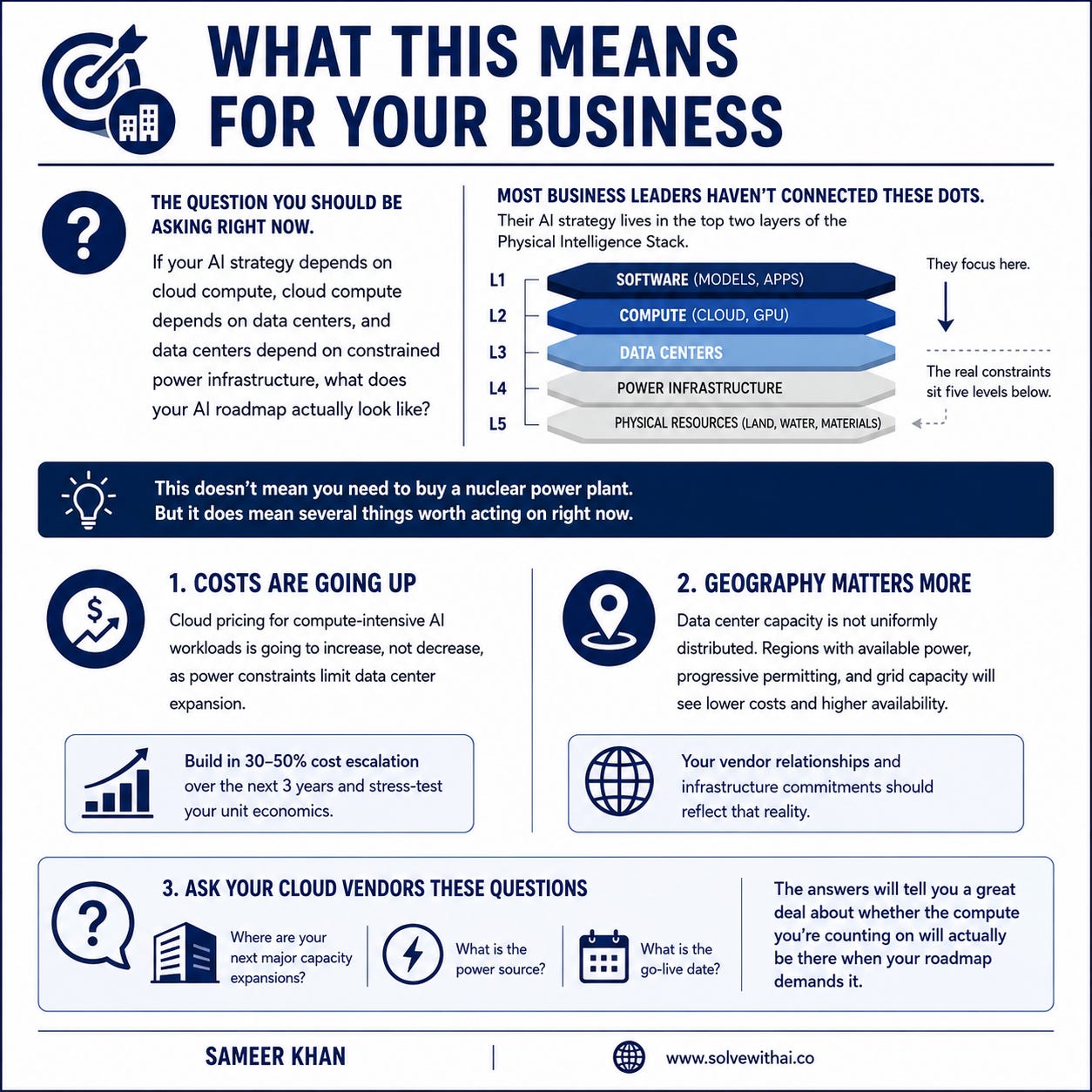
Most business leaders I speak with have not connected those dots. Their AI strategy lives entirely in the top two layers of the Physical Intelligence Stack: software and compute.
They are thinking about which models to use, which vendors to evaluate, and which use cases to pilot. They have not thought about the layer five levels below that, where the real constraints are accumulating.
This does not mean you need to buy a nuclear power plant.
But it does mean several things worth acting on right now. Cloud pricing for compute-intensive AI workloads is going to increase, not decrease, as power constraints bite into data center expansion plans. If your AI economics depend on today's cloud pricing holding flat, your business case is built on a fragile assumption.
Build in a 30 to 50 percent cost escalation over the next three years and stress-test your unit economics under that scenario.
Geographic positioning matters more than it has in a decade. Data center capacity is not uniformly distributed. Regions with available power, progressive permitting, and grid capacity will see AI compute costs stay lower and availability stay higher.
Your vendor relationships and infrastructure commitments should reflect that reality. Ask your cloud vendors directly:
Where are your next major capacity expansions?
What is the power source?
What is the go-live date?
The answers will tell you a great deal about whether the compute you are counting on will actually be there when your roadmap demands it.
The Substation Moat
The AI era that everyone assumed would be determined by model quality is being quietly reshaped by something far more fundamental.
The companies that control physical power supply, through owned generation, long-term nuclear power purchase agreements, or positioning in power-rich geographies, are building what I call the Substation Moat.
This moat cannot be crossed by shipping a better model. It cannot be crossed by hiring better engineers or spending more on research and development. It is, by definition, a physical constraint.
The companies that understood this three years ago, the ones signing 20-year nuclear deals and building AI campuses next to power stations, are going to have an operating cost and capacity advantage for the better part of the next decade.
The IEA projects global data center electricity consumption will double by 2030. Demand from AI-optimized infrastructure is expected to quadruple over the same period. The electricity to power that demand does not yet exist in the infrastructure pipeline.
Something has to give.
What gives is the pace of AI deployment for organizations that have not secured their place in the stack.
For example, if two companies are equally brilliant and equally funded. Both are trying to deploy AI at the same scale. One signed a nuclear power purchase agreement in 2024. The other is waiting on a transformer that will not arrive until 2028. The model quality difference between those two companies is irrelevant. The infrastructure difference is everything.
Last week, I told you the AI story is becoming a physical story. This week, I showed you what that costs. Next week, we go one layer up in the Physical Intelligence Stack: cooling and compute density, the engineering problem that makes GPUs the most thermally demanding objects in the history of commercial computing.
The race is on. But it runs through substations, not server farms and the gap is wider than most people realize.
Talk soon,
Sameer Khan