

2026: The Year Work Stops Looking Like Work
A practical map for leaders, builders, and operators

Hey Productivity Explorer,
Happy New Year!
Let me start with something you may already feel but have not fully named yet.
2025 was strange.
You saw real progress. Models got better. Tools got faster. Use cases multiplied. And yet, if you are honest, your work probably did not feel radically different by the end of the year.
You were busier.
You experimented more.
But you did not feel ahead durably.
That disconnect matters.
What actually happened to you in 2025
Last year was not about results. It was about exposure.
You learned what AI is good at and what it is bad at.
You learned where it saves time and where it creates new cleanup work.
You learned that “just adding AI” does not fix unclear goals, messy data, or vague ownership.
Most of all, you learned this:
AI did not remove work from your life.
It moved work around.
You spent less time creating from scratch.
You spent more time reviewing, validating, correcting, and coordinating.
That is why 2025 felt noisy instead of transformational.
It was not a failure. It was friction from a system mid-change.
Why 2026 is different for you
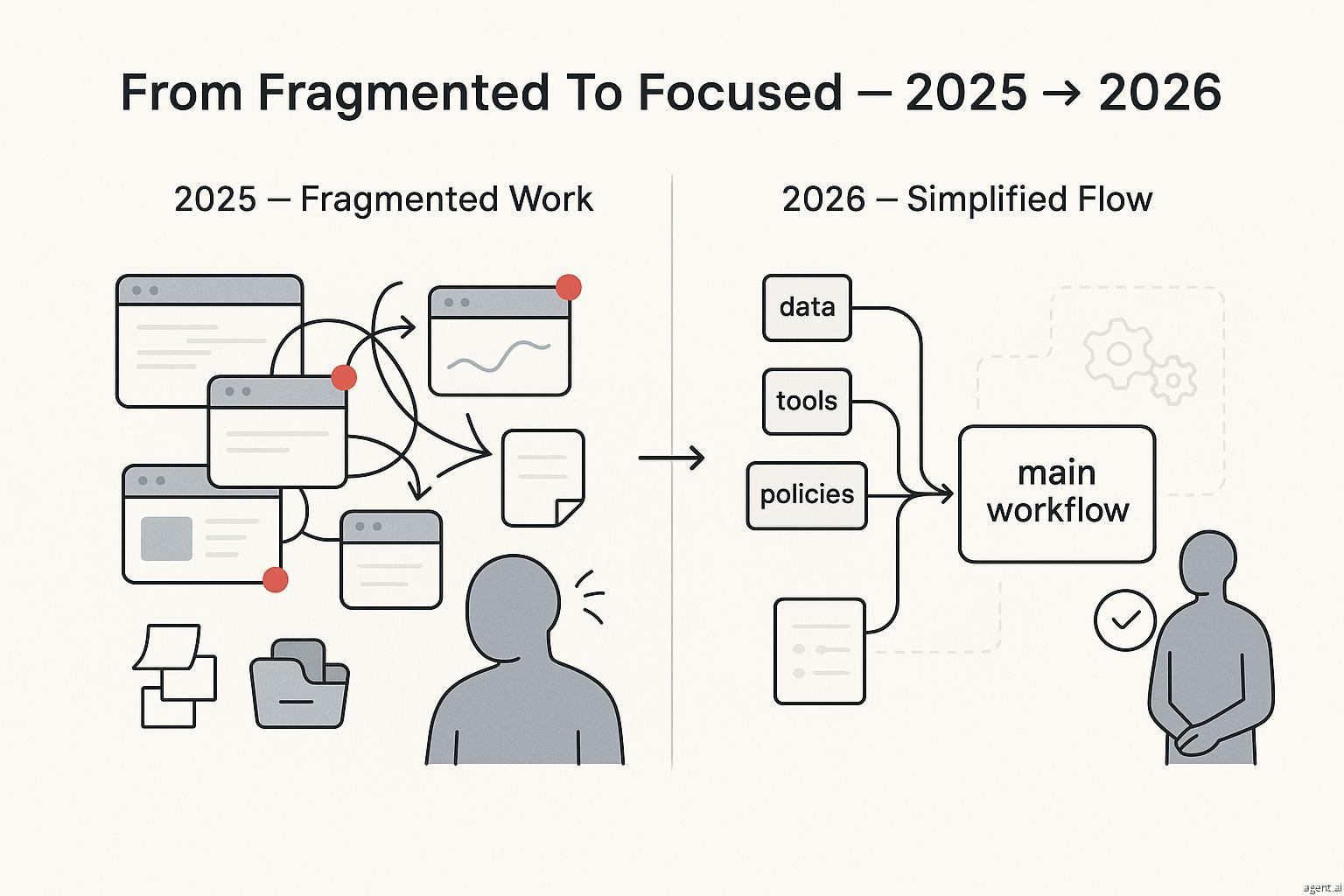
Here is the key shift you should pay attention to.
In 2025, the limiting factor was capability.
People kept asking, “Can the model do this?”
In 2026, the limiting factor becomes design.
The question changes to, “Why am I still doing this at all?”
That is a very different moment.
You already know AI can draft, summarize, analyze, and recommend.
What you may not have done yet is decide which parts of your thinking deserve to be reused instead of repeated.
2026 is the year that the decision starts paying off.
The biggest gains you will see this year will not come from better prompts.
They will come from noticing patterns in your own work:
the same decisions you make every week
the same follow-ups you keep chasing
the same information you keep reassembling
the same judgment you keep re-applying
Once you see those patterns, it becomes hard to unsee them.
At that point, continuing to do everything manually starts to feel irrational, not virtuous.
A personal observation, you might recognize
Every meaningful AI win I have seen so far came from someone quietly asking themselves a hard question:
“Why am I personally involved in this every single time?”
2026 rewards the people who fix that.
Not with hustle.
Not with shortcuts.
With reuse.
How to read the rest of this year’s posts
This year, this newsletter is written for you if:
you are tired of experimenting without compounding results
you want leverage, not more tools
you care about quality, trust, and control, not hype
you want AI to run alongside you, not distract you
We will talk less about what AI can do.
We will spend more time on what you should never have to do again.
That is the difference between 2025 and 2026.
Table of Contents:
Agents Go Mainstream (and what changes inside companies)
The Death of the Click, and how distribution re-wires
Micro-Companies: The Power of One + Agent Swarms
Enterprise Reality: Governance, Security, and the AI Middle Layer
The Coming Backlash: Slop, Trust, and Verification
Talent and Education: AI tutors, credential compression, new hiring signals
Regulation and Platform Moves (what to watch, what to ignore)
Your 2026 Bets: Build / Buy / Avoid (practical, not financial advice)
The 90-Day Execution Plan + Scorecard Templates (copy/paste)
